

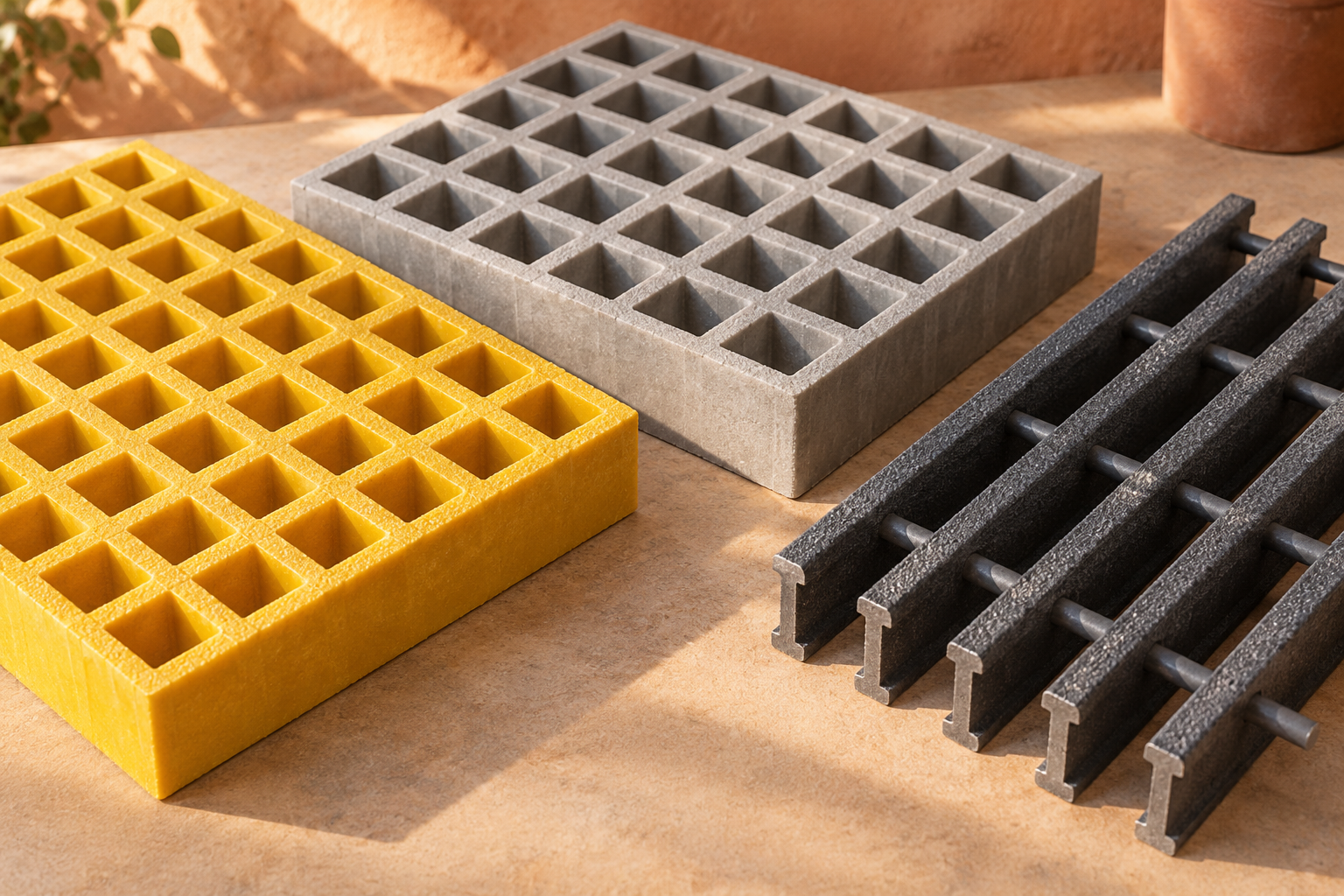
FRP grating is an open-mesh structural panel made of glass fibre and thermoset resin, used as a walking surface on walkways, platforms, stairs and trench covers. It does the same job as steel bar grating, but it does not rust, does not conduct electricity and weighs much less. FRP stands for fibre-reinforced plastic (or polymer). The same product is also sold as GRP grating and fiberglass grating. This page explains what it is made of, how it is made, what it can and cannot do, and where to read more on each topic.
Key Takeaways
- FRP grating is glass fibre locked in a thermoset resin. The glass gives strength, the resin gives shape and corrosion resistance.
- There are two main types: molded grating (one-piece, strong in both directions) and pultruded grating (assembled bars, stiffer in one direction).
- It is light: 38 mm MACHS molded grating weighs 19.50 kg/m².
- Its main limits are lower stiffness than steel and the fact that it is combustible, so span and fire requirements must be checked.
What is FRP grating made of?
FRP grating has two main ingredients, plus a few additions for safety and appearance:
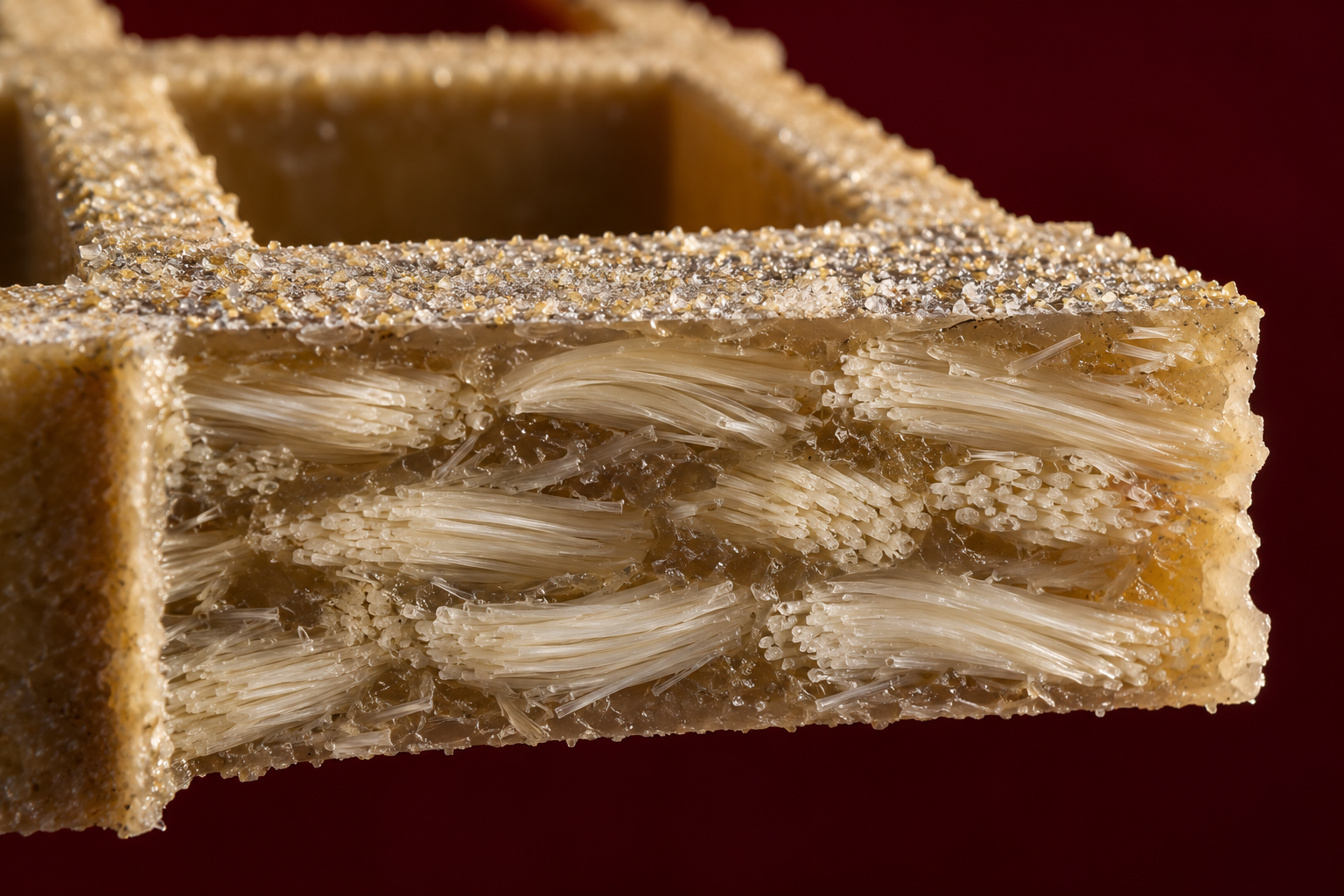
- Glass fibre: continuous glass rovings that carry the load. They give the grating its strength.
- Thermoset resin: binds the fibres, sets the shape and resists chemicals. Once cured, it cannot be melted again. MACHS uses six resin systems, from orthophthalic polyester for general building use to vinyl ester for heavy chemical exposure and phenolic for fire-critical areas.
- Surface grit (optional): sand bonded into the top surface for slip resistance in wet or oily areas.
- Pigment: mixed through the resin, so the colour does not wear off like paint. Common colours are RAL 1003 yellow and RAL 7035 light grey.
The resin choice decides how the grating behaves in chemicals. See our FRP grating chemical resistance guide.
Are FRP, GRP and fiberglass grating the same thing?
Yes. The names describe the same product:
- FRP (fibre-reinforced plastic or polymer) is the general industry term.
- GRP (glass-reinforced plastic) is common in the UK, Australia and the Middle East.
- Fiberglass grating is common in North America.
Strictly, “FRP” also covers composites made with carbon or aramid fibre, but grating is made with glass fibre, so for grating the three terms mean the same thing. More detail is in FRP vs GRP grating.
How is FRP grating made?
By one of two processes, which give the two main types of grating:
| Molded grating | Pultruded grating | |
|---|---|---|
| Process | Glass rovings are laid in both directions in an open grid mould, wetted with resin and cured as one piece | Glass fibres are pulled through resin and a heated die to form I- or T-shaped bars, which are then joined with cross rods |
| Strength | Equal in both directions | Much stiffer along the bars |
| Typical use | Walkways, platforms, trench covers, chemical areas | Longer spans, heavier loads, long continuous walkways |
At the same 38 mm depth and a 914 mm span, MACHS I4015 pultruded grating deflected 0.76 mm under 4.8 kN/m², against 3.45 mm for molded grating. The full comparison is in molded vs pultruded FRP grating.
What does FRP grating look like?
An FRP grating panel is described by its thickness, its mesh (the spacing of the bars) and its open area (the share of the surface that is open):
- Thickness: MACHS molded grating is made from 13 to 60 mm thick. 38 mm is the most common for industrial walkways.
- Mesh: square openings from 19 × 19 mm (mini mesh) to 83.3 × 83.3 mm, plus rectangular meshes such as 25 × 100 mm.
- Open area: from 42% for mini mesh to 87% for thin, wide-mesh grating. More open area means better drainage; less open area stops small objects falling through.
- Panel size: standard sheets such as 1220 × 4000 mm, cut to fit the site.
Each of these is explained in FRP grating specifications explained, and weights for every size are in our FRP grating weight table.
What properties make FRP grating useful?
- Corrosion resistance: it does not rust and needs no painting or galvanizing.
- Light weight: 38 mm molded grating weighs 19.50 kg/m², so cut pieces can usually be placed by hand.
- Electrical safety: it is non-conductive, which matters near substations and rail lines.
- No sparks: it does not spark on impact, which helps in flammable atmospheres.
- Slip resistance: a grit top gives grip on wet and oily floors.
- Easy cutting: it is cut with ordinary power tools and needs no welding on site.
What are the limitations of FRP grating?
FRP grating is not a drop-in replacement for steel in every case. Three limits matter most:
- Lower stiffness: FRP bends more than steel under the same load, so its span is usually limited by deflection. In our tests, 38 mm molded grating deflected 3.45 mm at a 914 mm span under 4.8 kN/m², but 12.17 mm at 1219 mm. See FRP grating load capacity.
- Fire: FRP is combustible. Fire-retardant grades can still achieve low flame spread: our SGS-tested samples reached Class A under ASTM E84. Hydrocarbon fire zones need a separate assessment, explained in our note on FRP grating in hydrocarbon fires.
- Heat and chemicals: both depend on the resin system, so the operating temperature and chemicals must be known before choosing.
How these trade-offs compare with steel is covered in FRP grating vs steel grating.
Where is FRP grating used?
Mostly where steel would corrode or where electrical safety matters:
- Chemical and petrochemical plants: walkways and platforms near acids and alkalis. See FRP grating for chemical plant walkways.
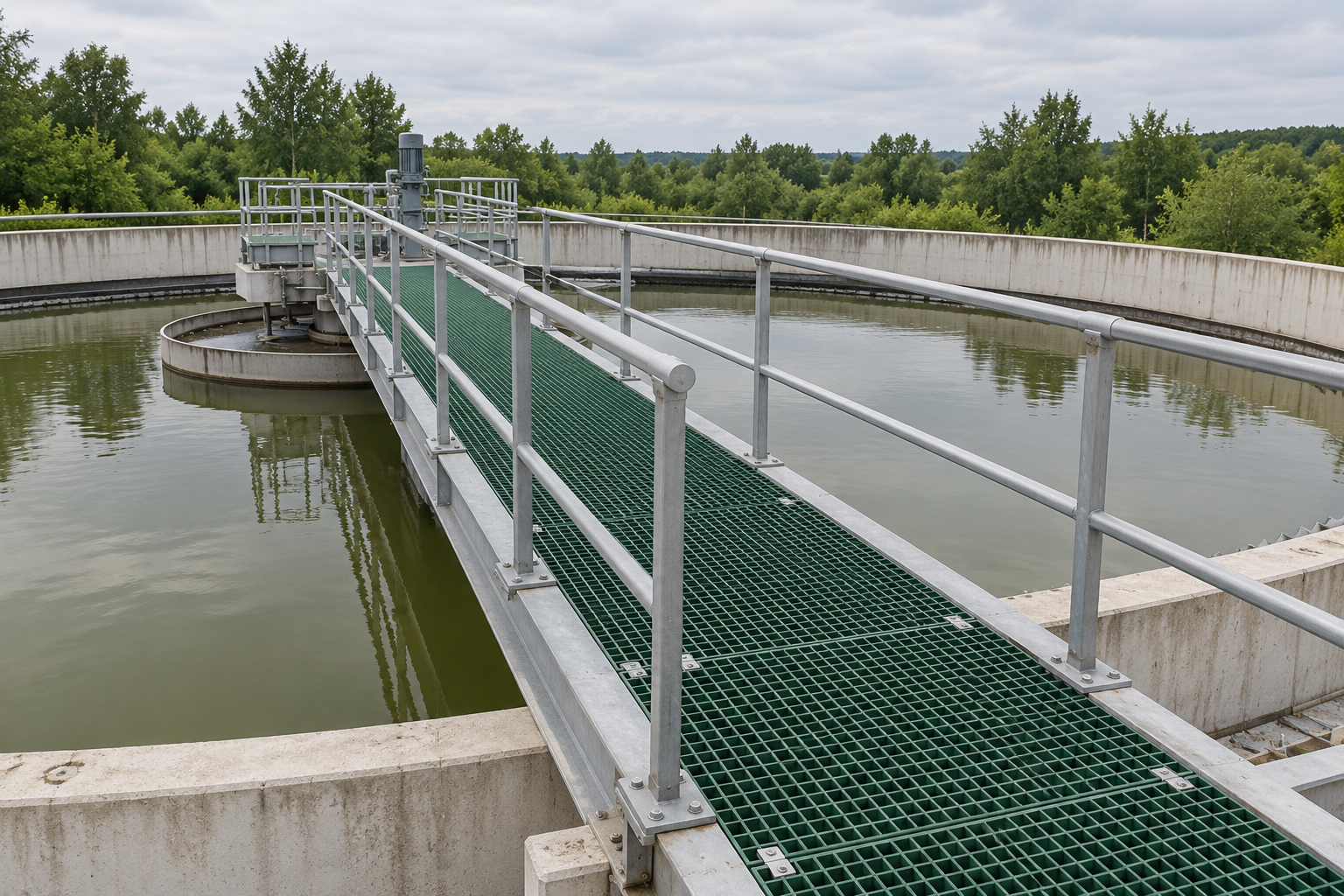
- Water and wastewater treatment: tank covers, channels and access walkways. See grating in wastewater plants.
- Ports, jetties and offshore: decks and walkways in salt spray.
- Power and rail: non-conductive platforms and trackside walkways. See GRP trackside walkways.
- Cooling towers and rooftops: wet fan decks and roof walkways. See FRP walkways for rooftop solar.
How long does FRP grating last?
When the resin suits the environment and the span suits the load, FRP grating lasts for decades. MACHS grating installed at Jebel Ali Port, Dubai, in 2009 is still in service after more than 15 years of salt spray and summer heat. What shortens its life, and how to inspect it, is covered in FRP grating service life.
Which standards apply to FRP grating?
- ASTM F3059: specification for FRP gratings used in marine construction and shipbuilding.
- BS 4592-4: UK specification for GRP open bar gratings used as industrial flooring and stair treads.
- ASTM E84: surface burning test used to rate flame spread.
- OSHA 1910.22 (US) and AS 1657 (Australia): rules for walking surfaces and platforms, whatever the material.
A general background on the material is also given in the Wikipedia article on FRP grating.
MACHS manufactures molded and pultruded FRP grating in Nantong, China, with published load data and SGS fire test reports.
See the FRP grating range →Frequently Asked Questions
What does FRP stand for in FRP grating?
Fibre-reinforced plastic (or polymer). In grating, the fibre is glass, which is why it is also called glass-reinforced plastic (GRP) or fiberglass grating.
Is FRP grating stronger than steel?
It has a high strength-to-weight ratio, but it is less stiff than steel, so it deflects more under the same load. That is why FRP grating is chosen by span and deflection.
Can FRP grating be used outdoors?
Yes. It does not rust in rain or salt spray. Over many years, sunlight can fade the surface, which does not by itself mean a loss of strength.