

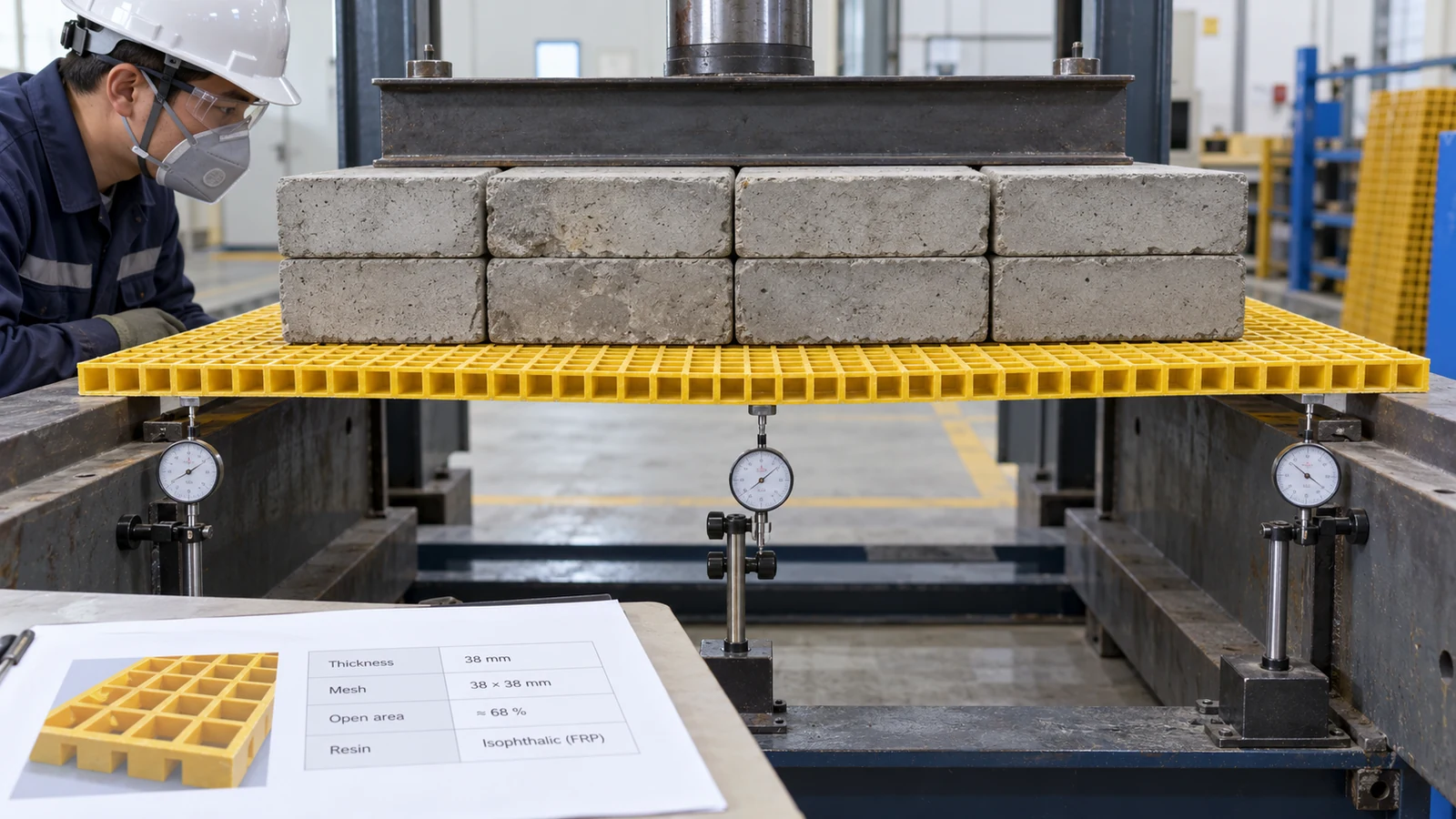
FRP grating load capacity depends on depth, mesh, span and the deflection you accept, so it is given as a table rather than one number. As a guide from our tests: under a uniform pedestrian load of 4.8 kN/m² (100 psf), 38 mm molded grating stays within span/200 up to a 914 mm span, and 50 mm molded grating up to 1219 mm. This page publishes the MACHS load and deflection data and shows how to read it.
Key Takeaways
- Deflection, not breaking strength, sets the usable load of FRP grating.
- In our tests, deflection roughly doubled when the load doubled, and grew about 4 times when the span grew 1.5 times.
- Pultruded I4015 (38 mm) deflected 0.76 mm at 914 mm under 4.8 kN/m², about one-fifth of 38 mm molded grating.
- Ultimate (breaking) loads are not design loads. Use the deflection tables and your project’s limit.
How was this load data measured?
The data comes from the MACHS product design manual. Panels were tested on simple supports along two parallel sides, and deflection was measured in millimetres at set loads. The test loads match common imperial values: 50, 100, 200 and 400 psf for uniform loads, and 200, 400, 500 and 1000 lb/ft for line loads. We show both kN and the original kg values.
Flexural behaviour of FRP materials is tested to standards such as ASTM D790. Panel load tables like these show how the whole grating behaves on real spans, which is what a specifier needs.
How much uniform load can molded FRP grating carry?
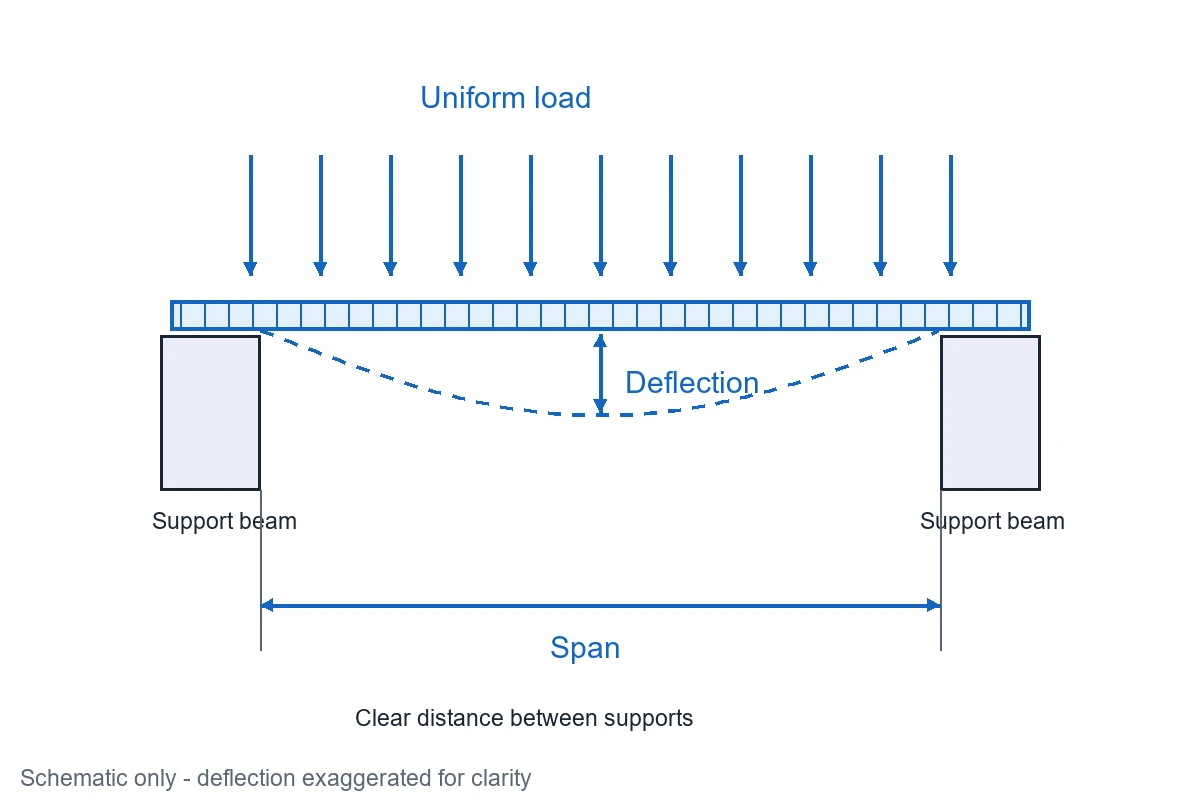
The table shows deflection (mm) under a uniform load spread over the panel.
| Grating | Span | 2.39 kN/m² (244 kg/m²) | 4.80 kN/m² (489 kg/m²) | 9.58 kN/m² (977 kg/m²) |
|---|---|---|---|---|
| 25 mm, 38 × 38 | 610 mm | 1.12 | 2.11 | 4.14 |
| 25 mm, 38 × 38 | 914 mm | 5.54 | 11.18 | 21.72 |
| 38 mm, 38 × 38 | 610 mm | 0.43 | 0.81 | 1.55 |
| 38 mm, 38 × 38 | 914 mm | 1.70 | 3.45 | 6.96 |
| 38 mm, 38 × 38 | 1219 mm | 5.97 | 12.17 | 24.51 |
| 50 mm, 50 × 50 | 610 mm | 0.38 | 0.58 | 0.97 |
| 50 mm, 50 × 50 | 914 mm | 1.19 | 2.11 | 3.94 |
| 50 mm, 50 × 50 | 1219 mm | 2.41 | 4.93 | 9.96 |
Source: MACHS product design manual, simple support on two parallel sides.
What is the longest span for each grating?
Applying a span/200 deflection limit to the table above gives the longest tested span each grating passes. This is the quickest way to shortlist a depth.
| Uniform load | 25 mm molded | 38 mm molded | 50 mm molded | I4015 pultruded |
|---|---|---|---|---|
| 2.39 kN/m² | 610 mm | 1219 mm | 1219 mm | — |
| 4.80 kN/m² | 610 mm | 914 mm | 1219 mm | 914 mm* |
| 9.58 kN/m² | below 610 mm | 610 mm | 914 mm | 914 mm* |
| 19.17 kN/m² | — | — | — | 914 mm |
Limits: 3.05 mm at 610 mm, 4.57 mm at 914 mm, 6.10 mm at 1219 mm. *The I4015 table has no reading at 1219 mm for these loads, so 914 mm is the longest confirmed span. “—” means not tested.
How does grating behave under a line load?
A line load acts along a narrow strip across the panel, for example a wheel track or a row of equipment feet. Deflection (mm):
| Grating | Span | 2.92 kN/m (298 kg/m) | 5.84 kN/m (596 kg/m) |
|---|---|---|---|
| 38 mm, 38 × 38 | 610 mm | 1.25 | 2.46 |
| 38 mm, 38 × 38 | 914 mm | 3.68 | 7.42 |
| 38 mm, 38 × 38 | 1219 mm | 9.68 | 19.58 |
| 50 mm, 50 × 50 | 610 mm | 0.81 | 1.75 |
| 50 mm, 50 × 50 | 914 mm | 2.24 | 5.16 |
| 50 mm, 50 × 50 | 1219 mm | 3.94 | 9.96 |
Full-panel test, 38 mm molded grating on a 1220 × 3660 mm panel, total load spread over the panel:
| Span | 7.31 kN total (745 kg) | 14.61 kN total (1490 kg) |
|---|---|---|
| 457 mm | 0.71 | 1.14 |
| 610 mm | 1.50 | 2.41 |
| 914 mm | 2.90 | 5.41 |
| 1219 mm | 4.70 | 9.20 |
How much more load does pultruded grating carry?
Much more, along its load bars. MACHS I4015 pultruded grating (38 mm, 40% open area, 23.5 kg/m²) gave these deflections (mm):
| Span | 4.80 kN/m² | 9.58 kN/m² | 19.17 kN/m² |
|---|---|---|---|
| 610 mm | 0.25 | 0.51 | 0.76 |
| 914 mm | 0.76 | 1.52 | 2.79 |
| 1219 mm | — | — | 8.64 |
At 914 mm under 9.58 kN/m², I4015 deflected 1.52 mm against 6.96 mm for 38 mm molded grating of the same depth, about 4.6 times stiffer. Compare both types in molded vs pultruded FRP grating.
What patterns does the data show?
- Load: deflection rises roughly in proportion to load. For 38 mm grating at 914 mm, it went from 1.70 to 3.45 to 6.96 mm as the load doubled each time.
- Span: deflection rises steeply with span. For 38 mm grating under 4.8 kN/m², moving from 610 to 914 mm (1.5 times the span) raised deflection from 0.81 to 3.45 mm, about 4 times.
- Depth: moving from 38 mm to 50 mm cut deflection at 1219 mm from 12.17 to 4.93 mm under the same load.
These patterns are what make the step-by-step method in how to calculate FRP grating load capacity work.

Can the breaking load be used for design?
No. Our manual also records ultimate loads, but an ultimate load is the point of failure, not a safe working load. The allowable load depends on the full specification, the support conditions and your deflection limit. The legal duty in the US is set by OSHA 1910.22: walking-working surfaces must support their maximum intended load. Full tables for each model, including ultimate data, are available on request for your engineer.
Need data for a different mesh, a concentrated load or a pultruded T-bar model? Tell us the configuration and we will send the matching table.
Request a load table →Frequently Asked Questions
How much weight can 38 mm FRP grating hold?
On a 914 mm span, our 38 mm molded grating deflected 3.45 mm under 4.8 kN/m² (489 kg/m²), within a span/200 limit of 4.57 mm. At 9.58 kN/m² it deflected 6.96 mm, which exceeds that limit, so heavier loads need a shorter span or deeper grating.
Can forklifts drive on FRP grating?
Wheel loads are concentrated loads and need a specific check against the wheel load and contact area. Our standard tables cover uniform and line loads. Send the vehicle details for an assessment, or consider pultruded or heavy-duty grating.
Does mesh size change load capacity?
Yes. Mesh, bar width and depth all change stiffness, so a table for one mesh does not apply to another. Always use the table for the exact grating you are buying.