


To check whether FRP grating can carry your load, find the tested deflection for your span and load in the manufacturer’s table, and compare it with your deflection limit. If the deflection is within the limit, the grating passes. Round your span and load up to the next tested values, never down. The six steps below use MACHS test data and include three worked examples, from a simple walkway to a heavy maintenance area.
Key Takeaways
- FRP grating is checked by deflection: tested deflection must be at or below your limit, for example span/200.
- Convert loads to kN/m²: kg/m² × 0.00981, or psf × 0.0479.
- Always round span and load up to the next tested values. Our data shows why: 1.5 times the span gave about 4 times the deflection.
- Breaking loads are not design loads. Concentrated wheel loads need a separate check.
1Define the load and convert it to kN/m²
Identify the load type first:
- Uniform load: spread over the whole area, such as people or stored material. Unit: kN/m².
- Line load: along a narrow strip across the panel. Unit: kN/m.
- Concentrated load: on a small area, such as a wheel or equipment foot. Unit: kN. This needs its own check, see step 6.
Conversions: kg/m² × 0.00981 = kN/m², and psf × 0.0479 = kN/m². For example, 489 kg/m² = 4.80 kN/m² = 100 psf. Your project’s design standard sets the load. In the US, OSHA 1910.22 requires surfaces to support their maximum intended load. In Australia, platforms and walkways follow AS 1657.
2Measure the span in the load-bearing direction
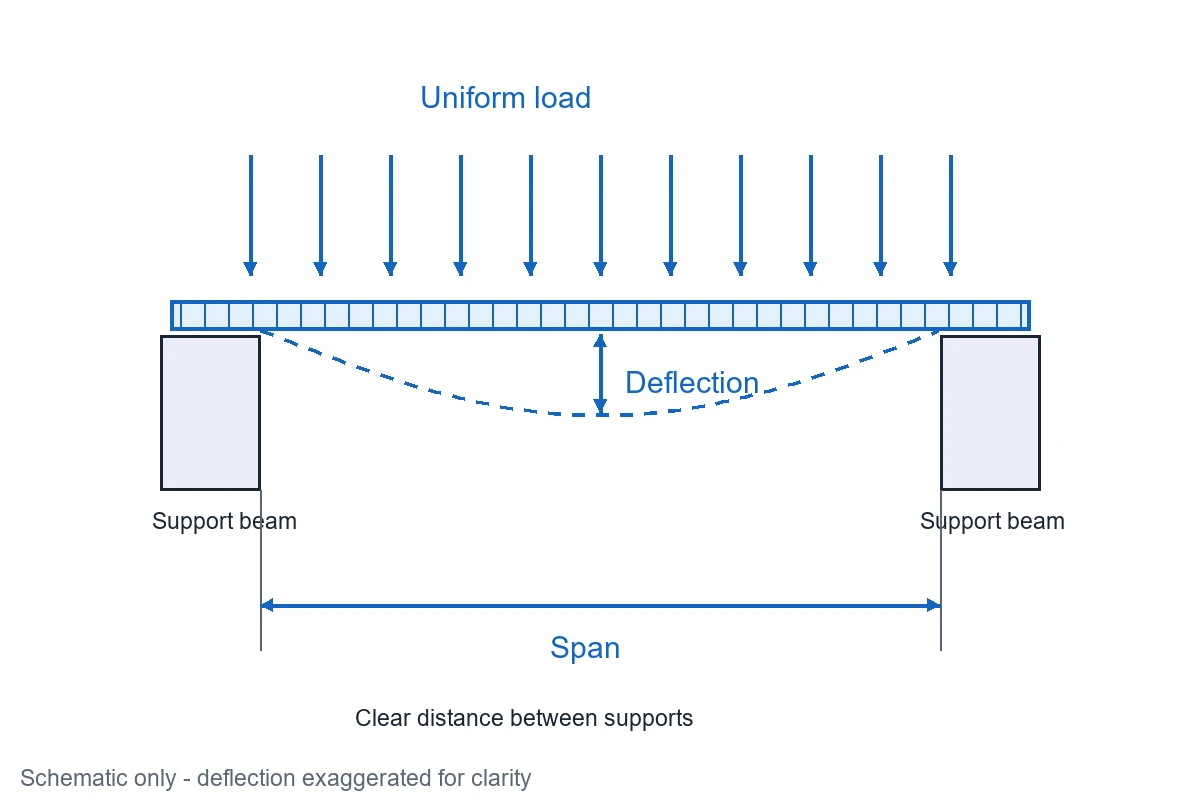
The span is the distance between the supports that carry the grating. For pultruded and rectangular-mesh grating, measure along the direction of the load-bearing bars, which must run across the supports. Square-mesh molded grating carries load both ways, so measure the shorter span between parallel supports.
3Set the deflection limit
Use the limit in your specification. This article uses span/200, which gives:
- 610 mm span: 3.05 mm
- 914 mm span: 4.57 mm
- 1219 mm span: 6.10 mm
A stricter limit, for example in public areas, means a shorter span or deeper grating.
4Find the table value, rounding up
Use the load table for the exact grating type, depth and mesh. Take the next tested span at or above yours, and the next tested load at or above yours. Our uniform-load data for molded grating (deflection in mm):
| Grating | Span | 2.39 kN/m² | 4.80 kN/m² | 9.58 kN/m² |
|---|---|---|---|---|
| 25 mm, 38 × 38 | 610 mm | 1.12 | 2.11 | 4.14 |
| 25 mm, 38 × 38 | 914 mm | 5.54 | 11.18 | 21.72 |
| 38 mm, 38 × 38 | 610 mm | 0.43 | 0.81 | 1.55 |
| 38 mm, 38 × 38 | 914 mm | 1.70 | 3.45 | 6.96 |
| 38 mm, 38 × 38 | 1219 mm | 5.97 | 12.17 | 24.51 |
| 50 mm, 50 × 50 | 914 mm | 1.19 | 2.11 | 3.94 |
| 50 mm, 50 × 50 | 1219 mm | 2.41 | 4.93 | 9.96 |
Source: MACHS product design manual, simple support on two parallel sides. Full tables in our FRP grating load capacity guide.
5Compare deflection with the limit
If the table deflection is at or below the limit, the grating passes for that load and span. If not, choose a deeper grating, a stiffer type, or add a support to shorten the span.
6Check the conditions the table does not cover
- Concentrated loads such as trolley or forklift wheels need a check against the wheel load and contact area.
- Cut-outs and free edges reduce stiffness locally. Support them or band the edges.
- High temperatures reduce resin stiffness. Tell your supplier the operating temperature.
- Ultimate loads in test reports are failure points, not working loads.
Worked example 1: is 38 mm grating enough for a 900 mm walkway?
Yes. Design load 3.5 kN/m², clear span 900 mm.
- Round up: span to 914 mm, load to 4.80 kN/m².
- Limit: 900 / 200 = 4.5 mm.
- Table: 38 mm, 38 × 38 at 914 mm and 4.80 kN/m² = 3.45 mm.
- 3.45 mm is below 4.5 mm, so 38 mm molded grating passes. 25 mm would not: it deflects 11.18 mm at 914 mm.
Worked example 2: which grating suits a 1200 mm span?
50 mm molded grating. Design load 4.8 kN/m², clear span 1200 mm.
- Round up: span to 1219 mm. Load is 4.80 kN/m².
- Limit: 1200 / 200 = 6.0 mm.
- 38 mm at 1219 mm: 12.17 mm. Fails.
- 50 mm, 50 × 50 at 1219 mm: 4.93 mm. Passes.
Adding one support to halve the span to 600 mm would let 25 mm grating pass instead (2.11 mm at 610 mm against a 3.0 mm limit). Compare the cost of the extra beam with the cost of deeper grating.
Worked example 3: what about a 9 kN/m² maintenance area?
50 mm molded or pultruded I4015. Design load 9.0 kN/m², clear span 900 mm.
- Round up: load to 9.58 kN/m², span to 914 mm. Limit: 4.5 mm.
- 38 mm molded: 6.96 mm. Fails.
- 50 mm molded: 3.94 mm. Passes.
- Pultruded I4015 (38 mm): 1.52 mm. Passes with a large margin, at the same depth as the 38 mm molded grating.
Pultruded grating is the better choice if a 38 mm depth must be kept or if spans will grow. See molded vs pultruded FRP grating.
Why must you round up instead of extrapolating?
Because deflection rises much faster than span. In our data for 38 mm molded grating under 4.80 kN/m²:
- 610 mm span: 0.81 mm
- 914 mm span (1.5 times longer): 3.45 mm, about 4 times more
- 1219 mm span (2 times longer): 12.17 mm, about 15 times more
Load is more forgiving: deflection roughly doubles when the load doubles (1.70, 3.45 and 6.96 mm at 914 mm). Even so, stay inside the tested range. If your span or load is outside the table, ask for tested data rather than stretching the numbers.

Send your span, load type and deflection limit. Our engineers check them against the full tables, including concentrated loads, and recommend the grating.
Request a load check →Frequently Asked Questions
Can I interpolate between two values in the load table?
Between two tested loads at the same span, a straight-line estimate is usually reasonable, because deflection rose roughly in proportion to load in our tests. Rounding up to the next tested value is simpler and always on the safe side.
Should the grating’s own weight be added to the load?
For the supporting structure, yes: 38 mm molded grating adds about 0.19 kN/m². For the grating check, follow the method used in the load table and your design standard.
Does a calculation replace an engineer’s approval?
No. This method is for selection and budgeting. Structural platforms and public areas should be approved by the project engineer.