

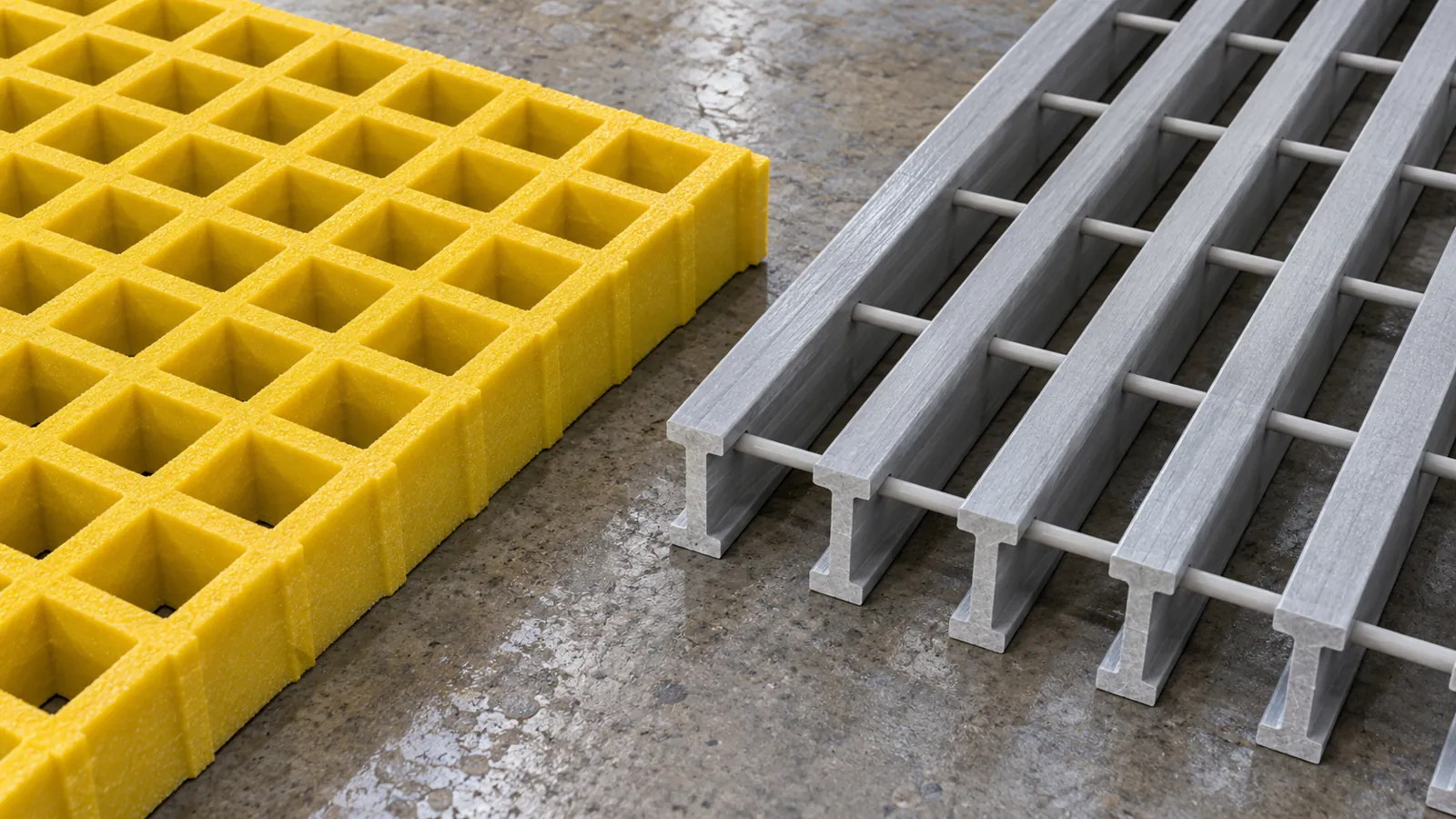
Choose molded FRP grating for corrosive areas, short to medium spans and easy on-site cutting. Choose pultruded FRP grating for longer spans and heavier loads, because its continuous load bars are much stiffer in one direction. In our tests at a 914 mm span, 38 mm pultruded I4015 deflected 1.52 mm under 9.58 kN/m², against 6.96 mm for 38 mm molded grating. The rest of this page explains where that difference matters and where it does not.
Key Takeaways
- Molded grating is a one-piece panel with continuous glass rovings laid in both directions, so it carries load in both directions.
- Pultruded grating is assembled from pultruded I-bars or T-bars with cross rods at 152 mm centres, and is stiffest along the bars.
- At the same 38 mm depth, pultruded I4015 was about 4.5 times stiffer in our tests, and about 20% heavier (23.5 vs 19.50 kg/m²).
- Molded grating comes in more mesh options, including 19 × 19 mm mini mesh. Pultruded panels can be made up to about 12 m long.
How are molded and pultruded grating made?
Molded grating
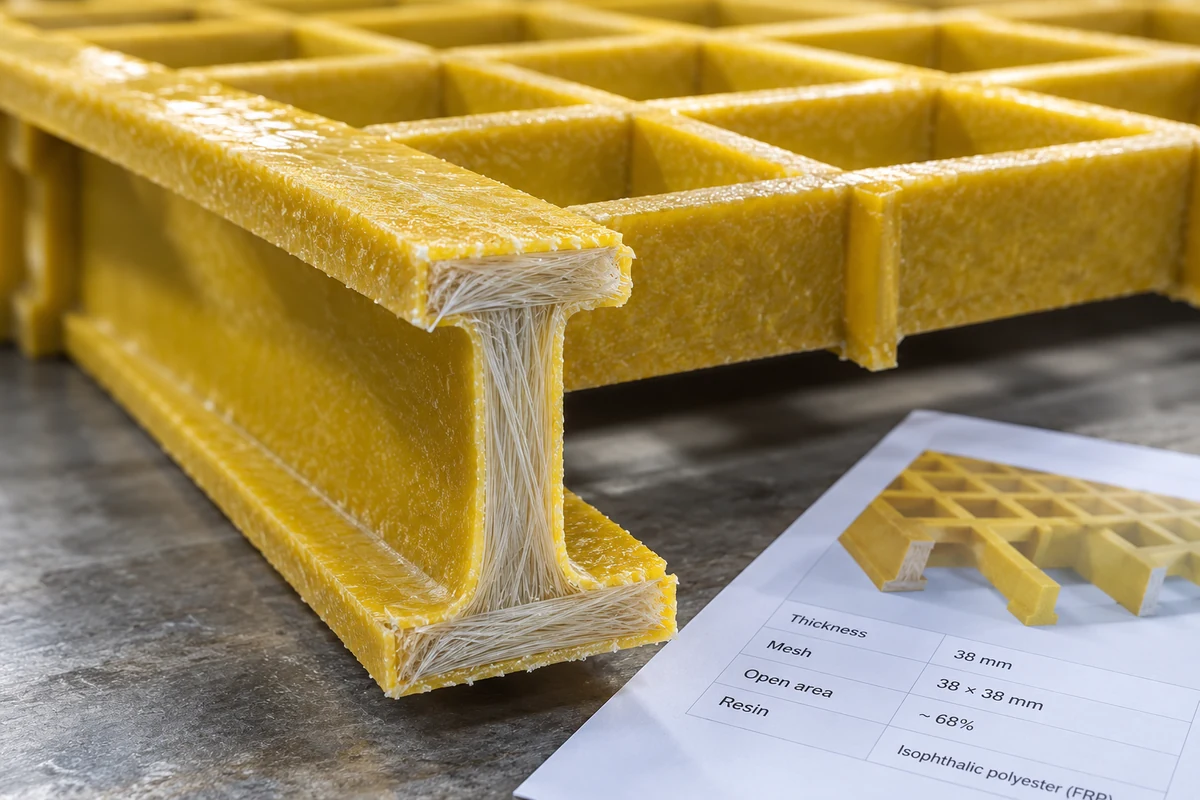
Continuous glass rovings are laid in both directions in an open grid mould, wetted with resin and cured as one piece. The result is a monolithic panel with square or rectangular openings and the same stiffness in both directions.
Pultruded grating
Glass rovings and mats are pulled through a resin bath and a heated die to form long, straight load bars in I or T shapes. The bars are then locked together with cross rods. Our cross rods are at 152 mm centres. The fibres in each bar run along its length, which is why the bars are so stiff in that direction. The process is described in our pultrusion process guide.
How do they compare side by side?
| Property | Molded grating | Pultruded grating |
|---|---|---|
| Load direction | Both directions | Along the load bars |
| Depths (MACHS) | 13–60 mm | 26, 38 and 51 mm bar heights |
| Openings | 19 × 19 to 83.3 × 83.3 mm squares, plus rectangular meshes; 42–87% open | 18–60% open, set by bar type and spacing |
| Weight, 38 mm example | 19.50 kg/m² (38 × 38 mesh) | 23.5 kg/m² (I4015) |
| Deflection, 914 mm span, 4.80 kN/m² | 3.45 mm | 0.76 mm (I4015) |
| Deflection, 914 mm span, 9.58 kN/m² | 6.96 mm | 1.52 mm (I4015) |
| Standard panel sizes | 1220 × 4000, 1220 × 3660, 1220 × 2440, 915 × 3050 mm | Lengths 3050 / 3660 / 6100 mm, up to about 12 m; widths 915 / 1220 mm, up to about 1500 mm |
| Surfaces | Standard top or grit top | I-bar: grit or grooved top. T-bar: grit top |
| On-site cutting | Easy, any direction | Possible, but cuts through separate bars |
| Fire test (SGS, ASTM E84) | Class A on 38 mm grit-top samples (FSI 10–15) | Class A on I-6015, 38 mm (FSI 10) |
Deflection data: MACHS product design manual, simple support on two parallel sides. Fire results apply only to the tested samples. Flexural properties of FRP are tested to methods such as ASTM D790.
When does molded grating make more sense?
- Spans up to about 914 mm (38 mm grating) or 1219 mm (50 mm grating) under pedestrian loads of 4.8 kN/m².
- Load in both directions, for example irregular platforms or areas where panels are cut into odd shapes.
- Many cut-outs for pipes and columns, because the one-piece grid stays intact around the cut.
- Small openings needed, with 19 × 19 or 20 × 20 mm mini mesh.
- Budget-led projects, where its lower weight per square metre helps.
When is pultruded grating worth the extra cost?
- Longer spans, where it lets you remove intermediate supports.
- Heavier loads, such as maintenance areas with equipment. I4015 deflected 2.79 mm at 914 mm under 19.17 kN/m².
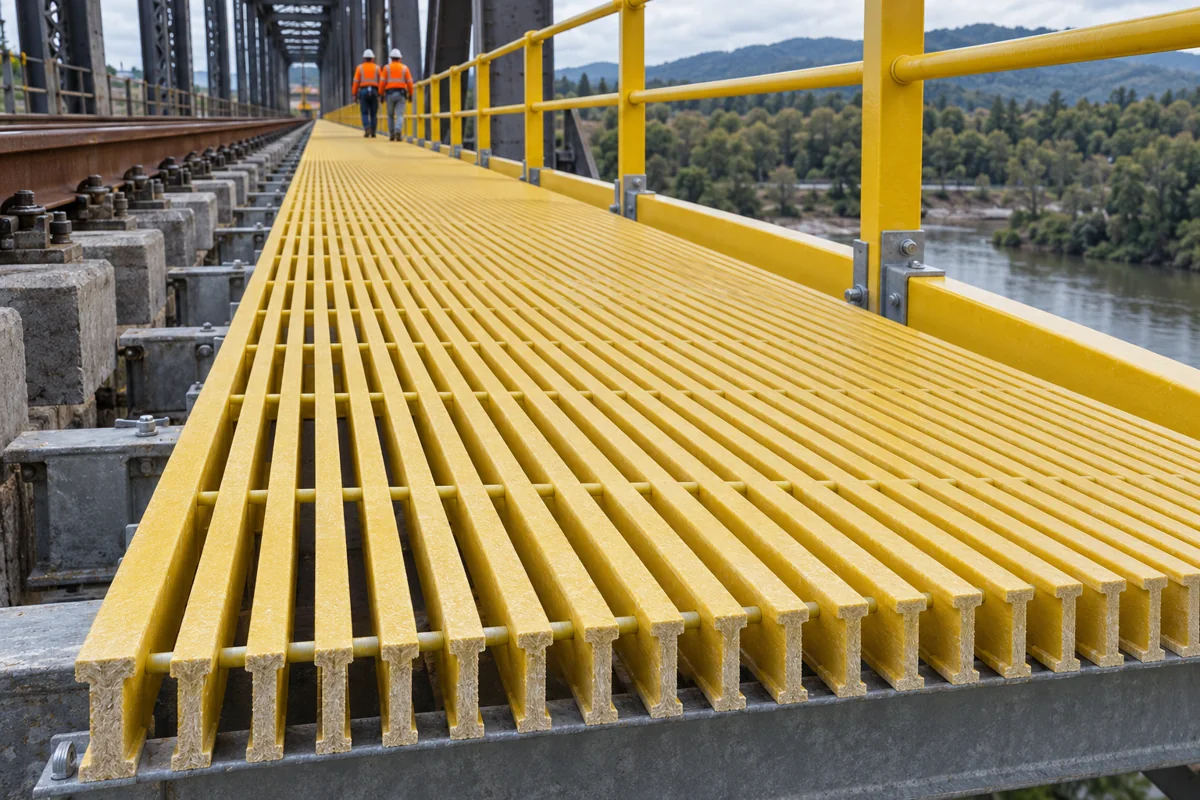
- Long continuous runs, such as bridge and trackside walkways, using panels up to about 12 m. See our GRP trackside walkway guide.
- Offshore and marine decks, where the extra stiffness and fewer joints help.
How do you read pultruded model codes?
MACHS pultruded models follow one pattern: a letter for the bar shape, two digits for the open area, and two digits for the bar height in tenths of an inch.
| Model | Bar | Open area | Bar height |
|---|---|---|---|
| I4010 / I5010 / I6010 | I-bar | 40 / 50 / 60% | 26 mm (1.0 in) |
| I4015 / I5015 / I6015 | I-bar | 40 / 50 / 60% | 38 mm (1.5 in) |
| T1810 / T3510 | T-bar | 18 / 35% | 26 mm (1.0 in) |
| T3320 / T5020 | T-bar | 33 / 50% | 51 mm (2.0 in) |
More open area means wider bar spacing, which lets more light and liquid through but gives less material per metre of width. Load tables for each model are available on request.
MACHS makes molded and pultruded grating in-house, so we can recommend the type that fits your span rather than the one we happen to sell.
Compare the grating range →Frequently Asked Questions
Which is stronger, molded or pultruded grating?
Pultruded grating is stronger and stiffer along its load bars. Molded grating has more even strength in both directions. For one-way spans between parallel beams, pultruded grating carries more at the same depth.
Is molded grating more corrosion resistant?
Corrosion resistance depends mainly on the resin system, not the grating type. Both can be made in vinyl ester, isophthalic or phenolic resin. See our chemical resistance guide.
Can molded and pultruded grating be used on the same platform?
Yes. A common approach is pultruded grating on long walkway spans and molded grating around equipment where many cut-outs are needed. Match the depths so the surface stays level.