

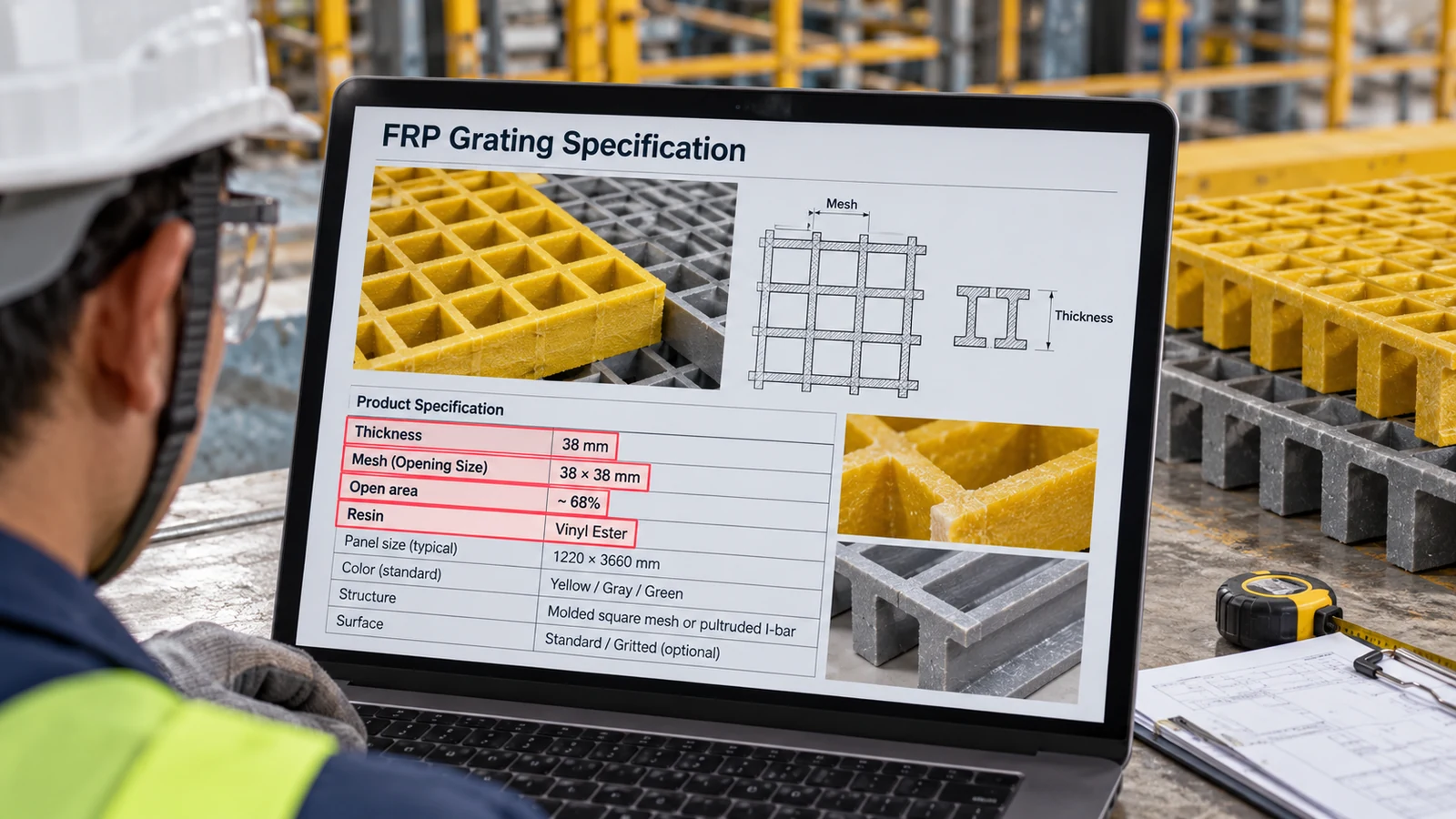
An FRP grating specification is fully defined by nine items: grating type, thickness, mesh, open area, panel size, load direction, resin system, surface, and colour, plus a fire test report where the project needs one. If a data sheet or quote leaves one of these out, you cannot compare it with another supplier. This page explains what each item means, using MACHS product data.
Key Takeaways
- Thickness and mesh together set stiffness and weight. 38 mm with 38 × 38 mm mesh is the most common industrial walkway grating.
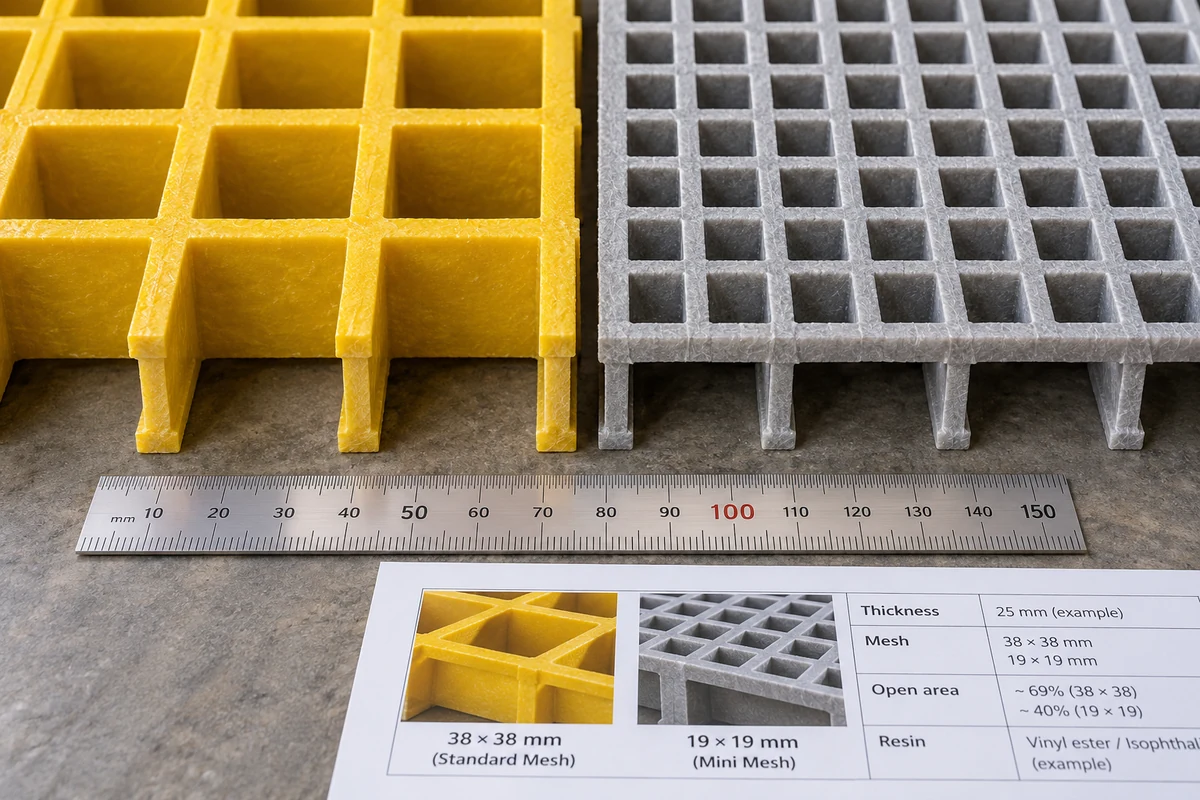
- Open area is the share of the surface that is open: 68% for 38 × 38 mesh and 42% for 19 × 19 mini mesh.
- Rectangular meshes and pultruded grating are directional, so the specification must say which way the load-bearing bars run.
- Resin is specified by system (vinyl ester, isophthalic, phenolic, orthophthalic), not just “fire retardant” or “corrosion resistant”.
What does each specification field mean?
| Field | What it tells you | MACHS options |
|---|---|---|
| Type | How the grating is made and how it carries load | Molded or pultruded |
| Thickness / bar height | Overall depth of the panel | Molded 13–60 mm; pultruded 26, 38, 51 mm |
| Mesh | Centre-to-centre spacing of the bars | 19 × 19 to 83.3 × 83.3 mm squares; rectangular meshes |
| Open area | Share of the surface that is open | Molded 42–87%; pultruded 18–60% |
| Panel size | Standard sheet that pieces are cut from | 1220 × 4000, 1220 × 3660, 1220 × 2440, 915 × 3050 mm and others |
| Load direction | Which way the main bars must span | Needed for rectangular mesh and pultruded grating |
| Resin system | Chemical and fire behaviour | VCF, IIF, IFF, PIN, OAF, OAG |
| Surface | Slip resistance and cleanability | Standard top or grit top (code G); covered plate |
| Colour | Appearance and safety marking | RAL 1003, 6010, 7004, 7015, 7035 |
How do thickness and mesh work together?
Thickness gives stiffness. Mesh decides how much material sits in each square metre. Both change the weight and the span the grating can cover. Our most-used molded sizes:
| Thickness | Mesh | Open area | Weight |
|---|---|---|---|
| 25 mm | 38 × 38 mm | 68% | 12.30 kg/m² |
| 30 mm | 38 × 38 mm | 68% | 14.60 kg/m² |
| 38 mm | 38 × 38 mm | 68% | 19.50 kg/m² |
| 50 mm | 50 × 50 mm | 71% | 23.51 kg/m² |
| 38 mm | 19 × 19 mm (mini mesh) | 42% | 23.51 kg/m² |
Notice that 38 mm mini mesh weighs the same as 50 mm standard mesh. Smaller openings put more bars, and more material, into the same area. Full weights for every size are in our FRP grating weight table.
Why does open area matter?
Open area decides drainage, light, airflow and what can fall through.
- High open area (68–87%): best drainage and least weight. Standard for industrial walkways.
- Low open area (42% mini mesh): stops small tools, heels and debris. The 2010 ADA Standards limit openings on accessible routes so that a 1/2 in (13 mm) sphere cannot pass.
- Zero open area: covered grating with a solid smooth or gritted plate, for spill areas and solid floors.
When does load direction need to be specified?
Whenever the grating is stronger one way than the other. That applies to:
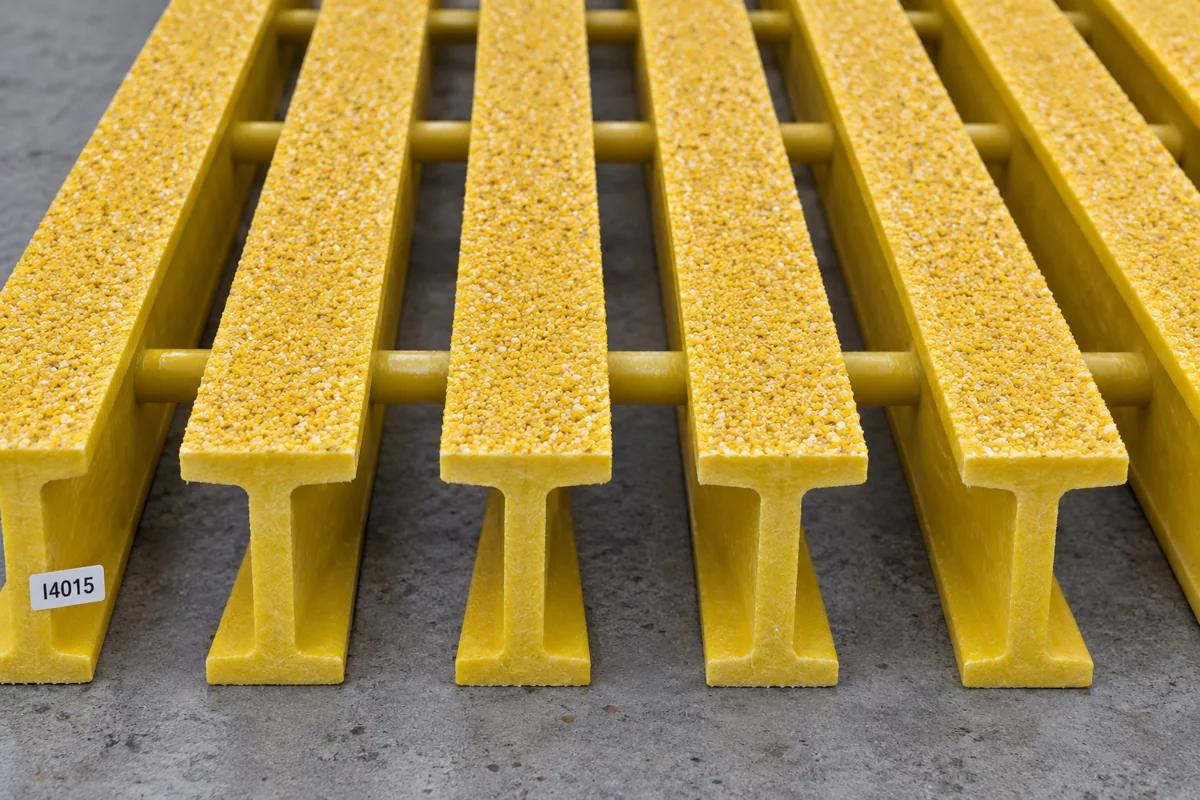
- Pultruded grating: the load bars must span between supports.
- Rectangular mesh molded grating: our data sheets mark these as “load on long side” or “load on short side”. For example, 38 mm with 25 × 152 mm mesh carries load on the long side, and 38 mm with 38 × 152 mm mesh on the short side.
Square-mesh molded grating carries load equally both ways, so direction does not need to be stated. The difference is explained in molded vs pultruded FRP grating.
How do you read resin and surface codes?
MACHS uses three-letter resin codes:
- VCF: vinyl ester, for heavy chemical corrosion
- IIF: isophthalic polyester, for general industrial corrosion
- IFF: isophthalic food-grade system, for food processing areas
- PIN: phenolic, where fire behaviour is critical
- OAF / OAG: orthophthalic polyester, for light corrosion or general building use
Surface code G means grit top. Pultruded I-bar panels come with grit or grooved tops, and T-bar panels with grit tops. How to pick the resin is covered in our chemical resistance guide.
How do you read pultruded model codes?
MACHS pultruded models read as bar shape, open area, then bar height in tenths of an inch. For example:
- I4015: I-bar, 40% open area, 1.5 in (38 mm) high. Weight 23.5 kg/m².
- I6010: I-bar, 60% open area, 1.0 in (26 mm) high.
- T5020: T-bar, 50% open area, 2.0 in (51 mm) high.
Which documents belong with the specification?
- Load table for the exact model, with the test support conditions stated. See our load capacity data.
- Fire test report matching the thickness, resin and surface. Our SGS reports to ASTM E84 cover 38 mm molded grit-top samples and 38 mm I-6015 pultruded grating, all Class A.
- Glass content or burn-off result if you want to verify material quantity, tested to ASTM D2584.
Certificates and reports can be requested from our resource download page.
Every MACHS grating size has a published thickness, mesh, open area and unit weight. Ask for the data sheet of the size you are considering.
Browse grating specifications →Frequently Asked Questions
Is mesh size measured centre to centre?
Yes. A 38 × 38 mm mesh means the bars are 38 mm apart centre to centre, so the clear opening is smaller than 38 mm.
Why do two suppliers list different weights for the same size?
Bar width, glass content and resin all change weight. A lower weight for the same thickness and mesh can mean less material. Ask for the unit weight and compare it.
Does the specification need a load rating?
It needs the span and load, so the grating can be checked. FRP grating has no single load rating because capacity depends on span and the deflection limit you set.