

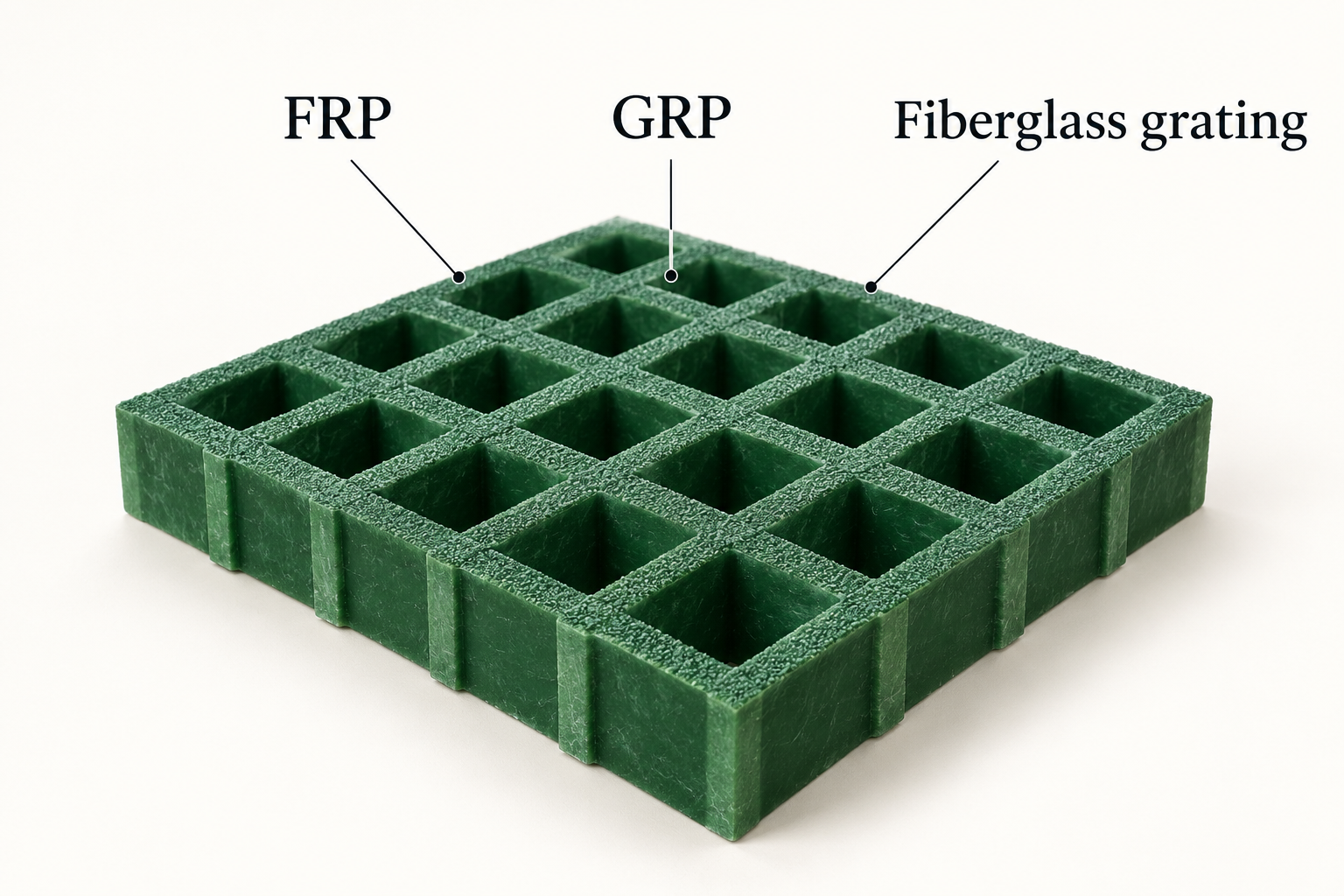
For grating, there is no material difference between FRP and GRP. Both names describe the same product: an open-mesh panel made of glass fibre and thermoset resin. The difference is in the words, not the grating. FRP (fibre-reinforced plastic or polymer) is the wider family name, and GRP (glass-reinforced plastic) names the glass-fibre member of that family. Standard industrial grating is made with glass fibre, so an “FRP grating” and a “GRP grating” of the same type, resin and size are the same panel. Which name you meet depends mostly on where you are and which standard your project uses.
Key Takeaways
- FRP grating, GRP grating and fiberglass grating are the same product: glass fibre reinforcing a thermoset resin.
- FRP is the umbrella term (it can include carbon or aramid fibre); GRP specifies glass fibre. Grating uses glass fibre, so the terms overlap completely.
- Standards use different names for the same thing: ASTM F3059 says FRP, BS 4592 says GRP.
- Real differences between gratings come from the type, resin, depth, mesh, surface and fire test, not from the label.
What do FRP and GRP stand for?
- FRP: fibre-reinforced plastic, or fibre-reinforced polymer. A family of composites in which fibres carry the load and a resin holds them together. The fibre can be glass, carbon, aramid or basalt.
- GRP: glass-reinforced plastic. The same idea, with glass fibre named specifically.
- GFRP: glass-fibre-reinforced polymer. Another way of saying “FRP made with glass”. It is common for rebar, for example in ASTM D7957, the specification for glass fiber reinforced polymer bars.
- Fiberglass (fibreglass): the everyday name for glass-fibre composites, used mainly in North America.
So GRP is a type of FRP. Every GRP grating is an FRP grating. An FRP grating would only differ from a GRP one if it were made with another fibre, which standard grating is not.
So is there any difference between FRP and GRP grating?
No. In practice the two names are interchangeable for grating. The best evidence is the standards themselves, which describe the same glass-fibre product under different names:
| Standard | Official title (shortened) | Name used |
|---|---|---|
| ASTM F3059 (US) | Fiber-Reinforced Polymer (FRP) Gratings Used in Marine Construction and Shipbuilding | FRP |
| BS 4592-4 (UK) | Industrial type flooring and stair treads: Glass reinforced plastics (GRP) open bar gratings | GRP |
| ASTM D7957 (US, rebar) | Solid Round Glass Fiber Reinforced Polymer Bars for Concrete Reinforcement | GFRP |
The material behind every label is the same: continuous glass fibre in a thermoset resin. The Wikipedia article on fiberglass reinforced plastic grating also lists FRP grating, GRP grating and fiberglass grating as names for one product.
Where is each name used?
- GRP: the usual term in the UK, Ireland, Australia, New Zealand and much of the Middle East.
- Fiberglass grating: the usual trade term in the US and Canada.
- FRP: widely used in Asia, in engineering documents and in US standards such as ASTM F3059.
Buyers searching online meet all three. A UK contractor may ask for “GRP walkway grating” while a US engineer specifies “fiberglass grating” for the same job.
What actually makes one grating different from another?
The specification, not the name. These are the properties that change performance and price:
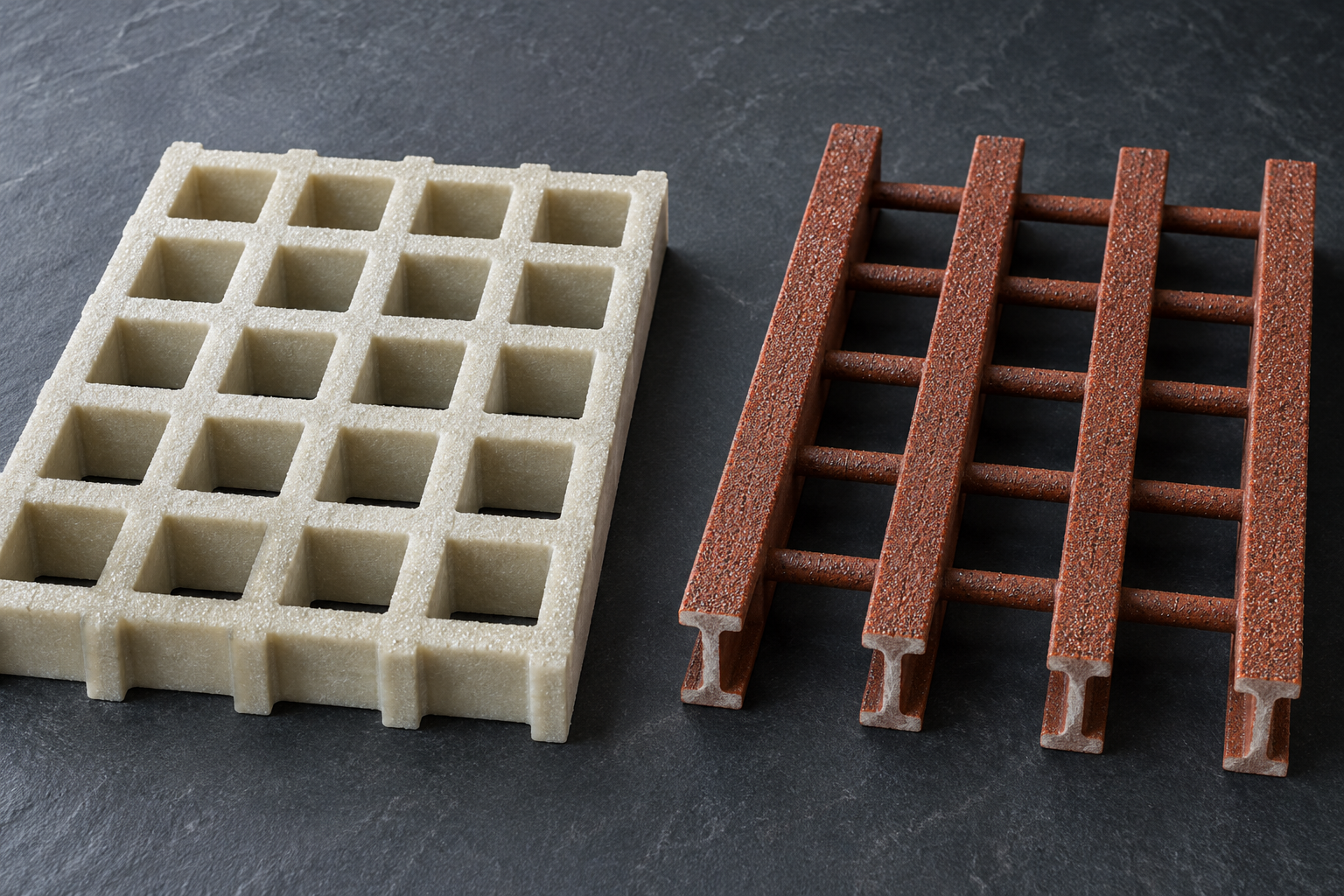
- Type: molded (one-piece, equal strength both ways) or pultruded (assembled bars, stiffer in one direction). At a 914 mm span under 4.8 kN/m², MACHS 38 mm molded grating deflected 3.45 mm and I4015 pultruded grating 0.76 mm. See molded vs pultruded FRP grating.
- Resin: vinyl ester, isophthalic, phenolic or orthophthalic, which sets chemical and fire behaviour. See the chemical resistance guide.
- Depth and mesh: for example, 25 mm grating weighs 12.30 kg/m² and 38 mm weighs 19.50 kg/m² with the same 38 × 38 mm mesh. See FRP grating specifications explained.
- Surface: standard top or grit top for slip resistance.
- Fire test: a test report applies only to the configuration tested. Our SGS ASTM E84 results were Class A for 38 mm molded grit-top and 38 mm I-6015 pultruded samples.
Why do some articles say FRP and GRP are different?
Because FRP, as a family name, also covers carbon-fibre and aramid composites, which really are different materials. That distinction matters for aerospace parts or structural strengthening. It does not matter for standard grating, which is made with glass fibre. MACHS grating, for example, is glass fibre in every model.
Which name should you use in a specification or RFQ?
- Use the term your governing standard uses: GRP for BS 4592 projects, FRP for ASTM F3059 projects.
- Add the other names once, so every supplier recognises the product, for example “FRP (GRP / fiberglass) molded grating”.
- Then define the grating by its properties, not its name. Our FRP grating RFQ checklist lists the 12 items to include.
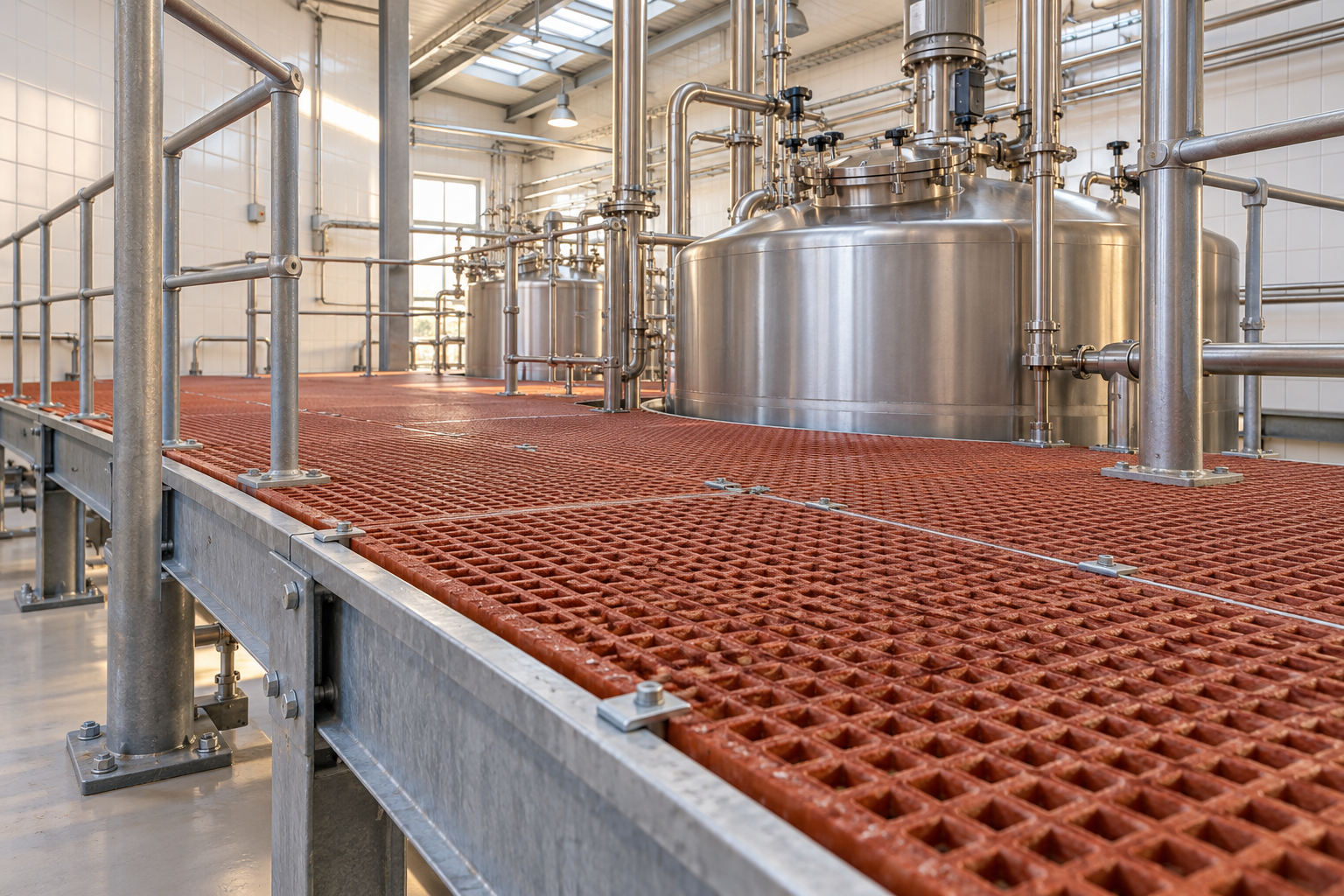
MACHS makes molded and pultruded FRP (GRP) grating with published weights, load data and SGS fire test reports.
See the grating range →Frequently Asked Questions
Is fiberglass grating the same as FRP grating?
Yes. Fiberglass grating, FRP grating and GRP grating are three names for the same glass-fibre composite grating.
Is GRP grating weaker than FRP grating?
No. The name does not change the strength. Strength depends on the grating type, depth, mesh and resin. Compare load tables, not labels. See FRP grating load capacity.
Is GFRP the same as GRP?
Yes, both mean a polymer or plastic reinforced with glass fibre. GFRP is common for rebar; GRP is common for grating and tanks. For rebar, see what is FRP rebar.