

Short Answer
A fire rating for FRP grating is only valid for the fire it was tested against. Offshore FRP grating is usually certified with a cellulosic (building-type) fire. The UK HSE warned that some of these gratings can lose their strength much faster in a hydrocarbon pool fire. They can also look undamaged afterwards and still fail when someone walks on them. On oil, gas and petrochemical sites, specify grating against the fire hazard that is actually present.
Key Takeaways
- In HID 2-2012, the UK HSE warned that some phenolic and isophthalic FRP gratings failed in hydrocarbon pool fires well before the 60 minutes they were certified for.
- Gratings can look intact after a fire yet be too weak to carry a person walking or running.
- ASTM F3059 covers fire exposure based on ASTM E119. It does not cover hydrocarbon pool or jet fires.
- Map each area’s fire hazard first, then choose the grating and any fire protection.
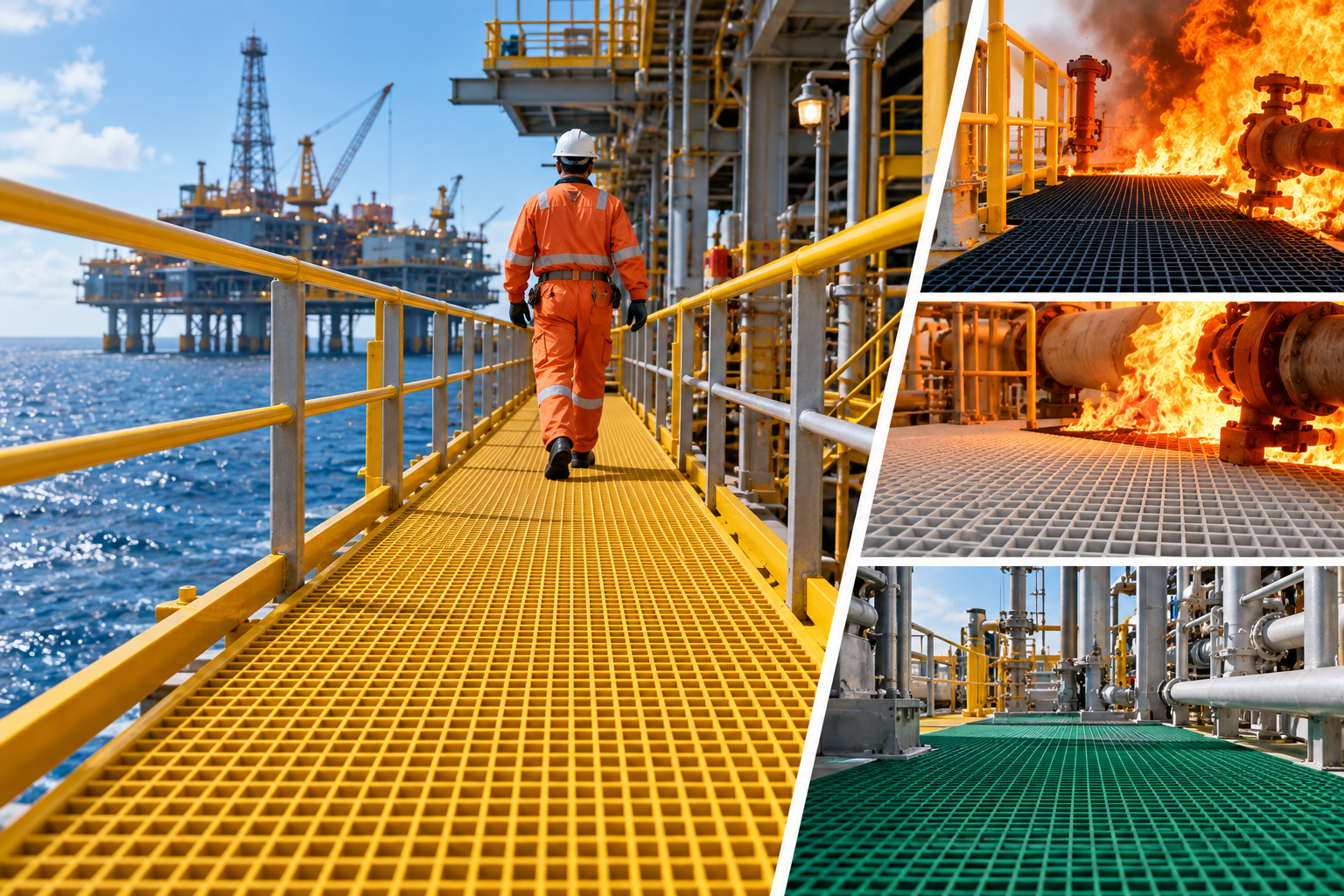
What is the difference between a cellulosic fire and a hydrocarbon fire?
A hydrocarbon fire heats up much faster and burns hotter early on than a cellulosic fire. A cellulosic fire is the slower-growing fire you get from burning wood and paper in a building. A hydrocarbon fire comes from burning oil or gas, which is the typical fire on process plants and offshore platforms.
- Cellulosic fire: the basis of most building fire tests, including ASTM E119.
- Hydrocarbon pool fire: spilled fuel burning in a pool under or near the grating.
- Jet fire: pressurized gas or liquid burning as a high-speed flame, the most severe case.
What did the HSE warning say?
The HSE found that certified fire-resistant FRP gratings may fail after relatively short hydrocarbon pool fires. In Safety Alert HID 2-2012, it reported the following (HSE):
- Testing for HSE covered FRP gratings made with phenolic or isophthalic resin. Some lost their load-bearing ability, or failed, after a hydrocarbon pool fire.
- They failed far sooner than the 60-minute period from their cellulosic fire certification.
- A grating may appear intact after the fire yet be too weak for the dynamic load of a person walking or running.
- Duty holders were told to identify where composite gratings may face hydrocarbon fires and how to keep people safe.
Australia’s offshore regulator issued a similar alert on FRP deck gratings (NOPSEMA Safety Alert 60).
What do the fire integrity levels mean?
Offshore fire integrity levels come from the USCG test protocol PFM 2-98. Under it, grating is exposed to a 60-minute fire and then load-tested. The two levels most often specified are:
| Level | Intended use | Extra requirement |
|---|---|---|
| L3 | Escape routes and areas needing access for firefighting or rescue during or shortly after a fire | Passes the fire test |
| L2 | Open decks where groups gather, such as temporary refuge and lifeboat embarkation areas | Meets L3 and also carries at least 4.5 kN/m² (94 lbf/ft²) after the fire |
Source: summaries of PFM 2-98 criteria published by grating manufacturers. ASTM F3059 uses the same 4.5 kN/m² reference load. Key limit: both are based on a cellulosic-type fire, not a hydrocarbon fire.
How should you specify FRP grating for oil, gas and petrochemical sites?
Start from a fire hazard map, not a product catalog.
- Classify each area: where a hydrocarbon pool fire or jet fire is possible, and where it is not.
- Keep FRP out of high-risk zones, or protect it, where the design fire is hydrocarbon and the grating is part of an escape route.
- Use FRP where it fits: areas with low fire risk and high corrosion, such as splash zones, seawater systems and chemical areas.
- Ask suppliers for the test standard and fire type behind every fire claim.
- Plan post-fire inspection: treat any fire-exposed FRP grating as suspect, even if it looks fine.
Is FRP grating still a good choice offshore?
Yes, in the right areas. FRP does not rust, weighs less than steel and cuts maintenance in wet, salty environments. The HSE warning is about specifying it correctly, not about banning it.
- Good fits: walkways away from hydrocarbon sources, splash zones and chemical service areas.
- Poor fits: escape routes directly above possible fuel pools without extra protection.
See how FRP compares with steel in FRP grating vs steel grating.
FAQ
Does a 60-minute fire rating mean the grating lasts 60 minutes in any fire?
No. It means 60 minutes in the tested fire type. In a hydrocarbon pool fire, the HSE found failures happened considerably sooner.
Is phenolic grating safe offshore?
Phenolic resin gives low smoke and good fire performance. It was, however, among the types the HSE warned about for hydrocarbon fires. Use it with a proper fire hazard assessment.
What should I do after a fire on an FRP walkway?
Close the area and replace or load-test the grating before anyone walks on it, even if it looks undamaged.
Need fire-rated grating?
Send us your area classification and the fire standard you need. We will tell you which of our products are tested to it and which are not. Contact our engineers.