

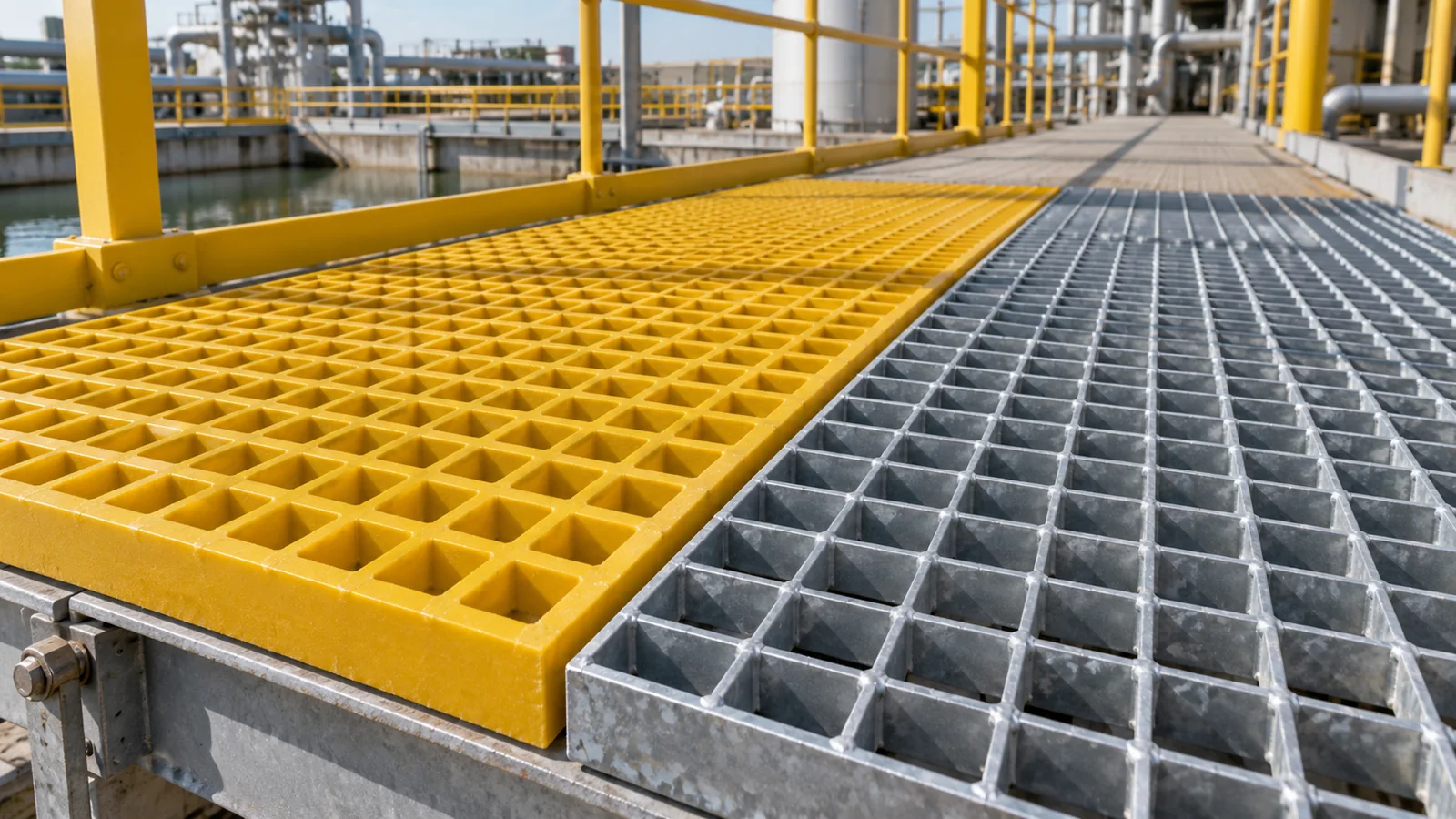
FRP grating is the better choice where corrosion, electrical safety or manual handling drive the decision. Steel grating is the better choice where you need maximum stiffness over long spans, heavy vehicle loads, high heat, or non-combustible flooring. Neither material wins everywhere. This page compares them on the factors that decide real projects, using test data from our own grating.
Key Takeaways
- 38 mm MACHS molded FRP grating weighs 19.50 kg/m², so a full 1220 × 3660 mm panel weighs about 87 kg.
- FRP does not rust and needs no coating. Galvanized steel relies on a zinc coating whose life depends on the environment.
- Steel is stiffer. FRP spans are limited by deflection: under 4.8 kN/m², 38 mm molded grating deflects 3.45 mm at a 914 mm span.
- FRP is combustible. Our tested samples reached ASTM E84 Class A, but hydrocarbon-fire zones need a separate assessment.
Which material lasts longer in corrosive environments?
FRP lasts longer wherever steel would need repeated coating repair. The glass fibre and resin do not oxidise, so there is no coating to break down. Galvanized steel is protected by zinc applied to ASTM A123, and the American Galvanizers Association shows that the time to first maintenance shortens sharply in industrial and marine atmospheres.
- Wastewater and H2S areas: steel and aluminium corrode quickly. See our guide to replacing corroded grating in wastewater plants.
- Chemical plants: the resin system decides resistance. Vinyl ester (our VCF system) is used for heavy chemical exposure.
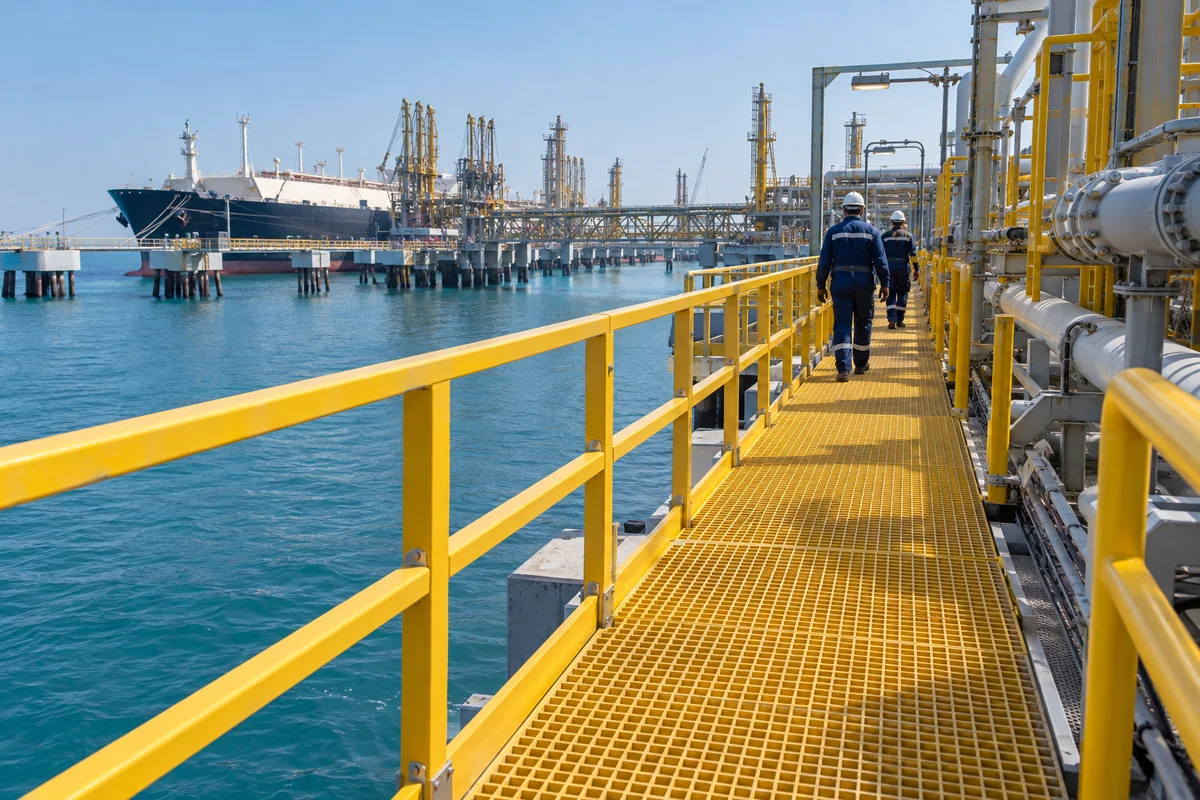
- Coastal sites: MACHS FRP grating and handrails installed at Jebel Ali Port, Dubai, in 2009 replaced corroded steel and are still in service.
How much lighter is FRP grating?
FRP grating is light enough to move with simple lifting aids, and cut panels can often be placed by hand. Our molded grating weights per square metre are:
| MACHS molded grating | Weight | 1220 × 3660 mm panel |
|---|---|---|
| 25 mm, 38 × 38 mm mesh | 12.30 kg/m² | 54.9 kg |
| 38 mm, 38 × 38 mm mesh | 19.50 kg/m² | 87.1 kg |
| 50 mm, 50 × 50 mm mesh | 23.51 kg/m² | 105.0 kg |
To compare with steel, take the catalogue weight of the steel bar grating you would otherwise use. Steel grating manufacturers publish these in their catalogues, and the NAAMM Metal Bar Grating Manual is the common US reference. The full FRP table is in our FRP grating weight guide.
Is FRP grating as strong and stiff as steel?
No. Steel is much stiffer, so FRP grating needs closer supports or a deeper section for the same deflection. In FRP design, stiffness (deflection) usually controls the selection before strength does.
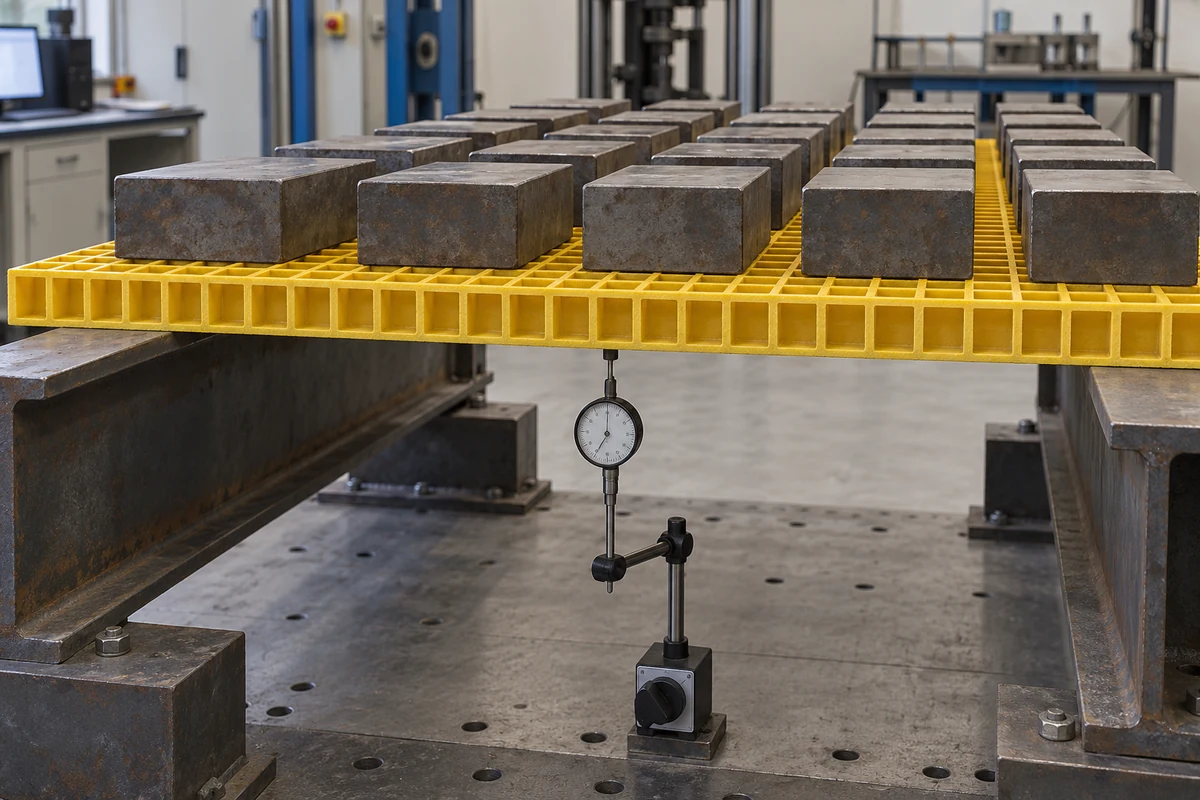
Our test data shows how deflection limits the span. Under a uniform load of 4.8 kN/m² (100 psf), with a span/200 deflection limit:
- 25 mm molded: passes at 610 mm (2.11 mm deflection), fails at 914 mm.
- 38 mm molded: passes at 914 mm (3.45 mm), fails at 1219 mm (12.17 mm).
- 50 mm molded: passes at 1219 mm (4.93 mm).
- 38 mm pultruded I4015: deflects only 0.76 mm at 914 mm, so it suits longer spans.
If you are replacing steel on existing supports, measure the support spacing first. Full tables are in our FRP grating load capacity guide.
How do FRP and steel compare on safety?
FRP has three safety advantages over steel and one clear disadvantage.
- Electrical: FRP is non-conductive, which matters around substations, cable trenches and rail overhead lines.
- Sparking: FRP does not create impact sparks, which is useful in flammable atmospheres.
- Slip resistance: grit-top FRP grating has the anti-slip surface built in. Steel needs serrated bars.
- Fire (disadvantage): FRP is combustible and steel is not. Fire-retardant FRP can still achieve low flame spread. Our SGS tests to ASTM E84 gave Class A results (flame spread index 10–15) on 38 mm molded grit-top grating and 38 mm I-6015 pultruded grating.
Which is cheaper over the life of the project?
Steel usually costs less to buy. FRP often costs less to own in corrosive environments because it needs no repainting, re-galvanizing or panel replacement. The answer depends on how often steel would need maintenance on your site.
- Purchase price: steel is usually lower per square metre.
- Installation: FRP is cut with hand tools and needs no hot-work permit.
- Maintenance: FRP needs washing and clip checks. Steel needs coating repair once corrosion starts.
What sets the FRP price is covered in our FRP grating price factors guide.
When should you still choose steel?
Choose steel when one of these conditions applies:
- Spans are long and supports cannot be added, and pultruded FRP still deflects too much.
- Heavy vehicles or forklifts run on the grating.
- Operating temperatures are high enough to soften the resin.
- The specification requires non-combustible flooring.
- The site is dry and non-corrosive, so steel’s coating will last and its lower price wins.
Molded grating from 13 to 60 mm thick and pultruded grating 26 to 51 mm high, with published load data and SGS fire test reports.
View FRP grating specifications →Frequently Asked Questions
Can FRP grating replace steel on existing supports?
Often, yes, if the support spacing suits the FRP depth. Measure the clear span and check it against our load tables. If the span is too long, use deeper or pultruded grating, or add an intermediate support.
Does FRP grating meet OSHA walking-surface rules?
OSHA 1910.22 requires walking-working surfaces to support their maximum intended load and to be kept safe. It does not specify a material. Choose the FRP depth and span for your intended load.
Is FRP grating weaker than steel?
It is less stiff, and stiffness usually controls FRP design. That is why FRP grating is selected by span and deflection, not by strength alone.