

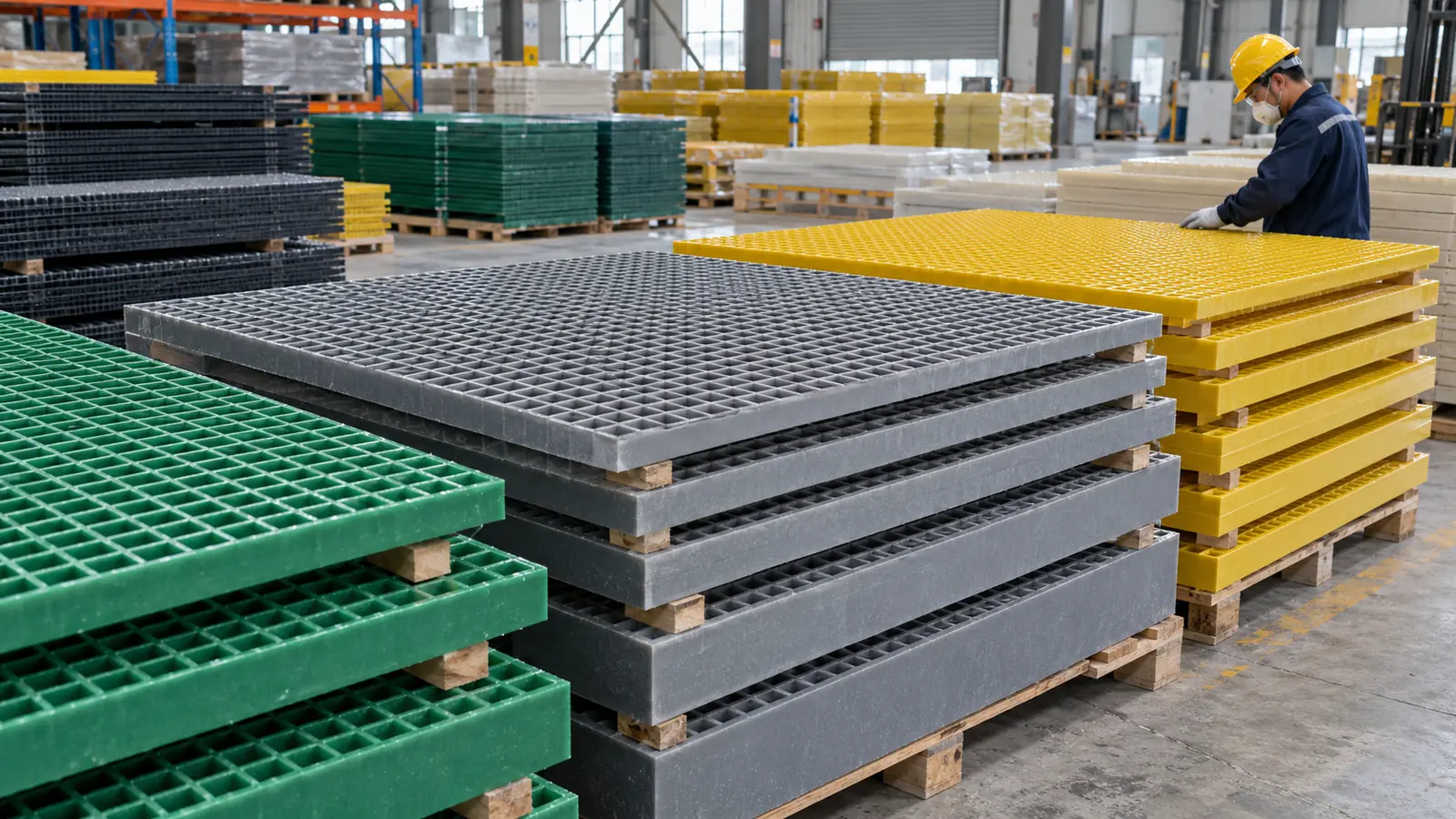
FRP grating price is driven mainly by how much material is in each square metre, which resin system is used, and how much cutting and finishing the order needs. Freight, duty and order size come on top. Because these factors combine, two quotes for “38 mm FRP grating” can differ widely and still both be fair. This page explains each factor so you can compare quotes on the same basis.
Key Takeaways
- Material quantity scales with weight: 38 mm molded grating uses 19.50 kg/m² against 12.30 kg/m² for 25 mm, about 59% more material.
- Resin choice changes cost: general-purpose polyester systems are the most economical, while vinyl ester and phenolic systems cost more.
- Cutting to drawing, cover plates, grit surfaces and non-standard colours all add cost.
- Always compare quotes on the same thickness, mesh, resin, surface, panel size and Incoterm.
Why does thickness change the price so much?
Thicker grating uses more glass fibre and resin per square metre, and material is the largest part of the cost. Unit weight is a direct way to see the difference:
| MACHS molded grating | Weight | Material vs 25 mm |
|---|---|---|
| 25 mm, 38 × 38 mm mesh | 12.30 kg/m² | baseline |
| 30 mm, 38 × 38 mm mesh | 14.60 kg/m² | +19% |
| 38 mm, 38 × 38 mm mesh | 19.50 kg/m² | +59% |
| 50 mm, 50 × 50 mm mesh | 23.51 kg/m² | +91% |
| 60 mm, 38 × 38 mm mesh (heavy duty) | 50.43 kg/m² | +310% |
The practical lesson: do not over-specify thickness. If your span is 610 mm under pedestrian load, 25 mm grating passes our deflection check and 38 mm adds cost without benefit. Check your span in the FRP grating load capacity guide before you ask for prices.
How much does the resin system add?
Resin is the second biggest driver. Our resin systems, from most economical to most specialised:
- OAG / OAF (orthophthalic polyester): general building use and light corrosion. Lowest cost.
- IIF (isophthalic polyester): general industrial corrosion, such as water treatment and marine walkways.
- IFF (isophthalic, food-grade system): for food processing areas.
- VCF (vinyl ester): heavy chemical corrosion. Higher cost.
- PIN (phenolic): where fire behaviour is critical, such as offshore and tunnels. Higher cost.
Paying for vinyl ester on a dry rooftop walkway wastes money. Using orthophthalic in an acid area costs more later in replacements. See how to match resin to chemicals.
Which finishing options add cost?
Anything beyond a standard panel in a standard colour adds labour or material:
- Grit top: bonded sand grit for slip resistance. Adds about 2.00 kg/m² of surface material on solid plates.
- Cover plates: a 3 mm gritted plate adds about 7.55 kg/m² (3 × 1.85 + 2.00) plus bonding work.
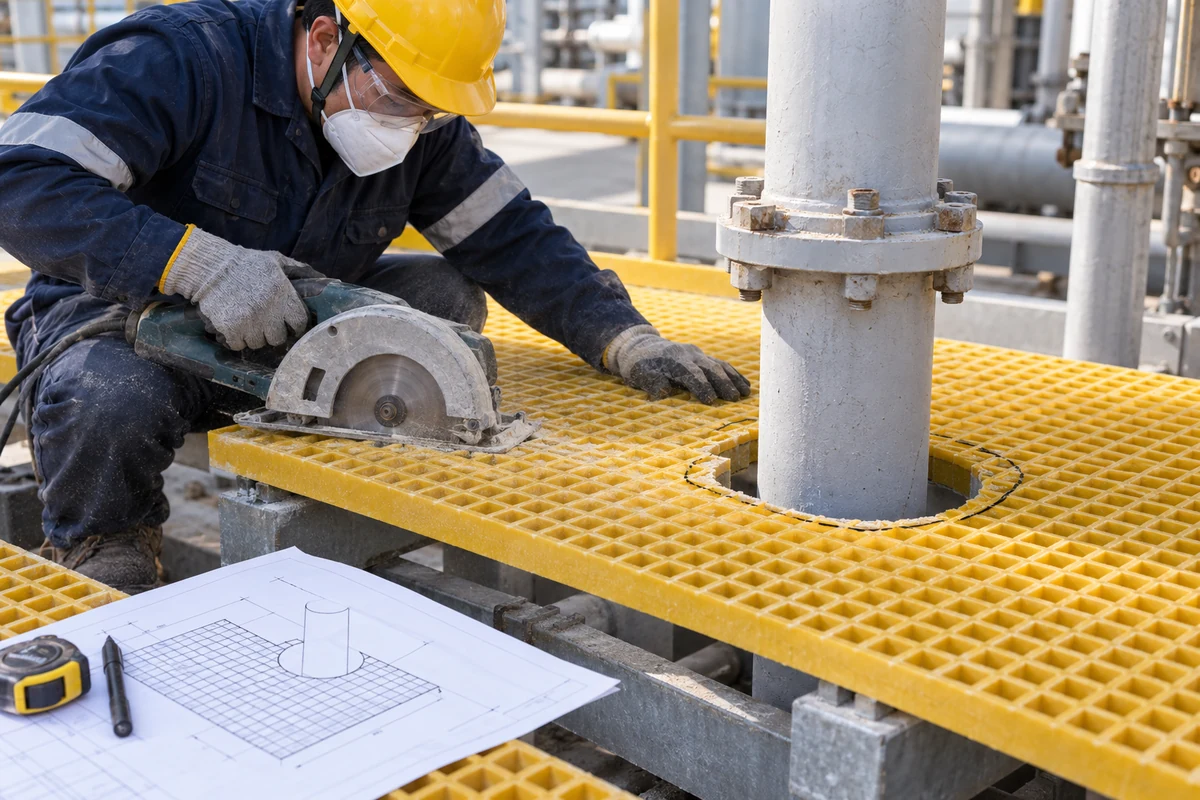
- Cutting to drawing: cut-outs for pipes, edge sealing and part numbering take labour time.
- Edge banding and frames: extra FRP profiles and assembly.
- Non-standard colours: our current standard colours are RAL 1003, 6010, 7004, 7015 and 7035. Other colours may need a minimum quantity.
How does panel size affect what you pay?
Panel yield matters because you pay for the whole standard panel your pieces are cut from. Our standard molded panels are 1220 × 4000, 1220 × 3660, 1220 × 2440 and 915 × 3050 mm, with 1524 mm wide panels for 38 mm grating.
- If your layout fits whole or half panels, offcut waste stays low.
- Odd widths can leave strips that cannot be used elsewhere in the order.
- Sending the full layout drawing lets the factory nest pieces across panels and reduce waste.
What costs sit outside the factory price?
The ex-works price is only part of what you pay. On top of it come:
- Packing: pallets or crates, strapping and corrugated protection.
- Freight: the cost per square metre depends on how many square metres fit in each container, so ask the supplier for the loading quantity of your exact thickness.
- Trade terms: an FOB and a DDP quote are not comparable. Check the ICC Incoterms rules for what each term includes.
- Import duty: set by your country’s tariff schedule. For the US, check the USITC Harmonized Tariff Schedule.
The full calculation is in our FRP grating landed cost guide.
How do you compare two FRP grating quotes fairly?
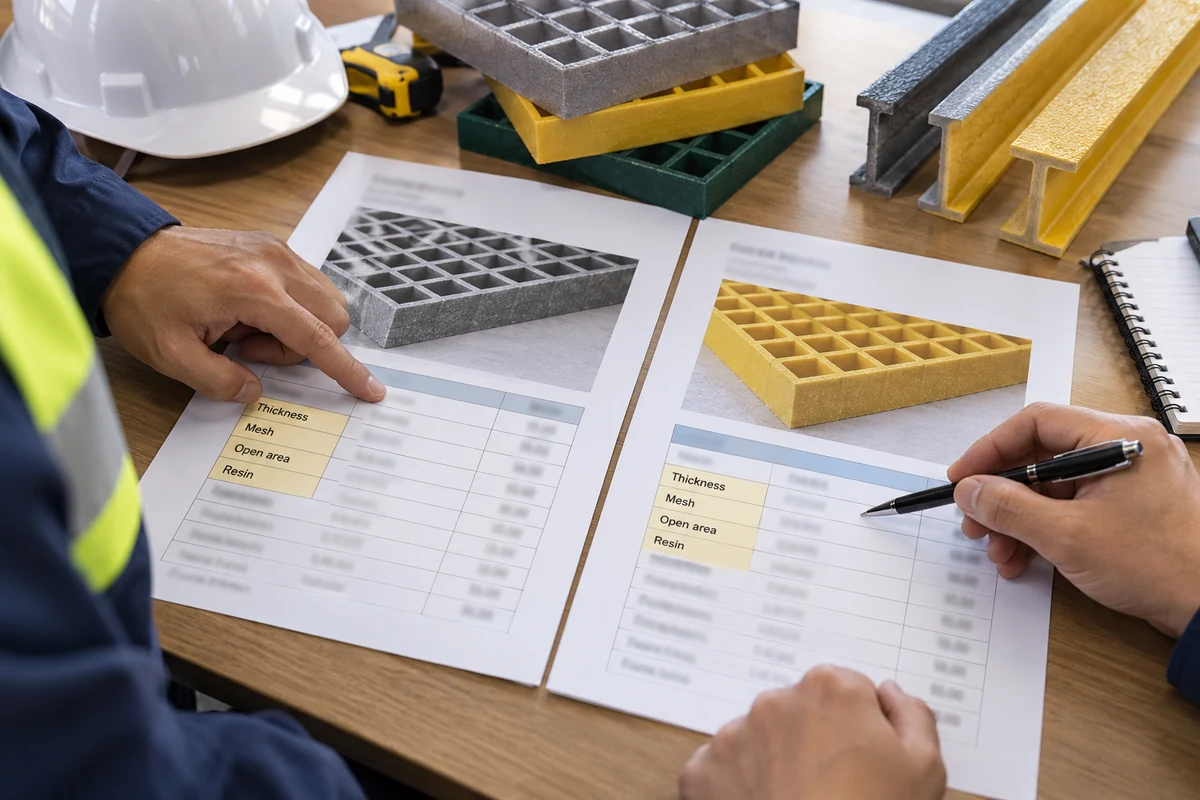
Put both quotes on the same specification line before comparing price. Check that each quote states:
- Grating type (molded or pultruded) and thickness
- Mesh size and open area
- Resin system
- Surface (standard or grit) and colour
- Panel size, or confirmation of cutting to your drawing
- Unit weight in kg/m²
- Fire test report, if your project needs one
- Incoterm, packing and lead time
Send your drawing, load and environment. We quote with the unit weight, resin system and fire report stated, so you can compare directly.
Request a quote →Frequently Asked Questions
Why is pultruded grating usually more expensive than molded?
Pultruded grating is assembled from separately produced load bars and cross rods, and I4015 weighs 23.5 kg/m² compared with 19.50 kg/m² for 38 mm molded grating. It earns the premium on longer spans, where it can reduce the number of supports.
Does a larger order lower the price per square metre?
Usually, because set-up, colour changes and cutting are spread over more area. Grouping several areas of a project into one order with one specification helps most.
Is the cheapest FRP grating a false saving?
It can be, if the low price comes from less material, an unsuitable resin or no fire test. Check unit weight, resin system and test reports before comparing prices.