



The resin decides how fiberglass resists chemicals, heat and fire, so choose it by the medium, concentration and temperature at your site rather than by name alone. Vinyl ester is the usual step up for harsher chemical duty, isophthalic polyester covers general corrosion, and phenolic is the option when fire and smoke performance matter.
A resin family name does not establish a chemical, temperature or fire rating by itself,1 so every choice below should be confirmed with test data for your conditions.
Resin Types at a Glance
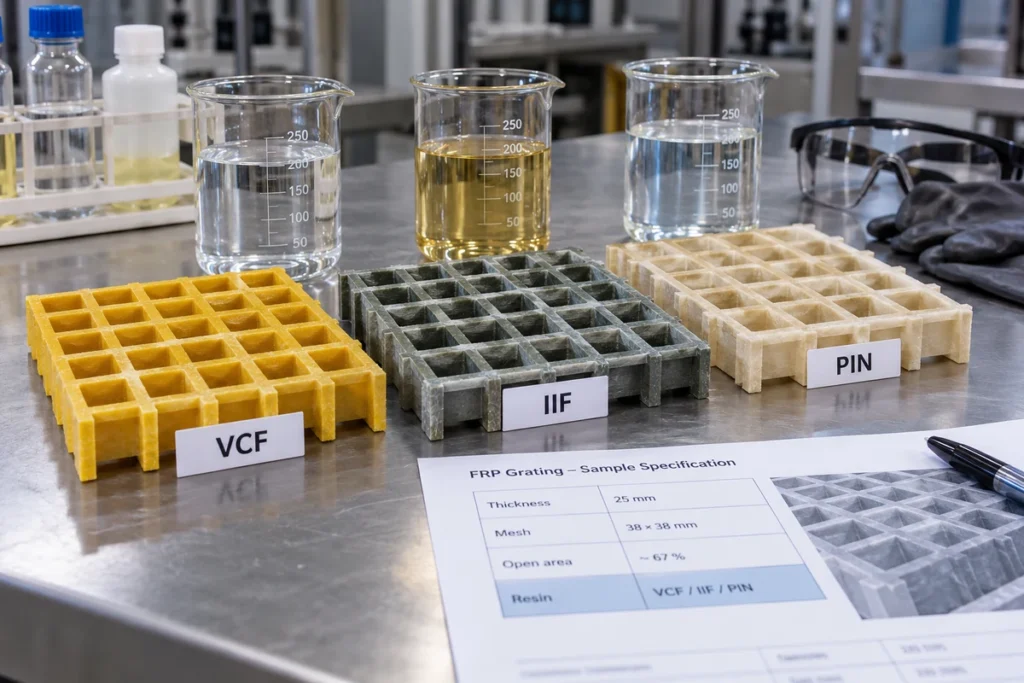
The table lists the resin codes Machs uses on its grating and how each is generally used. The general-use column is a starting point, not a guarantee of resistance to any particular chemical.
| Machs code | Resin | General use |
|---|---|---|
| VCF | Vinyl ester | Harsher chemical and corrosive duty |
| IIF | Isophthalic polyester | General corrosion resistance |
| IFF | Food-grade isophthalic polyester | Food and beverage areas |
| PIN | Phenolic | Where fire and smoke performance matter |
| OAF / OAG | Orthophthalic polyester | Mild environments with cost in mind |
Chemical dutyGeneral starting points
Colors follow the RAL range and surfaces vary by product, as listed on each product page.
How to Select a Resin
Work through these points in order, and send the answers to Machs with your enquiry:
- The mediumWhich chemicals touch the product, and in what form: liquid, splash or fumes.
- Concentration and temperatureBoth change the answer, so give the highest values.
- Duty typeContinuous immersion is harsher than occasional splash.
- Fire requirementA rated resin system is needed if the specification names a fire test (see fire and slip performance).
- Food contact or cleaning regimeFood areas call for the food-grade resin.
- Resistance dataAsk for data on your medium instead of relying on the family name.
What the Resin Label Does Not Tell You
Two products with the same resin family can differ in formulation, cure and fiber content, so the label does not set a rating.1 Ask the supplier which test method the resistance data came from.
The practice for evaluating the chemical resistance of thermosetting resins used in glass-fiber-reinforced structures for liquid service.2 Asking whether data follows a recognized method such as this is a fair purchasing question.
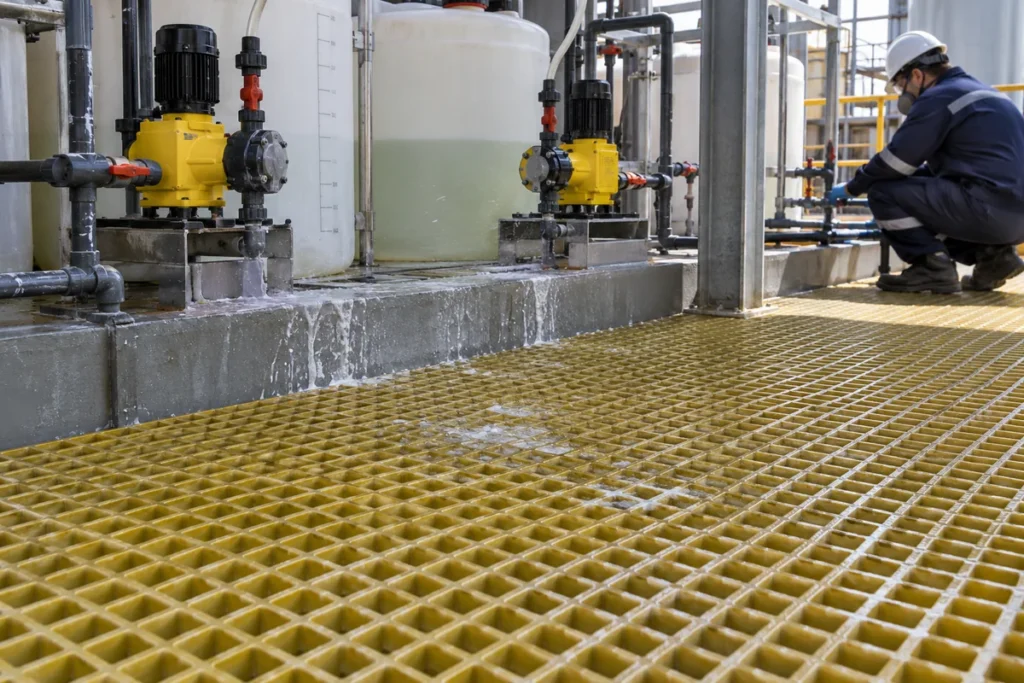
For grating in chemical areas, the Machs chemical resistance article gives more detail.
Questions About Resin Choice
Is vinyl ester always better than isophthalic?
It is generally chosen for harsher chemical duty, but for mild environments isophthalic can be enough, so match the resin to the medium.
Can Machs recommend a resin for my chemical?
Yes. Send the chemical, concentration and temperature to Machs engineering support.
Does the resin change the price?
Resin type is one of the factors, so quote the resin you actually need rather than the cheapest option.
Sources
- F1 Composite, Pultrusion Resin Systems (manufacturer guidance)
- ASTM C581, Chemical Resistance of Thermosetting Resins Used in Glass-Fiber-Reinforced Structures for Liquid Service (standard title only)