

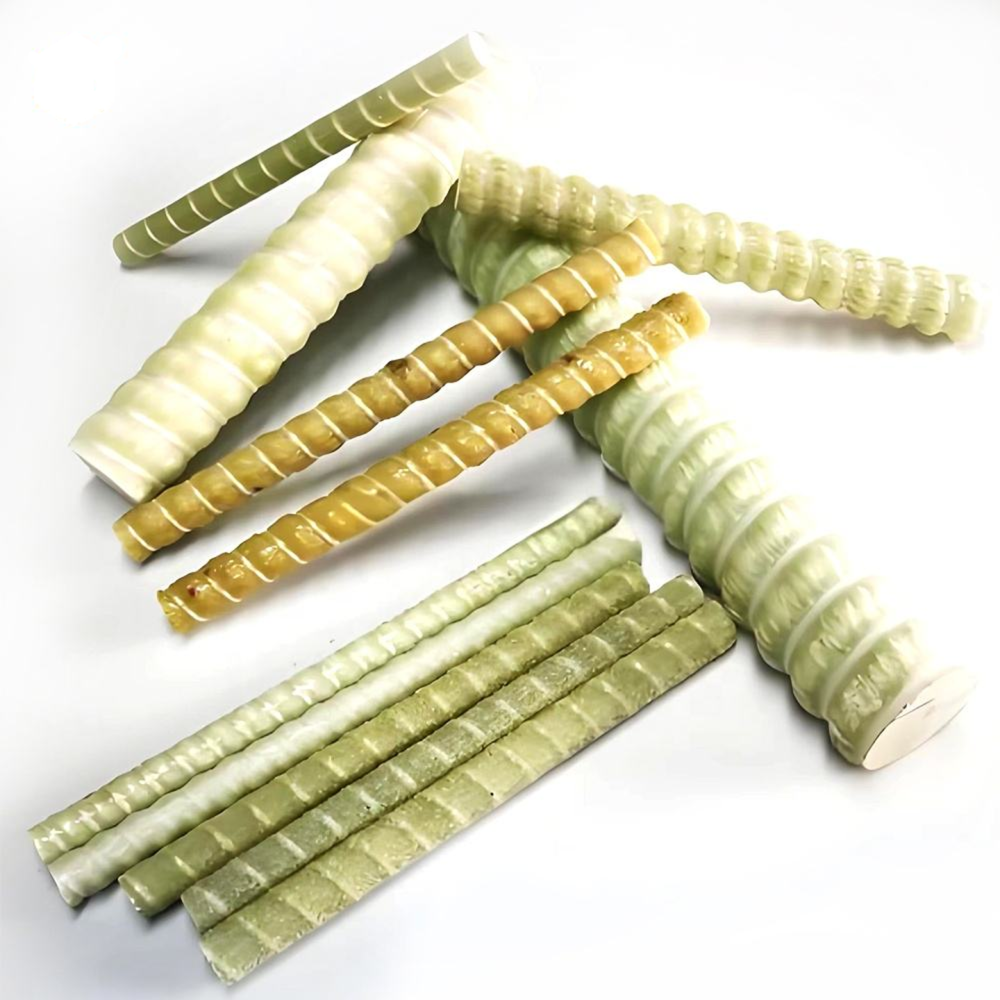
 Straight Bars01
FiberglassRebar
Machs fiberglass rebar (GFRP rebar, also called FRP rebar) is a pultruded glass fiber reinforced polymer bar used in place of steel reinforcement where concrete faces chlorides, chemicals or sensitive electrical equipment. It does not rust, weighs far less than steel and is non-magnetic. Send your bar schedule and Machs, a fiberglass rebar manufacturer, will quote sizes, lengths and factory-made bends for the project.
20+
Years pultruding FRP
in our own plant
Product Range
Fiberglass Rebar Range
Straight Bars01Bent Bars02
Why Fiberglass
Why Use Fiberglass Rebar Instead of Steel
Fiberglass rebar solves the problem that ends the life of most steel-reinforced concrete: corrosion of the bar.
- 01
No Chloride Corrosion
Suited to bridges, piers, parking structures and wastewater plants exposed to salt or chemicals.
- 02
Lightweight
About one quarter the density of steel, so bars are easier to ship, lift and place.
- 03
Non-Magnetic and Non-Conductive
Suited to MRI rooms, research laboratories and electrical installations.
Comparison
Fiberglass Rebar vs Steel Rebar
GFRP and steel behave differently, so the comparison matters for design as much as for durability.
| Property | Fiberglass (GFRP) Rebar | Steel Rebar |
|---|---|---|
| Corrosion | Does not rust | Rusts when chlorides reach the bar |
| Weight | About one quarter of steel | Heavy |
| Magnetic / Conductive | No / no | Yes / yes |
| Stiffness | Lower; deflection and cracking often govern design | Higher |
| Behavior at Overload | Linear elastic to rupture, no yielding | Yields before failure |
| Bending | Factory-made bends only | Can be bent on site |
| High Temperature | Resin softens; fire protection needed in fire-rated members | Retains more strength |
Applications
Where Fiberglass Rebar Is Used
Typical applications include bridge decks and barriers, marine and coastal structures, parking garages, water and wastewater facilities, industrial floors and tanks exposed to chemicals, and medical or research buildings that need non-magnetic reinforcement.
- 01
Bridge Decks and Barriers
- 02
Marine and Coastal Structures
- 03
Parking Garages
- 04
Water and Wastewater Facilities
- 05
Industrial Floors and Tanks
Exposed to chemicals
- 06
Medical and Research Buildings
Need non-magnetic reinforcement
Specifications
Fiberglass Rebar Specifications
Machs supplies fiberglass rebar to the following specifications.
| Item | Specification |
|---|---|
| Bar Diameters | 6–32 mm (about #2 to #10); other sizes on request |
| Surface | Helically wrapped and sand-coated for concrete bond |
| Resin System | Vinyl ester |
| Lengths and Bends | Straight bars cut to 6 m, 12 m or project lengths; factory-made bends to the bar schedule |
| Product Standard | Supplied to ASTM D7957/D7957M or the project standard |
| Mechanical Data per Size | Tensile strength, modulus and weight per size on the product data sheet |
Design
Design and Standards
Concrete reinforced with GFRP bars is designed differently from steel-reinforced concrete. Lower stiffness means deflection and crack width often control member size, the lack of yielding calls for different safety factors, and anchorage, lap splice and shear rules change. In the United States, ASTM D7957/D7957M is the standard specification for solid round GFRP bars for concrete reinforcement, and ACI PRC-440.1-15 guides the design and construction of concrete reinforced with FRP bars. The project's engineer of record sets the design basis.
What Changes in Design
Lower Stiffness
Deflection and crack width often control member size.
No Yielding
Calls for different safety factors.
Anchorage, Lap Splice and Shear
These rules change.
Standards
- ASTM D7957/D7957M
Standard specification for solid round GFRP bars for concrete reinforcement.
- ACI PRC-440.1-15
Guides the design and construction of concrete reinforced with FRP bars.
The project's engineer of record sets the design basis.
Ordering
How to Order Fiberglass Rebar
Send a bar schedule with sizes, lengths and quantities, the shapes and dimensions of any bends, the required surface and product standard, and the exposure the concrete will face.
- 01
Sizes, Lengths and Quantities
- 02
Shapes and Dimensions of Any Bends
- 03
Required Surface and Product Standard
- 04
Exposure the Concrete Will Face
Because bends cannot be made on site, every bent bar must be on the schedule before production.
Send Your Bar ScheduleFAQ
Questions About Fiberglass Rebar
Strength, bending, fire rating and sizes for Machs fiberglass rebar.
Its tensile strength is high, but its stiffness is lower and it does not yield, so members are designed for deflection and cracking rather than swapped bar for bar.
No. Bends are formed in the factory, so include every bent shape in the bar schedule.
The resin softens at high temperature, so fire-rated members need protection such as additional concrete cover; the design engineer decides the requirement.
Standard diameters run from 6 to 32 mm; send the bar schedule for other sizes.
Get a Quote
Discuss Your Project with Machs
Send the bar schedule, the product standard and the exposure conditions, and Machs will reply with a quotation for the bars and bends.
Helpful to Include
- Bar schedule
- Product standard
- Exposure conditions
- Bend shapes and dimensions
- Emailinfo@machsfrp.com
- Phone / WhatsApp+86 138 6294 9363
FactoryNo. 28, Longyou Road, Wuyao Town, Rugao City, Jiangsu, China
Request a Rebar Quote
Tell us about your project, the exposure and the bars you need. Fields marked * are required.
Accepted files: PDF, XLS, XLSX, CSV, DWG, DXF, JPG, PNG, up to 10 MB each, max 3 files.