

Short Answer
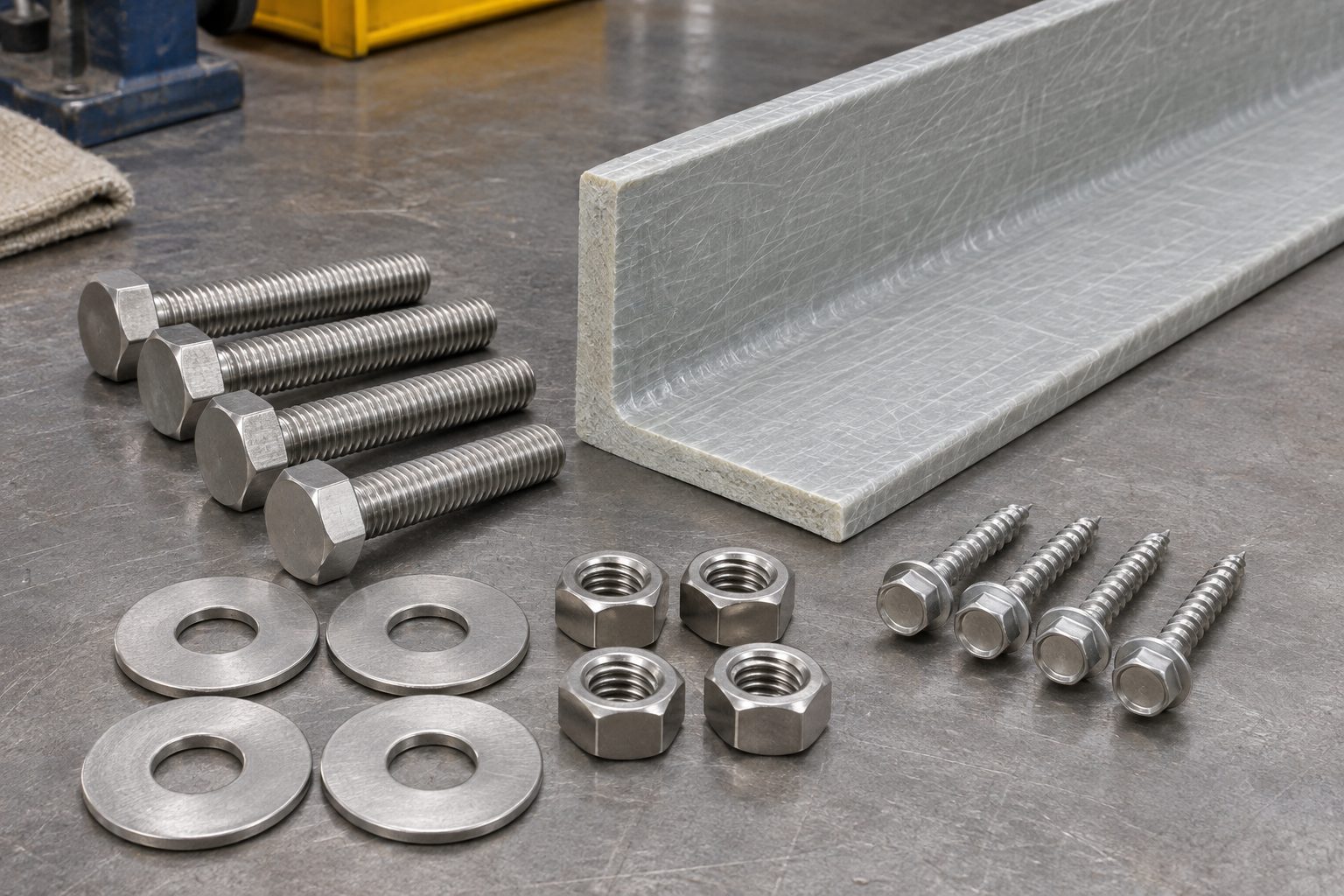
Use stainless steel fasteners for fiberglass (FRP): 316 stainless near salt water or chemicals, 304 for dry indoor areas. Self-tapping screws work for light, non-structural fixing. Anything that carries load, such as grating, handrail posts or frame joints, should be bolted through with a flat washer on both sides.
Key Takeaways
- Plain carbon steel rusts first. The fiberglass will outlast it.
- Screws suit light trim and covers; through-bolts with washers suit structural joints.
- Drill with carbide bits and light pressure, and keep holes away from edges.
- Seal every drilled hole and cut edge with a compatible resin.
Can you screw into fiberglass?
Yes, you can screw into fiberglass, but only for light loads. Strongwell, a US pultrusion maker, lists self-tapping and thread-cutting screws among the normal fasteners for fiberglass assemblies (Strongwell Design Manual, Section 19). A screw holds only by the threads it cuts into the laminate, so its grip is limited.
Exel Composites makes the same point: self-tapping screws “work well” when high strength is not needed, and they work best combined with an adhesive (Exel Composites). Exel also advises against lag screws, because they do not bite well into the composite.
Threads in fiberglass also wear out. Exel warns that FRP threads wear quickly and does not recommend bolts or screws in tapped holes, because the connection is weak. A part that you will remove and refit often needs a through-bolt with a nut, not a screw.
Which screw and bolt material is best for fiberglass?
Stainless steel is the best everyday choice. Strongwell recommends stainless steel fasteners “to eliminate the corrosion problem associated with regular steel fasteners,” and Exel advises stainless steel or Monel screws in corrosive environments.
The reason is simple: fiberglass does not rust, so a carbon steel screw becomes the weakest part of the joint. Rust stains the panel, loosens the joint and, in time, lets the part move.
| Material | Use it for | Avoid it for |
|---|---|---|
| 316 stainless steel | Coastal sites, wastewater, chemical plants, outdoor platforms | Very warm, salty or acidic service without a specialist check |
| 304 stainless steel | Dry indoor areas and mild outdoor sites | Splash zones and chloride-rich areas |
| Hot-dip galvanized steel | Mild outdoor sites where cost matters | Wet or chemical service, where the coating wears through |
| Plain carbon steel | Temporary fixing only | Any permanent FRP installation |
| Fiberglass bolts and nuts | Places that must stay non-metallic or non-conductive | High-load joints, unless the supplier rates them for it |
Where the whole assembly must stay metal-free, fiberglass threaded rod and nuts exist; Strongwell lists them alongside steel bolts in its fastener list. See is fiberglass conductive for why that matters near live equipment.
Self-tapping screws or through-bolts: which should you use?
Use self-tapping screws for light, non-structural parts and through-bolts for anything that carries load. The table below sorts common FRP jobs by fastener.
| Job | Recommended fastener | Why |
|---|---|---|
| Trim, cover plates, signs, cable clips | Stainless self-tapping screw in a pilot hole | Light load; quick to fit |
| Grating to steel or FRP supports | Stainless grating clips with bolt, nut and washer | Clips grip the bars without drilling the panel |
| Handrail posts to base plates | Stainless bolts or anchors | Posts carry the rail load |
| Beam and frame connections | Stainless through-bolts with washers, often plus adhesive | Structural load; needs designed spacing |
| Parts removed often | Through-bolt with nut | Threads cut in FRP wear out |
Bolted joints are stronger still with adhesive. Strongwell states that the strongest, most reliable connection combines mechanical fasteners with adhesives, and Exel says the strongest joint comes from properly fitted bolts plus adhesive on the prepared mating surfaces.
Why washers matter
Washers stop the bolt head and nut from crushing the laminate. Exel recommends flat washers on both sides of every bolted connection, because composites can fail under high local stress. A wide washer spreads the clamping force over more fiberglass.
How do you drill fiberglass without cracking it?
Drill fiberglass with a sharp carbide bit, light pressure and firm support. Strongwell says its pultruded products can be drilled with standard tools and recommends carbide drill bits to extend bit life (Strongwell fabrication FAQ).
- Support the part: clamp it rigidly. Strongwell notes that a shifting part chips at the cut edge.
- Use light pressure: too much force dulls the bit and creates heat that can scorch the resin and leave a ragged hole.
- Size the pilot hole to the screw: follow the screw maker’s pilot-hole size for the laminate thickness.
- Keep away from edges: Strongwell warns that poor bolt spacing and edge distance can cause tear-out or shear-through failure. Take spacing and edge distances from the design manual or the supplier, not by eye.
- Seal the hole: coat the inside of the hole with a compatible resin before fitting the fastener.
Sealing is not optional in wet service. Strongwell’s instruction is to seal any cut surfaces or edges with a compatible resin before the job is complete, because bare glass fibres draw in moisture. The same applies to every hole you drill.
Fiberglass dust irritates skin and lungs. Wear gloves, eye protection and a dust mask, and collect dust with a vacuum rather than blowing it around. Cutting tips are in how to cut fiberglass grating.
How tight should a fastener in fiberglass be?
Tighten until the joint is firm, then stop. Over-tightening crushes the laminate under the washer, and a crushed area slowly relaxes and loosens the joint.
Use the torque value the supplier gives for the fastener and part. Where no value is given, tighten by hand with a normal spanner rather than an impact driver, and check the joint again after the first weeks in service.
How are grating, profiles and handrails fixed in practice?
Each FRP product has its own usual fastener. Knowing it avoids drilling where you should clip, or screwing where you should bolt.
- Grating: hold-down clips grip the bars and bolt to the support below, so the panel itself is not drilled. Machs grating clips come in 316 or 304 stainless steel with bolt, nut and washer included. Clip types and spacing are covered in our grating clips guide.
- Handrails: on Machs fiberglass handrail systems, the moulded elbow, tee and cross fittings are fixed to the rails with stainless steel screws or rivets, and the posts stand on a base foot or side bracket held with M12 stainless anchors.
- Profiles and frames: angles, channels and beams are joined with stainless through-bolts and washers, often with adhesive, at the spacing set by the design. See pultruded fiberglass profiles.
What are the most common fastening mistakes?
Most loose or damaged joints in FRP come from a handful of avoidable mistakes:
- Carbon steel screws: they rust long before the fiberglass ages.
- Wood or lag screws: coarse threads do not hold well in composite.
- No washers: the head pulls into the laminate.
- Holes too close to the edge: the fastener tears out under load.
- Unsealed holes: moisture enters the bare fibres.
- Screws where bolts belong: structural loads pull screws out.
More field problems and their fixes are in FRP grating installation mistakes.
FAQ
What are the best screws for fiberglass?
Stainless steel self-tapping screws in a correctly sized pilot hole, 316 grade for wet, coastal or chemical areas. For any structural joint, use a stainless through-bolt with washers instead of a screw.
Can I use self-drilling screws in fiberglass?
For light fixing, a pilot hole and a self-tapping screw give more control. Aggressive self-drilling points can grab and crack thin laminate, so test on an offcut first.
Do I need to seal screw holes in FRP?
Yes. Coat drilled holes and cut edges with a compatible resin so moisture cannot enter the exposed fibres.
Can I paint over stainless fasteners on FRP?
Yes, once the surface is prepared. See can you paint FRP for preparation and coating steps.
Not sure which fastener your design needs?
Send your drawing, the loads and the site conditions. Machs engineers will confirm the clip, bolt and anchor layout for your grating, profiles or handrails. Contact Machs.