

Short Answer
Yes, you can paint FRP. The paint will only stick if you remove grease and release agents, sand away the glossy surface, clean off the dust and use a bonding primer. Outdoors, finish with a two-component polyurethane, because epoxy alone chalks and fades in sunlight.
Key Takeaways
- Most industrial FRP does not need paint: the colour is in the resin.
- Paint for a colour change, extra UV protection or repairs.
- Preparation decides success: degrease, sand, remove dust, prime.
- Painting a gritted surface reduces its slip resistance.
Does FRP need to be painted at all?
Usually not. Industrial FRP grating, profiles and handrails are coloured through the resin during manufacture, so there is no paint layer to peel or chip. A scratch shows the same colour underneath.
Outdoor parts are protected by additives rather than paint. Machs fiberglass handrail systems, for example, use a fire-retardant isophthalic resin with a UV inhibitor, in standard RAL 1003 safety yellow or RAL 7035 light grey.
Paint makes sense in three situations:
- Colour change: matching a site colour code or marking a hazard.
- Extra UV protection: long sun exposure fades and chalks the surface over the years, and a coating renews it.
- Repairs and refurbishment: covering resealed cut edges or weathered areas.
Coatings inspection firm KTA-Tator names UV protection as one of the primary reasons to coat FRP (KTA-Tator, Surface Preparation and Coatings for FRP).
Why is FRP hard to paint?
FRP is hard to paint because its surface is smooth, glossy and sometimes coated with release agent. KTA-Tator notes that FRP “typically has a very smooth, glossy finish which is not conducive for achieving good coating adhesion.”
Release agents are the second problem. Marine coatings maker Interlux states that all mold release agents, waxes or polishes must be removed before sanding, which is why degreasing always comes first (Interlux guide AW129).
How do you prepare FRP for painting?
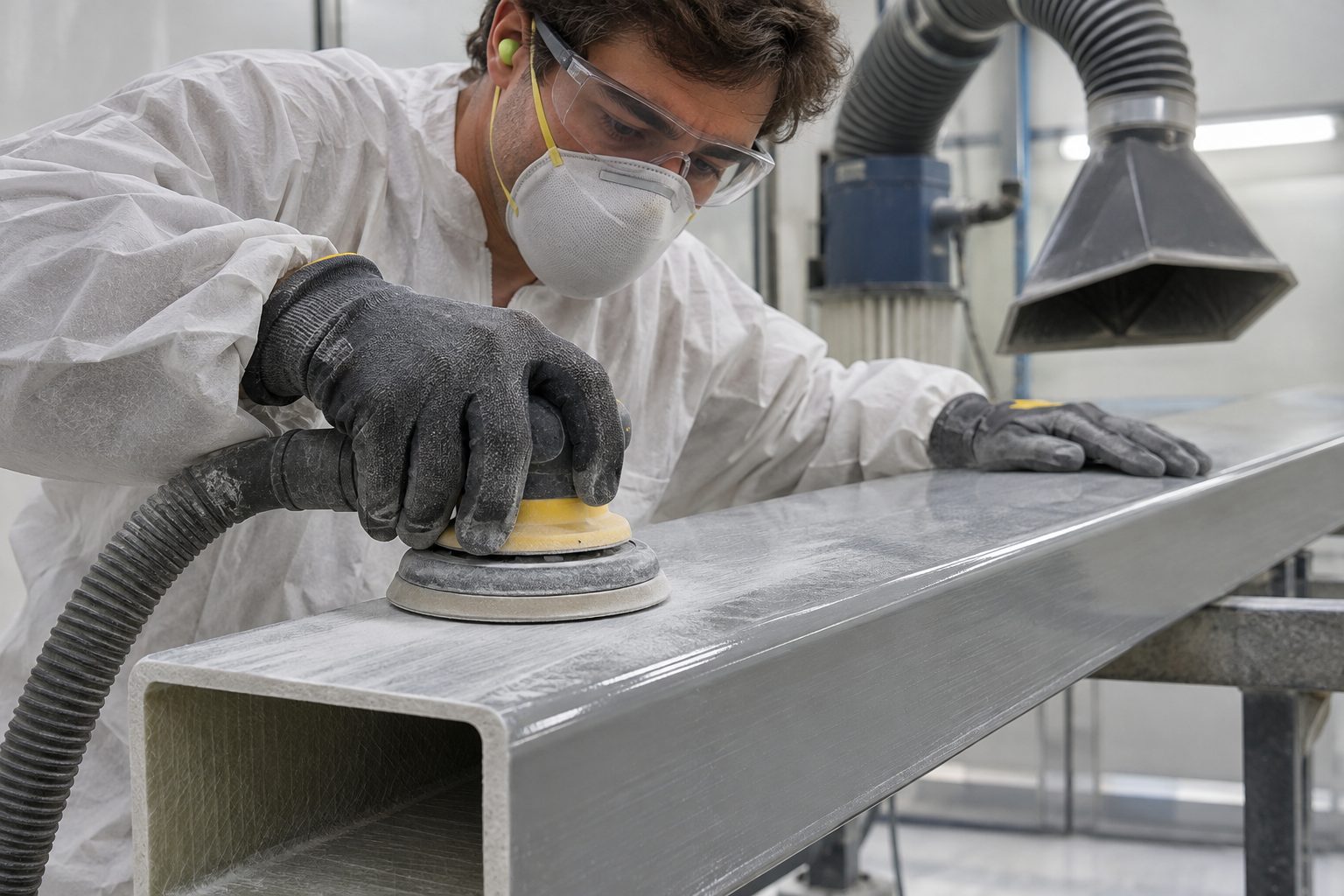
Prepare FRP in five steps: degrease, clean, sand, remove dust and inspect. Skipping any of them is the usual reason paint flakes off.
- Degrease: wipe with a solvent cleaner made for fiberglass to remove release agent, wax and oil. Interlux suggests a water test: after rinsing, water should spread evenly across the surface instead of beading.
- Clean: KTA-Tator recommends pressure washing with detergent as needed; low pressure, up to 5,000 psi as defined by SSPC, is enough. Where washing is not practical, scrub with detergent and rinse with clean water. Let the surface dry fully.
- Sand: remove all gloss. Interlux uses 180–280 grit for this step. KTA-Tator warns that FRP is much softer than steel, so sand only to roughen the surface, not to remove material. If blasting, use a gentler media than for steel, such as plastic, walnut shell or corn cob.
- Remove dust: vacuum, blow down with clean air or wipe with a damp cloth.
- Inspect: look for glass fibres sticking out of the surface and remove them. KTA-Tator explains that fibres poking through the paint film cause pinholes.
Sanding FRP produces fine glass dust. Wear a respirator, gloves and eye protection, and work outdoors or with dust extraction.
What is the best primer and paint for FRP?
A bonding primer under a two-component polyurethane topcoat is the most reliable system for outdoor FRP. Pultrusion maker Fiberline recommends a two-component polyurethane paint at a low dry film thickness of 40–60 µm, after cleaning and priming (Fiberline).
| Coating | Strength | Limit | Best use |
|---|---|---|---|
| Two-component polyurethane | Excellent UV resistance; suitable outdoors | Needs careful mixing and ventilation | Outdoor grating, handrails, profiles |
| Epoxy | Good adhesion and chemical resistance | Poor UV resistance; chalks and fades in sunlight | Primer, or indoor topcoat; put polyurethane over it outdoors |
| Water-based acrylic | Good UV resistance and colour retention, easy to apply | Performance varies by product; may need a bonding primer | Light-duty and indoor areas |
| Gel coat | Same base resin as the part, with UV stabilisers and pigment | Applied in the factory or by sprayer, brush or roller | Refinishing and factory surfaces |
The table follows KTA-Tator’s comparison: epoxies “have poor UV resistance and will chalk and fade,” while urethanes “have excellent resistance to UV light and are suitable for outdoor service.” Always use the primer the topcoat maker specifies for fiberglass.
How do you paint FRP step by step?
Apply thin, even coats and follow the paint maker’s drying times. Thick coats sag and trap solvent.
- Prime: apply a bonding primer rated for fiberglass soon after preparation, before dust settles.
- Light sand (optional): Fiberline suggests sanding after priming for a higher-quality finish, to knock down any loose fibres.
- Topcoat: apply the polyurethane in thin coats. Interlux notes that two to three finish coats are normally needed.
- Cure: keep the part out of service until the coating is fully cured.
Test first. Paint a small offcut or hidden area, let it cure, and check adhesion before coating a whole platform.
Can you paint FRP grating with a gritted surface?
You can, but the paint fills the grit and lowers slip resistance. A gritted top works because sharp particles stand proud of the surface; a paint film rounds them over.
If a gritted walkway must be painted, ask the coating supplier for an anti-slip additive or a broadcast grit coat, and check slip resistance after coating. How slip claims should be tested is covered in FRP fire and slip performance.
For new projects it is simpler to order the colour you need. Machs molded fiberglass grating and pultruded profiles are made in custom colours, so the surface never needs paint.
How long does paint last on FRP?
How long paint lasts on FRP depends first on preparation, then on sun, chemicals and foot traffic. Poor adhesion is the usual cause of early failure, so a well-prepared surface is the best predictor of a long life. For expected service life, use the figure the coating maker gives for the system.
Inspect painted FRP when you inspect the structure. Touch up chips early, before moisture reaches bare fibres, and reseal any new cut edges or holes with a compatible resin. Resin choice for chemical areas is covered in the fiberglass resin selection guide, and long-term weathering in FRP grating service life.
FAQ
Can FRP be painted with ordinary house paint?
Not reliably. Without degreasing, sanding and a bonding primer, ordinary paint peels. Use a primer and topcoat the paint maker approves for fiberglass.
What primer should I use on FRP?
A bonding or adhesion primer specified for fiberglass by the topcoat maker. Epoxy primers are common under a polyurethane topcoat outdoors.
Do I need to sand FRP before painting?
Yes. Sanding removes the gloss so the primer can grip. Roughen the surface only; do not cut into the glass fibres.
Is FRP paintable after years outdoors?
Yes. Weathered FRP needs the same steps, plus extra cleaning to remove chalk and any loose fibres before priming.
Need FRP in a specific colour?
Tell us the RAL colour, product and quantity. Machs can colour grating, profiles and handrails in the resin, so no site painting is needed. Request a quote.