


Correctly specified FRP grating lasts for decades in conditions that destroy steel within a few years. The MACHS grating installed at Jebel Ali Port, Dubai, in 2009 is still in service after more than 15 years of salt spray, UV and summer heat. Actual life depends less on the grating type than on four controllable factors: the right resin, UV protection, sealed cut edges, and staying within the load and span limits. We do not publish a single lifespan figure, because a number without those conditions would not mean anything.
Key Takeaways
- Field evidence: our grating at Jebel Ali Port (installed 2009) and Glenelg Wharf, Adelaide (about ten years) is still in use.
- FRP does not rust, so its life is not limited by coating breakdown the way galvanized steel is.
- The usual life-shorteners are the wrong resin, unprotected UV exposure, unsealed cuts, overloading and loose clips.
- Regular inspection is required anyway: OSHA 1910.22 says walking-working surfaces must be inspected and kept in safe condition.
What does field evidence show about FRP grating life?
Three long-running MACHS installations are all in harsh coastal environments. Jebel Ali and Glenelg are confirmed still in use:
| Project | Installed | Environment | Products |
|---|---|---|---|
| Jebel Ali Port, Dubai, UAE | 2009 | Marine, high UV, extreme heat | Molded grating, handrails, stair treads, supports |
| Sohar Port and Freezone, Oman | 2011 | Salt air and chemical vapour at a storage facility | Grating and reinforced handrail system |
| Glenelg Wharf, Adelaide, Australia | about 10 years ago | Public waterfront, heavy foot traffic | FRP stair and platform system |
In each case FRP replaced or avoided steel because of corrosion. Read the Glenelg Wharf case study.
Why does FRP outlast steel in corrosive areas?
Steel’s life is set by its coating. Once the zinc or paint is gone, the steel corrodes. The American Galvanizers Association shows that hot-dip galvanizing reaches first maintenance much sooner in industrial and marine atmospheres than in rural ones. FRP has no coating to lose. Its resin is the barrier through the whole section, so the questions are only whether that resin suits the chemicals and how well the surface resists UV. A full comparison is in FRP grating vs steel grating.
What shortens FRP grating life?
The wrong resin
A general-purpose resin in a strong acid or alkali area can soften, blister or pit. Specify VCF vinyl ester for heavy chemical exposure. See the chemical resistance guide.
UV exposure
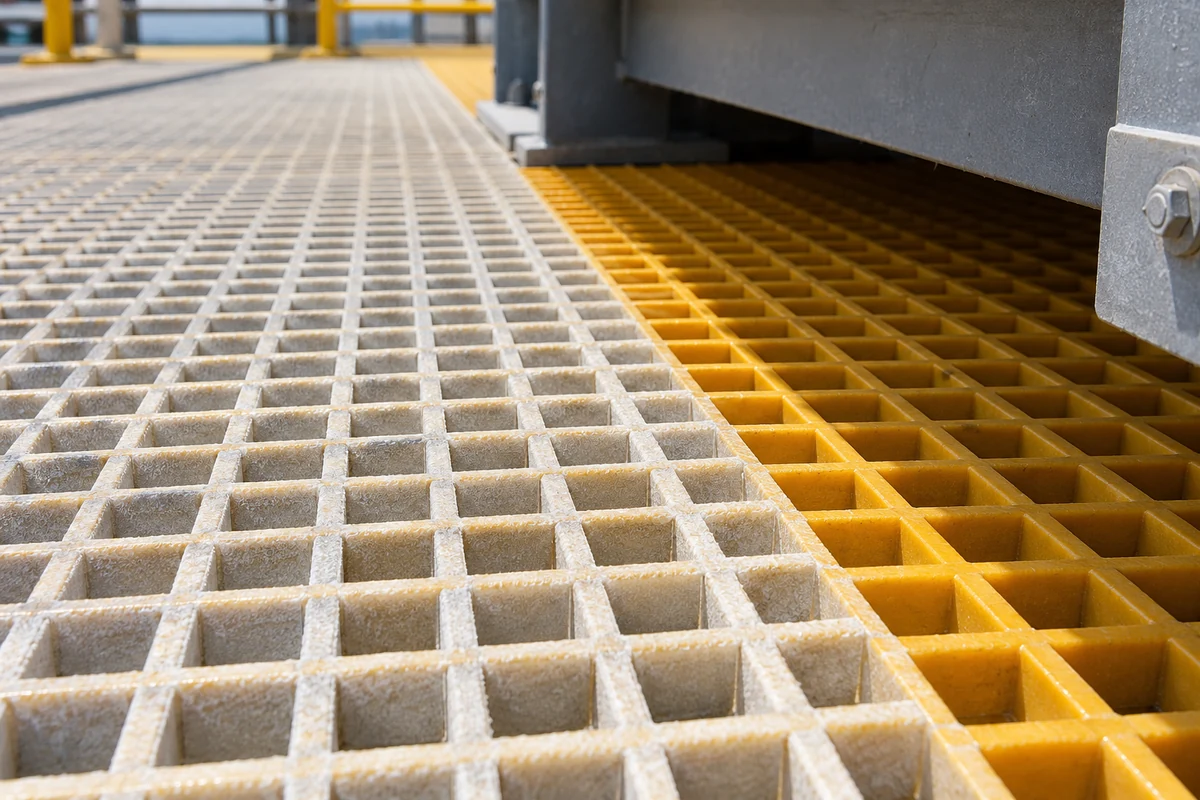
Sunlight slowly erodes the resin at the surface. The first signs are fading and chalking, and later glass fibres can show at the surface (“fibre bloom”). This is mostly cosmetic at first, but it roughens the surface over time. UV-inhibited resins slow it down. UV resistance is tested by accelerated weathering to ASTM G154.
Unsealed cut edges
Cutting exposes glass fibres. In chemical areas, unsealed edges let fluids wick into the panel. Seal every cut with resin. See how to cut fiberglass grating.
Overloading and long spans
Grating that deflects too much under daily loads wears faster at the supports and clips. Keep spans within the load tables. Our 38 mm molded grating, for example, deflected 3.45 mm at a 914 mm span under 4.8 kN/m², but 12.17 mm at 1219 mm. See the load capacity data.
Loose or missing clips
Panels that move under foot traffic and vibration wear their bearing edges. Check clips regularly. Common installation errors are listed in why FRP grating installations fail.
How should FRP grating be inspected?
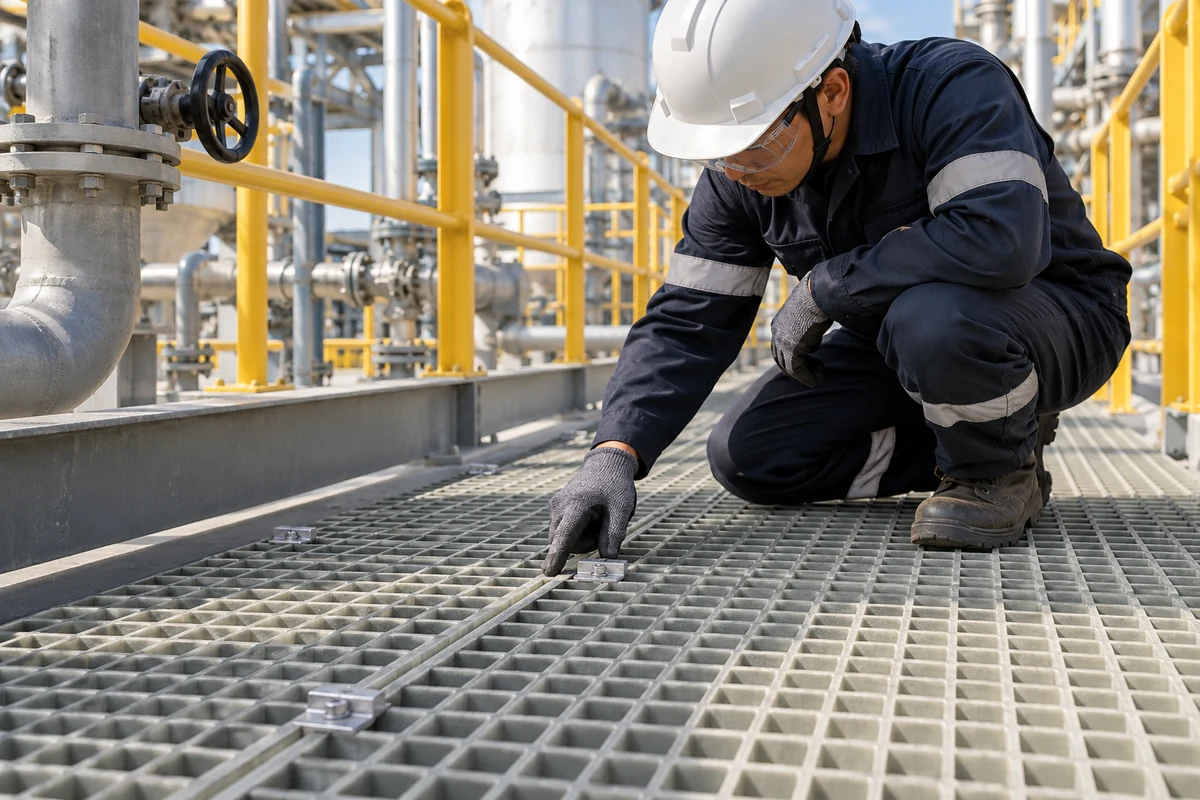
OSHA 1910.22 requires walking-working surfaces to be inspected regularly and as needed, and kept in safe condition. For FRP grating, check:
- Clips: present and tight, especially near vibrating equipment
- Cut edges: still sealed, no swelling or delamination
- Surface: grit worn smooth, cracks, soft spots, exposed fibres
- Deflection: any panel that feels bouncy under foot
- Supports: corrosion on steel frames under the grating, which often fail before the FRP does
- After fire or chemical spills: remove affected panels from service until checked
How do you get the longest life from FRP grating?
- Choose the resin for the worst chemical exposure, not the average one.
- Specify UV-inhibited resin for outdoor grating.
- Keep spans within the load table for your deflection limit.
- Seal every cut edge, including cuts made on site.
- Use enough clips and check them after the first months in service.
- Wash off grit and chemical residue as part of normal housekeeping.
Tell us the chemicals, temperatures and UV exposure on your site. We recommend the resin and surface that suit them, rather than the cheapest option.
See FRP grating options →Frequently Asked Questions
How many years does FRP grating last?
There is no single figure, because life depends on resin, UV, loads and maintenance. Our installation at Jebel Ali Port has been in service since 2009 in a hot marine environment.
Does faded FRP grating need replacing?
Not on its own. Fading is a surface change. Replace panels if you find cracks, soft spots, delamination, worn-out grit in wet areas, or deflection beyond your limit.
Can damaged FRP grating be repaired?
Small surface damage and unsealed edges can be resealed with resin. Panels with cracks through the bars or heat damage should be replaced.