

Short Answer
No, fiberglass is not conductive. Both the glass fibres and the resin are electrical insulators, which is why FRP is used for ladders, grating, handrails and cable supports near live equipment. It can carry current only when its surface is wet or dirty, when metal parts are fitted to it, or when it is made with carbon fibre instead of glass.
Key Takeaways
- Glass-fibre FRP is an electrical insulator; steel and aluminium are conductors.
- Strongwell lists a dielectric strength of 35 kV/in lengthwise for its EXTREN shapes.
- Water, dirt and metal fittings can create a path for current.
- Carbon-fibre composites conduct; check the fibre before you rely on insulation.
Does fiberglass conduct electricity?
Fiberglass does not conduct electricity under normal, dry conditions. Glass has no free electrons to carry current, and the polyester or vinyl ester resin that binds the fibres is also an insulator. The combination behaves as one insulating material.
That is the main electrical difference from metal. Steel and aluminium conduct current through their whole body, so a person touching a steel rail that contacts a live part is in the circuit. A fiberglass rail in the same position does not complete the circuit.
How well does fiberglass insulate? The dielectric data
Pultruded fiberglass withstands tens of kilovolts per inch before it breaks down. Strongwell publishes these minimum ultimate coupon values for its EXTREN Series 500, 525, 600 and 625 structural shapes (Strongwell Design Manual, Section 3):
| Property | Test method | Value |
|---|---|---|
| Dielectric strength, lengthwise | ASTM D149 | 35 kV/in (about 1.4 kV/mm) |
| Dielectric strength, perpendicular to the face | ASTM D149 | 200 volts/mil (about 7.9 kV/mm) |
| Arc resistance, lengthwise | ASTM D495 | 120 seconds |
| Thermal conductivity | ASTM C177 | 4 BTU-in/ft²/hr/°F |
Treat these as guide values, not a guarantee for every product. They are coupon results for one maker’s shapes, and the figure for a given part depends on its resin, glass content, thickness and test conditions. For an electrical specification, ask the supplier for a dielectric test on the actual product.
Dielectric strength is the voltage a material can withstand before it breaks down and lets current through, divided by its thickness. Arc resistance measures how long the surface resists forming a conductive track under an electric arc.
When can fiberglass conduct electricity?
Fiberglass itself stays an insulator, but four conditions can still create a path for current. Each one is about the surface or the parts attached, not the laminate.
- Water on the surface: a wet film, especially salt water, can carry current across the outside of an insulating part.
- Dirt and contamination: conductive dust, metal particles, soot or chemical residue form a path along the surface. Clean FRP insulates better than dirty FRP.
- Metal fittings: steel bolts, rivets, brackets and anchors conduct. An FRP ladder or rail with metal hardware is only as insulating as the gap between those metal parts.
- Carbon fibre or conductive additives: carbon-fibre composites conduct, and some glass-fibre products are deliberately coated to be anti-static. Confirm the fibre and any coatings.
Weathering matters too. When UV wears away the resin-rich surface and exposes glass fibres, the surface holds more moisture and dirt. Keeping outdoor FRP clean and intact keeps its insulating surface working.
Why is FRP specified around electricity?
FRP is specified near live equipment because it removes one way a worker can become part of a circuit. In the US, OSHA rule 29 CFR 1910.333(c)(7)(i) states that portable ladders “shall have nonconductive siderails” where the employee or the ladder could contact exposed energized parts (OSHA 1910.333). Fiberglass side rails are the common way to meet it.
The same reasoning extends to fixed structures:
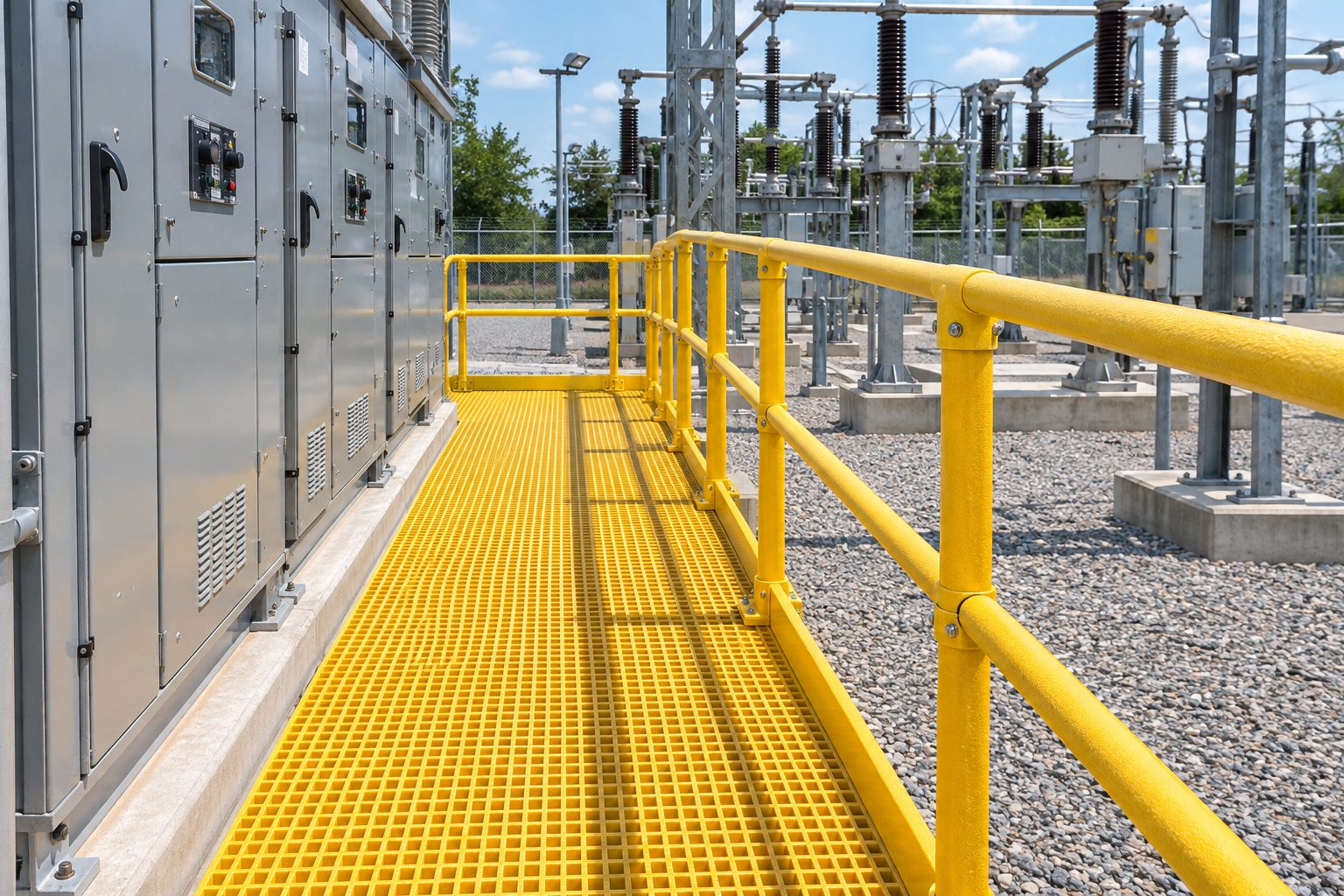
- Substations and switch rooms: FRP grating, platforms and handrails around transformers and switchgear.
- Railways: trackside walkways, handrails and cable troughs near overhead lines and third rails. See GRP trackside walkways and cable troughs.
- Cable support: FRP profiles carrying cables, where metal supports would need earthing.
- Water and wastewater plants: wet areas around pumps and motors, where FRP also avoids corrosion.
FRP does not replace electrical safety rules. Clearances, lockout, earthing of metal parts and protective equipment still apply; a non-conductive walkway lowers one risk, it does not remove the others.
Fiberglass vs steel, aluminium and carbon fibre: which conducts?
Of the four common structural materials, only glass-fibre FRP is an insulator. The others all conduct electricity.
| Material | Electrically conductive? | Magnetic? | Note |
|---|---|---|---|
| Fiberglass (glass-fibre FRP) | No | No | Insulator; check surface condition and metal fittings |
| Carbon steel | Yes | Yes | Needs earthing near live parts; rusts |
| Aluminium | Yes | No | Conducts well; corrodes in some chemicals |
| Carbon-fibre composite | Yes | No | The carbon fibres conduct |
The full material comparison, including weight and stiffness, is in fiberglass vs steel vs aluminum.
Is fiberglass magnetic?
No, fiberglass is not magnetic. Glass and polymer resin contain no iron, so FRP does not attract magnets or disturb magnetic fields. That makes it useful near sensitive instruments and equipment that strong magnetic fields affect.
The exception, again, is hardware. Carbon steel bolts in an FRP structure are magnetic; use non-magnetic stainless or fiberglass fasteners where that matters. See screws for fiberglass.
Is fiberglass a good thermal insulator?
Yes, solid fiberglass conducts heat far more slowly than metal. Strongwell lists a thermal conductivity of 4 BTU-in/ft²/hr/°F for its EXTREN shapes, so FRP handrails feel less hot or cold to the touch than steel ones, and FRP members create less of a thermal bridge.
Note the difference from fiberglass insulation batts. Those insulate through trapped air between loose fibres; solid FRP is a dense laminate whose low conductivity comes from the glass and resin themselves.
How do you keep FRP non-conductive in service?
Keep the surface clean and intact, and control the metal parts. A short routine protects the insulating benefit:
- Specify the fibre: confirm glass fibre, not carbon, and ask for dielectric test data where insulation is a design requirement.
- Choose fasteners deliberately: use non-metallic or stainless fasteners, and keep metal parts apart so they do not form a continuous path.
- Clean regularly: remove dirt, oil and conductive dust.
- Inspect for weathering: recoat or replace surfaces where glass fibres are exposed. Coating steps are in can you paint FRP.
- Seal cut edges: bare fibres at cuts and holes absorb moisture.
FAQ
Is fiberglass an insulator or a conductor?
An insulator. Glass-fibre FRP does not conduct electricity when clean and dry.
Can a fiberglass ladder conduct electricity?
The fiberglass rails do not, but a wet or dirty surface and the metal rungs, rivets or hinges can. Keep the ladder clean and dry and check it before use.
Is FRP grating non-conductive?
Yes, glass-fibre FRP grating is non-conductive. The steel or stainless clips that fix it are conductive, so treat them as metal parts in your electrical design.
Does fiberglass block radio signals?
Glass-fibre FRP is generally transparent to radio frequencies, which is why it is used for antenna covers. Carbon fibre, by contrast, blocks and reflects signals.
Building near live equipment?
Machs supplies fiberglass grating, handrail systems and platforms and walkways for electrical and rail sites. Send your layout and we will propose a non-metallic design. Contact Machs.