

Short Answer
Most FRP grating problems in the field come from installation, not the material. The seven common mistakes are: unsealed cut edges, too few clips, spans that are too long, poor support bearing, the wrong resin, no plan for UV exposure, and no inspection routine. Each one shows clear warning signs you can check on site.
Key Takeaways
- Seal every cut edge. Bare glass fibers let moisture in.
- Too much deflection pries clips loose. Deflection over about 1/2 in (12 mm) is not advised (Strongwell).
- Panels need full, level bearing on their supports.
- Use the table below to diagnose a problem from its symptom.
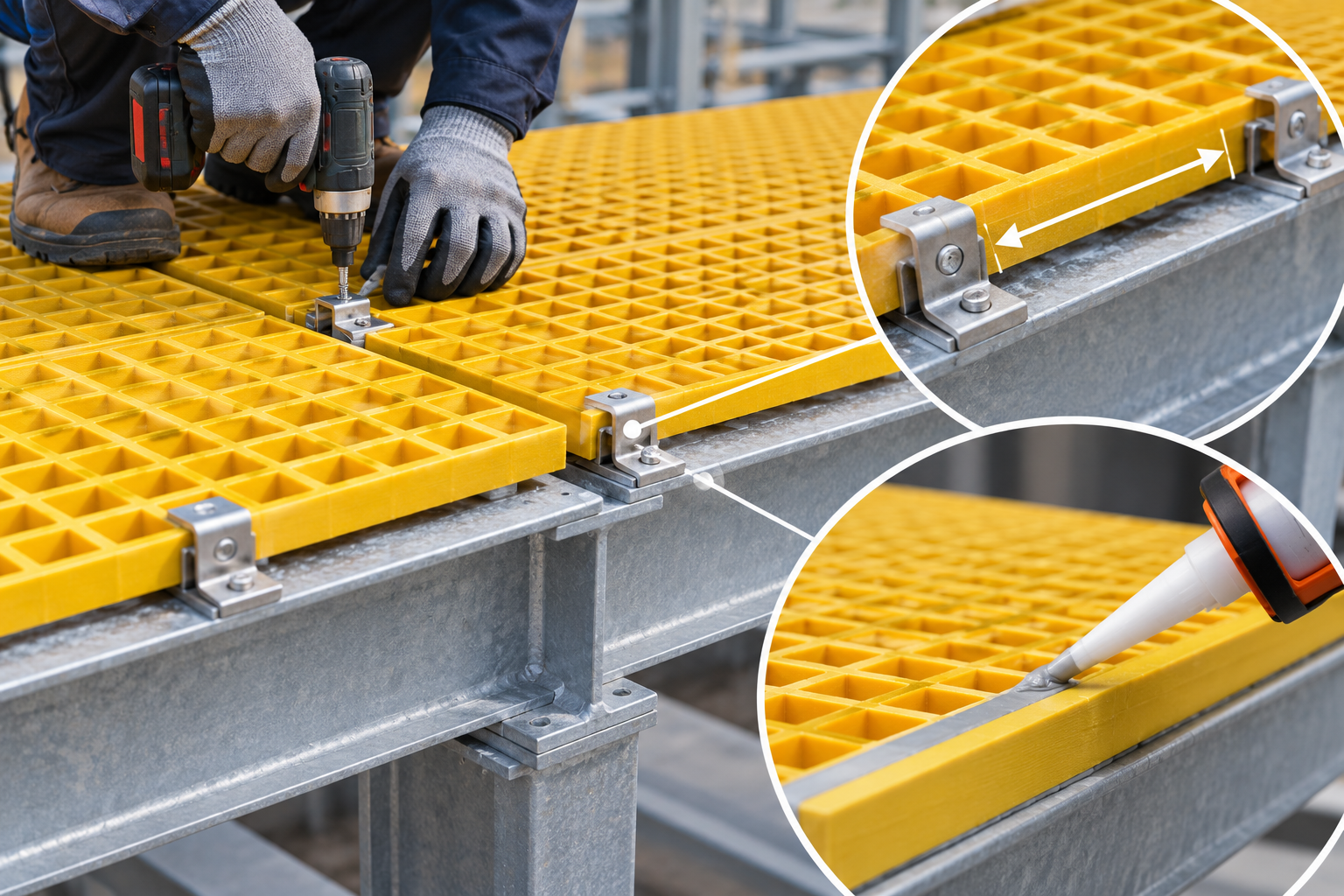
What are the warning signs, and what causes them?
Match the symptom you see to its most likely cause.
| Symptom | Likely cause | Mistake # |
|---|---|---|
| Swelling, whitening or fibers showing at cut edges | Unsealed cut edge | 1 |
| Panels rattle, shift or lift at one corner | Too few clips or loose clips | 2 |
| Floor feels bouncy; clips keep loosening | Span too long for the panel height | 3 |
| Panel rocks or cracks near supports | Poor or uneven bearing | 4 |
| Surface softening, blistering or pitting | Wrong resin for the chemicals present | 5 |
| Chalky surface, faded color, fibers showing on top | UV weathering | 6 |
| Small problems growing into failures | No inspection routine | 7 |
1. Why must cut edges be sealed?
Cutting exposes bare glass fibers, which draw moisture and chemicals into the panel. In wet or chemical service, this is where damage starts.
- Coat every cut with a resin that matches the panel.
- Seal on site right after cutting, while the surface is clean and dry.
How to cut and seal: how to cut fiberglass grating.
2. How many clips are enough?
Follow the supplier’s clip layout. Every panel needs clips at its corners and along its supports, never just one or two. Too few clips let panels move, and a moving panel wears and loosens its fixings.
Clip types and spacing: grating clips guide.
3. What happens if the span is too long?
The panel deflects too much. It feels unsafe, and the bending pries clips loose. For pedestrian comfort, deflection is often limited to about 1/4 in (6 mm) (Strongwell).
- Check the load table for your panel height at the actual span.
- Fix it by adding an intermediate support or using a taller or pultruded panel.
Specify it right from the start with our RFQ checklist.
4. Why does support bearing matter?
Panels need full, level contact on each support. Uneven supports make panels rock, which concentrates stress and cracks them over time.
- Level the support frame before laying the panels.
- Give enough bearing length at each end, as shown in the supplier’s installation guide.
- Bearing bars must run across the supports, not parallel to them.
5. How does the wrong resin cause failure?
Each resin resists a different range of chemicals. A general-purpose resin in an aggressive chemical area can soften, blister or pit. Check the chemical list against the resin before ordering.
6. Is UV damage a failure?
Surface weathering is common outdoors: fading, then chalking, then fibers showing on the surface. It usually starts at the surface and does not mean the panel has lost its strength. It does reduce appearance and grip over time.
- Specify UV inhibitors or a surface veil for outdoor use.
- Recoat weathered surfaces where needed.
7. What should a routine inspection check?
A simple inspection catches small problems before they grow. Check:
- Clips: present and tight
- Cut edges: still sealed
- Surface: grit worn, cracks, soft spots
- Deflection: any panel that feels bouncy
- Supports: corrosion on steel frames under the grating
Use a recognized walking-surface standard for your inspections, such as OSHA 1910.22 in the U.S. Visual defect terms for pultruded parts are defined in ASTM D4385.
FAQ
Can damaged FRP grating be repaired?
Small surface and edge damage can be resealed. Cracked or soft panels should be replaced.
Why do my grating clips keep loosening?
Usually because the span is too long or the supports are uneven, so the panel flexes. Fix the cause, not just the clip.
Is fading a safety problem?
Not by itself. Watch for worn grit, which reduces slip resistance.
Need help with a problem installation?
Send photos of the symptom, the span and the panel type. Our engineers will tell you the likely cause and the fix. Contact Machs.