

Short Answer
To buy FRP grating from China safely, verify five things before you pay a deposit: glass and resin content (burn-off test), a fire test report you can trace to a real lab, dimensional tolerance on a real sample, the factory’s own QC records, and a signed sample that becomes the acceptance standard. Price differences between Chinese suppliers usually come from these five points, not from labor cost.
Key Takeaways
- Ask for a burn-off (ignition loss) test to ASTM D2584. It shows how much glass is really in the panel.
- A fire rating is only valid if the test report names the lab, the standard, the resin and the exact product tested.
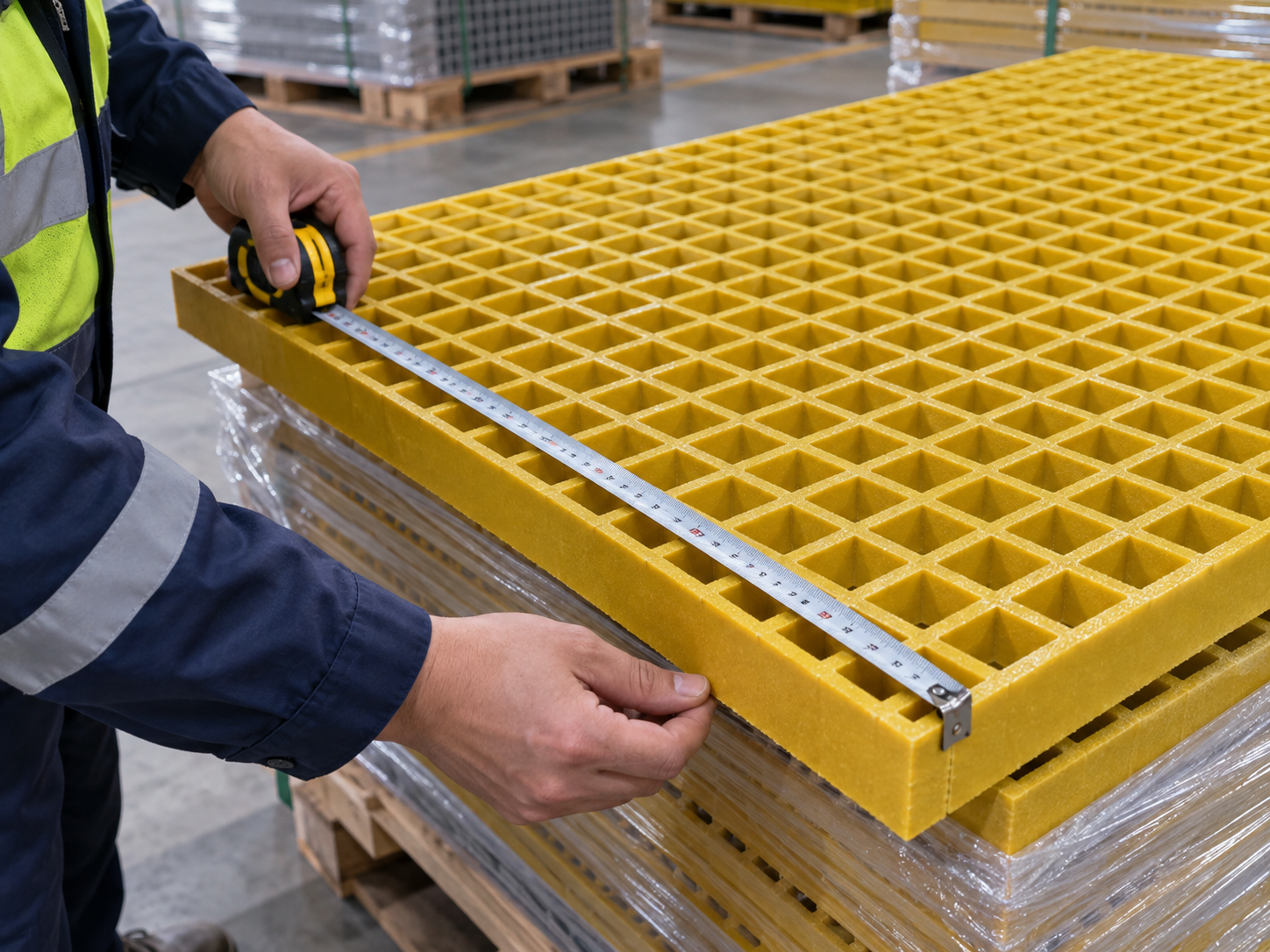
- Measure a sample yourself: height, mesh size, flatness and squareness.
- Keep one signed, sealed sample. It is the reference for every later shipment.
- Third-party inspection before loading costs little compared with a rejected container.
Why does FRP grating quality vary so much between suppliers?
Quality varies because the cheapest way to cut cost is invisible: less glass, more filler, or a cheaper resin. A panel can look identical and still carry less load, fade faster outdoors, or fail a fire test.
- Glass content controls stiffness and strength.
- Resin type controls chemical resistance and fire behavior.
- Additives (UV inhibitor, fire retardant) are easy to leave out and hard to see.
How do you check glass and resin content?
Use a burn-off test. ASTM D2584 heats a cured sample until the resin burns away. The weight lost is the resin content. The weight left is mainly glass.
- Ask the supplier for the burn-off result of the exact product you are buying.
- Cut a small piece from your sample and send it to a local lab to confirm the number.
- Heavy mineral fillers can distort the result, so ask whether filler is used and how much.
How do you know a fire test report is real?
A real report can be traced. Before you accept any fire rating, such as a flame spread class to ASTM E84, check the following:
- The lab name and report number. Contact the lab to confirm the number exists.
- The standard and the edition used.
- The product description: resin type, panel height, mesh size.
- The test date and the company named as the client.
A report for a different resin or a different panel height does not cover your product.
What should you measure on the sample?
Measure the dimensions that affect installation and load. Small errors add up across a whole platform.
| Check | Why it matters |
|---|---|
| Bar height (panel thickness) | Load capacity and deflection depend directly on it |
| Mesh size and bar width | Affects load, weight, and whether small objects fall through |
| Flatness and warping | Warped panels rock, loosen clips and create trip edges |
| Squareness and length | Panels must fit the support frame without forcing |
| Surface grit coverage | Uneven grit means uneven slip resistance |
| Color consistency | Batches should match on the same project |
For load and deflection testing methods, see our complete guide to FRP grating performance tests.
What should you look for in a factory audit?
Look for proof that quality is controlled every day, not just on the sample. An ISO 9001 certificate is a starting point, not proof.
- Incoming material records: resin and glass batch numbers you can trace to a finished panel.
- In-house lab: equipment to test load, burn-off and hardness, and records of recent tests.
- Molds in good condition: damaged molds cause warping and rough edges.
- Curing control: under-cured panels feel tacky and lose strength.
- Finished-goods inspection: a written checklist, not a quick look.
You can review our FRP laboratory and certificates before you visit.
How should you protect yourself on the first order?
Make the approved sample part of the contract, and inspect before loading.
- Approve a sample and keep one sealed piece on each side.
- Write the key specs into the purchase order: resin, height, mesh, grit, color, tolerance, fire rating.
- Book a third-party pre-shipment inspection against those specs.
- Ask for batch numbers on every panel label.
- Start with a smaller trial order before a full project.
Not sure what to write in the purchase order? Use our FRP grating RFQ checklist.
FAQ
Is FRP grating from China lower quality?
No. China makes both good and poor FRP grating. The difference is the factory’s materials and QC, which you can verify with the checks above.
Can I rely on a supplier’s own test report?
Use it as a starting point. Confirm key results, such as glass content, with your own sample test or a third-party inspection.
How many samples should I ask for?
At least two of each product: one to test or cut, and one to keep sealed as the reference.
Talk to our QC team
Send us your specification and we will send test records and a sample for the exact product you need. Contact Machs.