

Short Answer
For rail trackside work, specify GRP walkways, handrails and cable troughs for four reasons: they do not conduct electricity, they do not rust, they are light enough to install during short possessions, and they need no scrap-metal value protection. A good specification covers the profile standard (BS EN 13706), fire performance, design load, slip resistance and the rail owner’s product approval.
Key Takeaways
- Non-conductive GRP lowers the risk near electrified lines (overhead line and third rail).
- Light panels and profiles can be carried by hand, which suits short track possessions.
- GRP has no scrap value, so it does not attract metal theft.
- In the UK, check product acceptance against the Network Rail standards catalogue and project requirements.
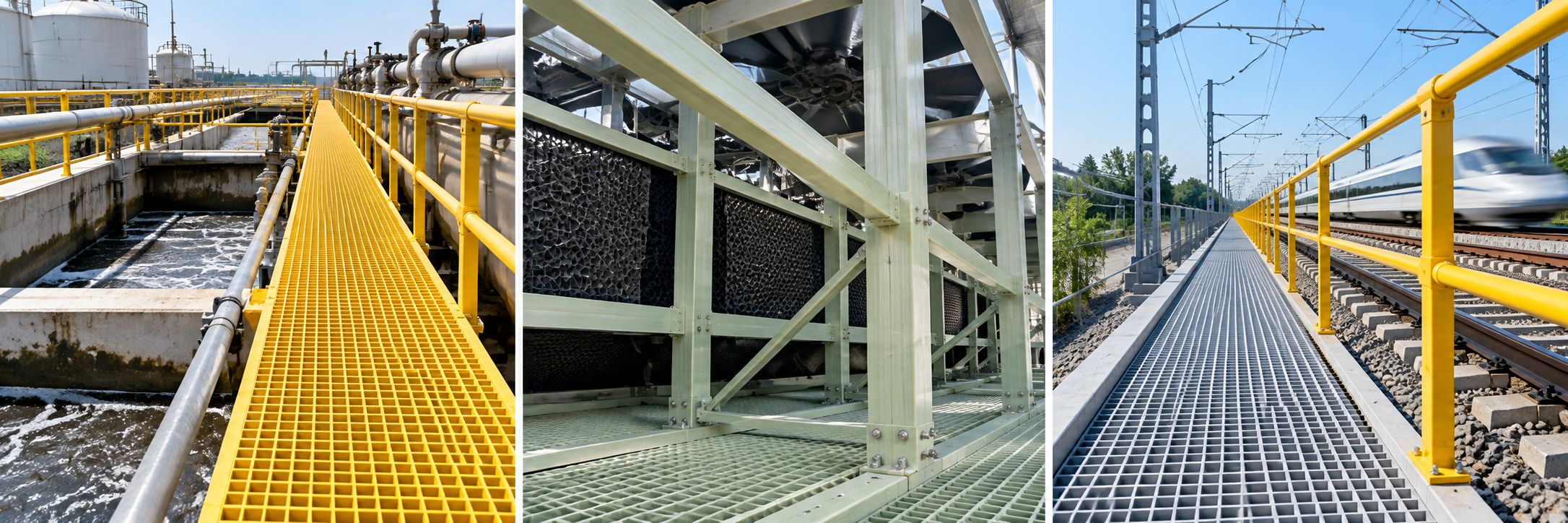
Why do rail projects use GRP instead of steel?
GRP removes the main problems of steel near track: conductivity, corrosion, weight and theft.
| Need | GRP | Steel |
|---|---|---|
| Electrical safety near live lines | Non-conductive | Conductive; needs bonding and earthing |
| Corrosion from weather and ballast water | Does not rust | Needs galvanizing and repairs |
| Installation in short possessions | Light, hand-carried | Often needs lifting equipment |
| Theft risk | No scrap value | Target for metal theft |
See our railway infrastructure solutions.
What should a GRP trackside walkway specification include?
List performance, not just dimensions.
- Profile standard: pultruded profiles to BS EN 13706, which grades profiles by effective flexural modulus (E23 or E17).
- Design load and deflection: the walkway load, the span between supports and the deflection limit.
- Slip resistance: grit-top surface for wet and icy conditions.
- Fire performance: the fire test and class the project requires, with a matching report.
- Handrail: height, post spacing and load resistance. See FRP handrail standards.
- UV resistance: UV-stabilized resin or surface veil for long outdoor life.
- Approval: the rail owner’s product acceptance, where required.
What should you specify for GRP cable troughs?
Specify troughs by cable type, route and load, and by where they sit (at ground level, raised on posts, or mounted on structures).
- Width and depth for the number and size of cables.
- Lid load: whether people will walk on it, and whether it doubles as a walkway.
- Mounting: ground level, post-elevated, bridge parapet or tunnel wall.
- Cable type: power, signalling or telecoms, and any separation rules.
- Fire and smoke: this matters most in tunnels and stations.
How are GRP walkways installed trackside?
They are prefabricated, carried in by hand and bolted to supports. This keeps possession time short.
- Fix the supports: posts, brackets or cantilever frames.
- Lay the grating panels or plank flooring and clip them down. See grating clips.
- Fit the handrail posts and rails.
- Seal any site-cut edges. See cutting FRP grating.
Working near the line is safety-critical. Follow the infrastructure manager’s rules and guidance from the rail safety regulator, such as the Office of Rail and Road (ORR) in Great Britain.
FAQ
Is GRP strong enough for rail walkways?
Yes, when it is sized for the span and load. GRP is designed on stiffness, so check deflection at your support spacing.
Does GRP need earthing near overhead lines?
GRP itself is non-conductive. Metal fixings and any metal parts still follow the project’s earthing and bonding design.
How long does GRP last outdoors?
With UV-stabilized resin or a surface veil, GRP keeps its strength outdoors for a long service life, although the surface may weather over time.
Specify GRP for your rail project
Send your drawings, spans and approval requirements. We will propose walkway, handrail and trough details with test reports. Contact our team.