

When choosing FRP grating for industrial platforms, safety standards are not optional — they’re essential.
OSHA and ISO guidelines define how walkways, platforms, and stairs must perform to protect workers and ensure long-term reliability.
This article gives you a clear overview of how FRP grating meets these standards and what you should look for before purchasing.
OSHA Requirements for Industrial Platforms and Walkways
In the United States, the Occupational Safety and Health Administration (OSHA) sets safety regulations for all industrial platforms and walking surfaces.
FRP grating, when properly designed and installed, fully complies with these requirements.
Key OSHA points related to gratings include:
OSHA 1910.22 – Walking surfaces must be firm, stable, and slip-resistant.
OSHA 1910.28 – Platforms higher than 4 feet require guardrails or fall protection.
OSHA 1910.29 – Specifies the minimum load and height for guardrails (42 ± 3 inches).
FRP grating naturally supports these safety needs.
It provides a non-slip surface, excellent load-bearing performance, and resistance to corrosion, making it suitable for harsh environments such as chemical plants, ports, and wastewater treatment facilities.
ISO and ASTM Standards for FRP Grating
Outside the U.S., international projects follow ISO and ASTM standards to ensure structural safety and product quality.
Common standards include:
ISO 14122-2 / 14122-3 – Safety of fixed platforms, stairs, and walkways.
ISO 9001:2015 – Quality management system certification.
ASTM E84 – Fire resistance and flame spread test.
ASTM D543 – Chemical resistance test for nonmetallic materials.
ASTM D635 / D2843 – Flammability and smoke generation of FRP materials.
EN 13501 – European fire classification standard.
Complying with these ensures that FRP grating used in global projects meets mechanical strength, fire safety, and environmental durability requirements.
Typical Safety Tests for FRP Grating
Before a product reaches the market, reputable manufacturers conduct several key tests:
Load & Deflection Test – Measures strength and stiffness under load.
Slip Resistance Test – Evaluates friction level on wet or oily surfaces (ASTM E303).
Fire Test – Rates flame spread and smoke density (ASTM E84).
Impact Test – Ensures panels resist sudden shocks or drops.
UV and Weathering Test – Checks long-term performance in outdoor conditions.
FRP gratings that pass these tests offer predictable and safe performance for decades.
Why Compliance Matters to Buyers
For industrial buyers and project contractors, verified compliance is more than paperwork — it’s risk management.
A compliant FRP grating means:
Safe working conditions for employees
Easier approval during project inspections
Longer service life with fewer failures
Fewer liabilities for accidents or replacements
Many global projects — from port walkways to refinery platforms — now require ASTM and ISO certificates as part of procurement documentation.
Choosing certified FRP products helps you avoid delays, rework, or costly retrofits later.
How Machs FRP Ensures Standard Compliance
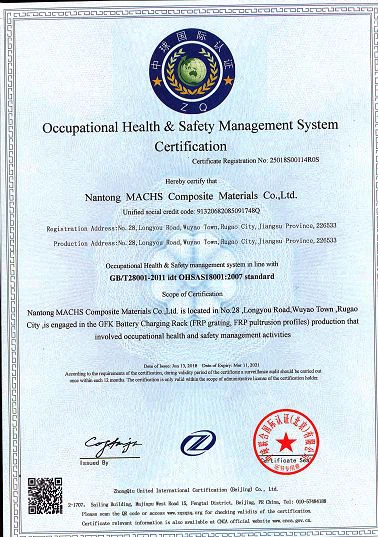
At Machs, every FRP grating is manufactured under ISO 9001 quality control and tested according to ASTM and ISO protocols.
Our molded and pultruded gratings are designed to:
Meet OSHA 1910.22 slip resistance and load criteria
Achieve Class 1 fire rating under ASTM E84
Pass chemical resistance testing for industrial applications
This makes Machs FRP suitable for projects that demand strict safety, corrosion resistance, and low maintenance.
Conclusion
Understanding OSHA and ISO safety standards helps you choose FRP gratings that perform reliably and pass inspection without issues.
These standards define what “safe and durable” truly means — from slip resistance to fire safety and load capacity.
If your project requires certified and compliant FRP products,
👉 Contact Machs FRP for documentation and technical support.
All our gratings are designed, tested, and manufactured to meet the world’s leading safety standards.