
Composite fabrication methods vary widely in cost, strength, production speed, and design flexibility. Selecting the right process determines project success. Machs FRP specializes in custom pultrusion and compression molding for industrial applications.
Choosing the Right Fabrication Method
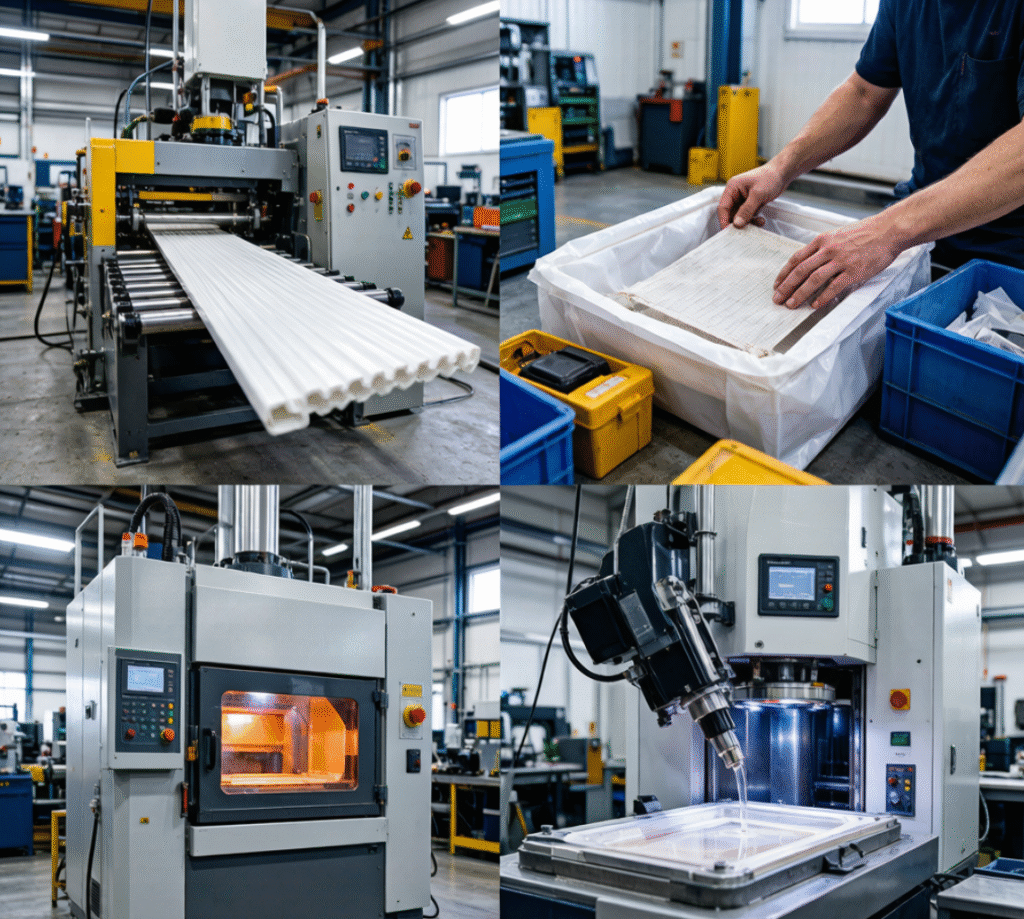
The four primary composite fabrication methods each serve different production needs. The Wikipedia article on composite materials provides background on how these processes differ. Factors including part complexity, production volume, dimensional tolerance, and cost determine which method is optimal.
Pultrusion
Pultrusion is a continuous process for producing constant cross-section profiles: Fibers are pulled through a resin bath and then through a heated die. The profile cures continuously as it exits the die. Pultrusion delivers the highest fiber content (65-75%) of any fabrication method, resulting in maximum strength. Production speeds: 1-5 ft/min. Ideal for beams, channels, angles, tubes, and grating. Pultruded products have excellent dimensional consistency and surface finish. This is Machs FRP’s core manufacturing process — our FRP structural profiles are produced using advanced pultrusion technology.
Hand Lay-Up
Hand lay-up is the simplest and oldest composite fabrication method. Layers of fiber reinforcement (mat, woven roving, or fabric) are placed in an open mold and saturated with resin by hand using rollers or brushes. No special equipment is required beyond molds and hand tools. Cure is at room temperature. Advantages: Low tooling cost, large part capability, design flexibility. Disadvantages: Inconsistent quality, labor-intensive, slow cycle times, higher resin content (50-65%). Best for prototypes, low-volume production, large parts like boat hulls and storage tanks.
Spray-Up
Spray-up uses a chopper gun that simultaneously cuts fiberglass roving and mixes it with catalyzed resin, spraying both onto the mold surface. The operator controls thickness by the number of passes. Spray-up is faster than hand lay-up but produces parts with lower strength due to shorter fibers. Resin content: 60-70%. Applications include shower stalls, bathtubs, truck body panels, and small boat hulls. The OSHA safety regulations for styrene exposure are particularly relevant for open-mold processes like spray-up.
Compression Molding
Compression molding uses matched metal molds in a hydraulic press. Sheet Molding Compound (SMC) or Bulk Molding Compound (BMC) is placed between heated mold halves, and pressure forces the material to fill the cavity. Cycle times: 2-10 minutes. Excellent dimensional accuracy and surface finish. Both sides are smooth. High fiber content (30-50% by weight depending on formulation). Ideal for moderate to high volume production of complex shapes. Applications: automotive body panels, electrical enclosures, structural components, and appliance parts.
Resin Transfer Molding (RTM)
RTM uses two matched mold halves with dry fiber preform placed inside. The mold is closed and resin is injected under pressure. RTM produces parts with good surface finish on both sides. Cycle times: 10-60 minutes depending on part size. Fiber content: 50-65%. Lower tooling cost than compression molding. RTM is ideal for medium-volume production of complex parts. Applications: aerospace components, automotive parts, marine structures, and wind turbine blades. The ASTM D5687 standard provides guidance for composite fabrication quality control.
Cost Comparison
| Method | Tooling Cost | Part Cost (Low Vol) | Part Cost (High Vol) |
|---|---|---|---|
| Hand Lay-Up | $500-2,000 | $50-100/sq ft | $30-50/sq ft |
| Spray-Up | $500-3,000 | $30-60/sq ft | $20-40/sq ft |
| Pultrusion | $3,000-8,000 | $15-30/sq ft | $5-12/sq ft |
| RTM | $5,000-20,000 | $25-50/sq ft | $10-20/sq ft |
| Compression Molding | $10,000-50,000 | $20-40/sq ft | $3-8/sq ft |
Strength and Quality Comparison
Pultrusion produces the highest fiber volume fraction (65-75%) and therefore the highest strength-to-weight ratio. RTM and compression molding produce good quality with consistent fiber distribution. Hand lay-up has the most variability. Pultruded products from Machs FRP undergo in-house laboratory testing to verify mechanical properties. For applications requiring certified strength data, pultrusion or compression molding are recommended.
Production Volume Suitability
Low volume (1-100 parts): Hand lay-up or spray-up. Medium volume (100-10,000 parts): RTM or pultrusion. High volume (10,000+ parts): Compression molding or pultrusion. Pultrusion is unique in being economical for both low and high volumes due to its continuous nature and low tooling cost relative to output. Machs FRP offers flexible production options for any volume requirement.
Comparison Table
| Factor | Pultrusion | Hand Lay-Up | Spray-Up | RTM | Compression |
|---|---|---|---|---|---|
| Fiber content | 65-75% | 30-45% | 25-35% | 50-65% | 30-50% |
| Cycle time | Continuous | Hours | 1-2 hrs | 10-60 min | 2-10 min |
| Tolerance | ±0.005 in | ±0.030 in | ±0.030 in | ±0.010 in | ±0.005 in |
| Strength | Highest | Moderate | Low | High | High |
| Tooling cost | Moderate | Low | Low | Moderate | High |
FAQ
Which composite fabrication method is strongest?
Pultrusion produces the highest fiber content (65-75%) and therefore the highest strength-to-weight ratio of all composite fabrication methods.
What is the cheapest composite fabrication method?
Hand lay-up has the lowest tooling cost. For high volumes, pultrusion and compression molding have the lowest per-part cost.
What is the difference between pultrusion and RTM?
Pultrusion is a continuous process for constant cross-section profiles. RTM is a closed-mold batch process for complex 3D shapes.
Which process is best for high-volume production?
Compression molding (2-10 min cycles) and pultrusion (continuous) are best for high-volume production. Hand lay-up is too slow.
Expert Composite Fabrication from Machs FRP
Machs FRP specializes in pultrusion and compression molding for industrial applications. With 20+ years of experience and ISO9001 certification, we deliver precision composite products for demanding environments. Explore custom pultrusion or contact our engineering team for project consultation.