

In an era of automated pultrusion lines and high-pressure closed-mold processes, you might wonder: is hand lay-up dead? The answer may surprise you. Despite being the oldest FRP manufacturing method, hand lay-up and its cousin spray-up remain very much alive in specific applications.
This guide explains what these processes are, where they still excel, and why no modern FRP manufacturer can afford to abandon them entirely.
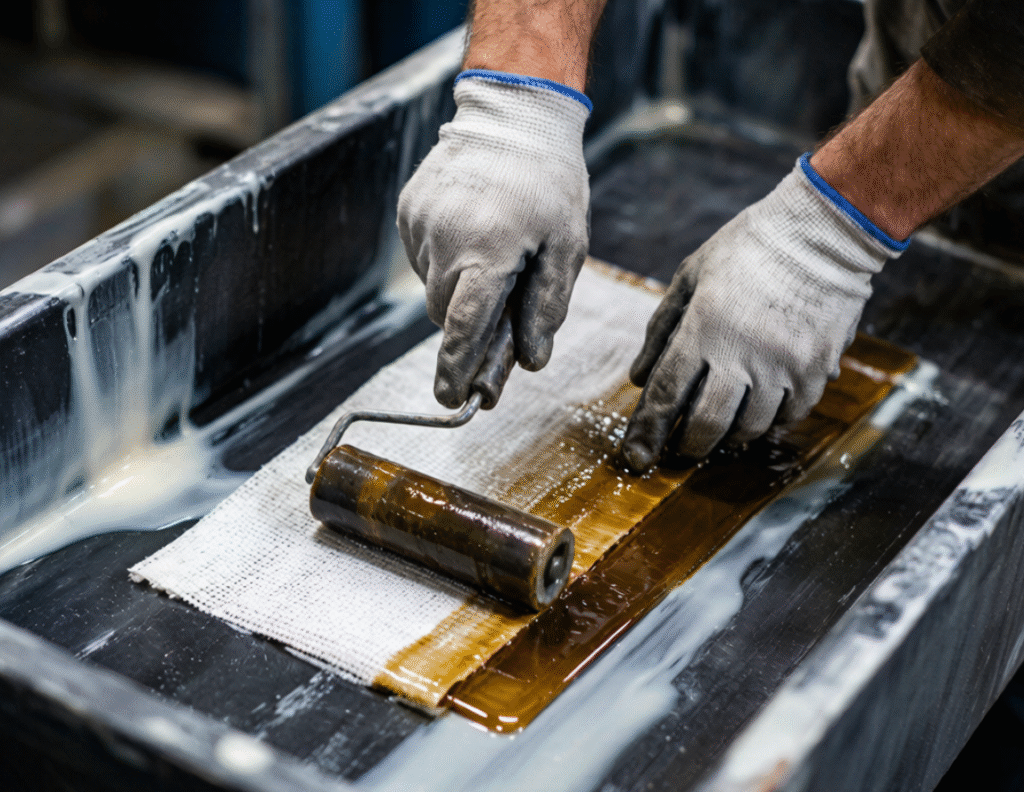
What Is Hand Lay-Up?
Key takeaway: Hand lay-up is the most flexible, lowest-cost FRP manufacturing method. It involves manually placing fiberglass reinforcement into an open mold and saturating it with resin — a process that requires skilled labor but virtually no specialized equipment.
In hand lay-up, the mold surface is first treated with gel coat (if a finished surface is needed). Layers of fiberglass mat, woven roving, or cloth are then placed into the mold by hand. Resin is applied with rollers or brushes, and the layers are consolidated to remove air bubbles. Part thickness is controlled by the number of layers applied.
Glass content in hand lay-up typically ranges from 25–35% by weight — lower than closed-mold processes, but sufficient for many applications. The ACMA composites standards provide guidelines for open-mold processing quality.
What Is Spray-Up?
Spray-up (also called the chopper gun process) is a faster alternative to hand lay-up. A specialized spray gun simultaneously cuts continuous fiberglass roving into short lengths (typically 25–50mm) and sprays them along with catalyzed resin onto the mold surface. The sprayed mixture is then consolidated with rollers.
Spray-up is faster than hand lay-up but produces lower mechanical properties because the fiber lengths are shorter. It is typically used for parts where cosmetics and moderate strength are acceptable — such as bathtubs, shower stalls, and truck body panels.
Comparison Table
| Factor | Hand Lay-Up | Spray-Up | Pultrusion (Closed Mold) |
|---|---|---|---|
| Production speed | Slow | Moderate | Fast |
| Tooling cost | Very low | Low | High |
| Glass content | 25–35% | 20–30% | 50–70% |
| Mechanical properties | Moderate | Lower | High |
| Part size limit | Unlimited | Moderate | Cross-section limited |
| Labor skill required | High | Moderate | Low |
| Surface finish | Excellent (gel coat) | Good | Fair to good |
When Open Molding Still Wins
Surprising fact: For large, one-off parts — think boat hulls, architectural features, or custom industrial tanks — hand lay-up is often the only practical method. No automated process can economically produce a single 15-meter boat hull, but a skilled lay-up team can.
Open molding remains the best choice for:
- Large parts: Boat hulls, wind turbine blades, architectural panels
- Low-volume production: 1–100 parts per year
- Prototypes: Quick iterations without expensive tooling
- Repairs: On-site repair of existing FRP structures
- Complex geometries: Parts with undercuts, tight corners, or variable thickness
- Custom FRP products: One-off custom fabrications
For custom FRP needs, see our custom FRP solutions page.
Limitations
- Slower cycle times — Each part takes significantly longer than closed-mold processes
- Higher labor cost per part — Skilled labor is expensive and increasingly scarce
- Variable quality — Results depend heavily on operator skill and consistency
- Styrene emissions — Open molds release volatile organic compounds; ventilation is critical
- Lower glass content — Results in lower strength-to-weight ratio
The composites industry has made significant progress in reducing emissions from open molding. Many facilities now use low-styrene resins and closed ventilation systems to meet environmental regulations. The ACMA provides guidance on best practices for emission control in open molding operations.
Modern Context
While hand lay-up and spray-up will never regain their dominance in high-volume production, they remain essential tools in the composites manufacturer’s toolkit. The key is knowing when to use them:
- High volume, consistent cross-section → Pultrusion or compression molding
- Large parts, low volume → Hand lay-up
- Medium volume, moderate complexity → Spray-up or resin infusion
- Prototypes → Hand lay-up (fastest turnaround)
Frequently Asked Questions
What is hand lay-up?
Open-mold process where fiberglass is manually placed and resin-saturated using rollers.
What is spray-up?
Chopped fiber and resin sprayed simultaneously onto a mold using a chopper gun.
Are these methods obsolete?
No. Still essential for large parts, low volume, prototypes, and repairs.
What are the advantages?
Low tooling cost, unlimited part size, complex shape capability.
What are the limitations?
Slower cycle times, higher labor cost, lower glass content, styrene emissions.
Conclusion
Hand lay-up and spray-up are not dying processes — they are specialized processes. For the right applications, they are irreplaceable. Understanding when to use open molding versus closed-mold processes is a mark of an experienced FRP manufacturer.