

FRP grating comes in two primary manufacturing types: molded and pultruded. While they serve similar applications, their structural behavior, span capabilities, and cost profiles are significantly different. Choosing the wrong type can lead to over-engineered costs or under-performing installations.
This guide explains the differences so you can make an informed decision. For an overview of molded grating specifically, see our FRP molded grating guide.
Product Overview
Key difference: Molded grating is made in a closed mold with random fiber orientation — equal strength in both directions. Pultruded grating is made by pulling continuous fibers through a heated die — much higher strength along the bearing bar direction, but weaker across it.
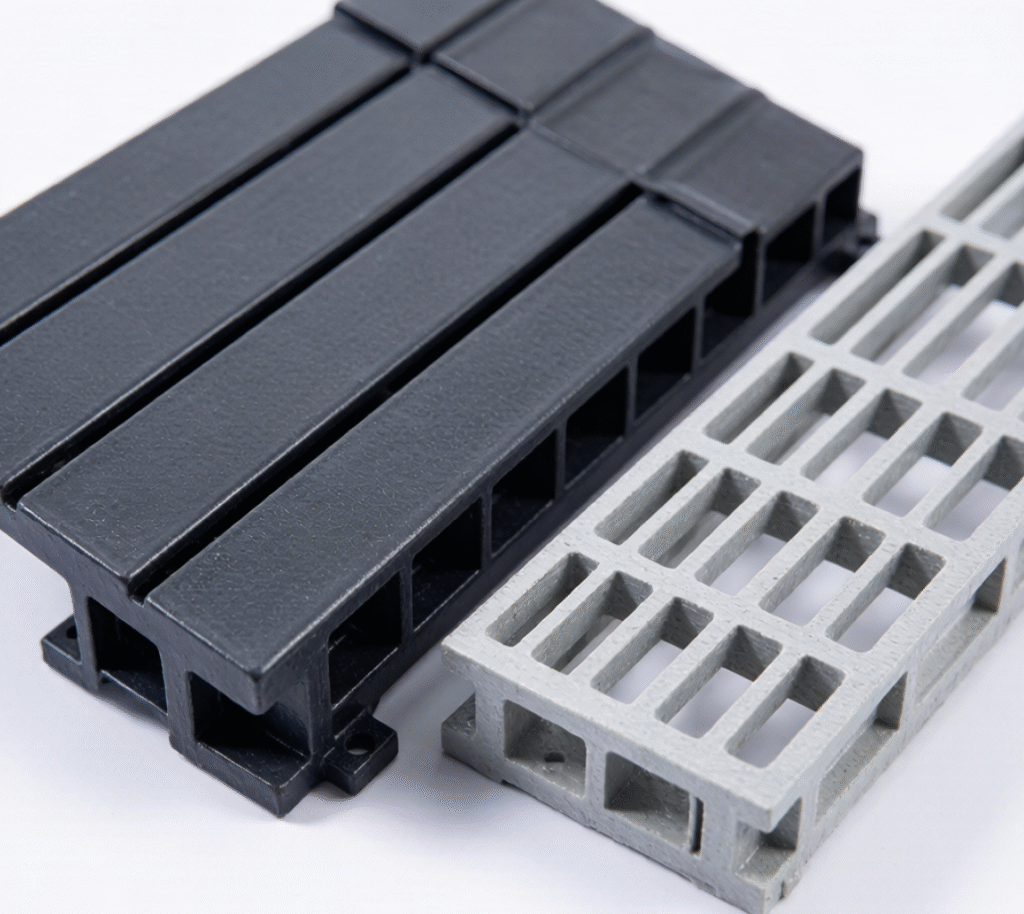
Molded grating is produced by layering fiberglass mat and resin in a mold, then compressing and curing. The result is a one-piece panel with a distinctive square or rectangular grid pattern. It is ideal for applications requiring equal load capacity in both directions.
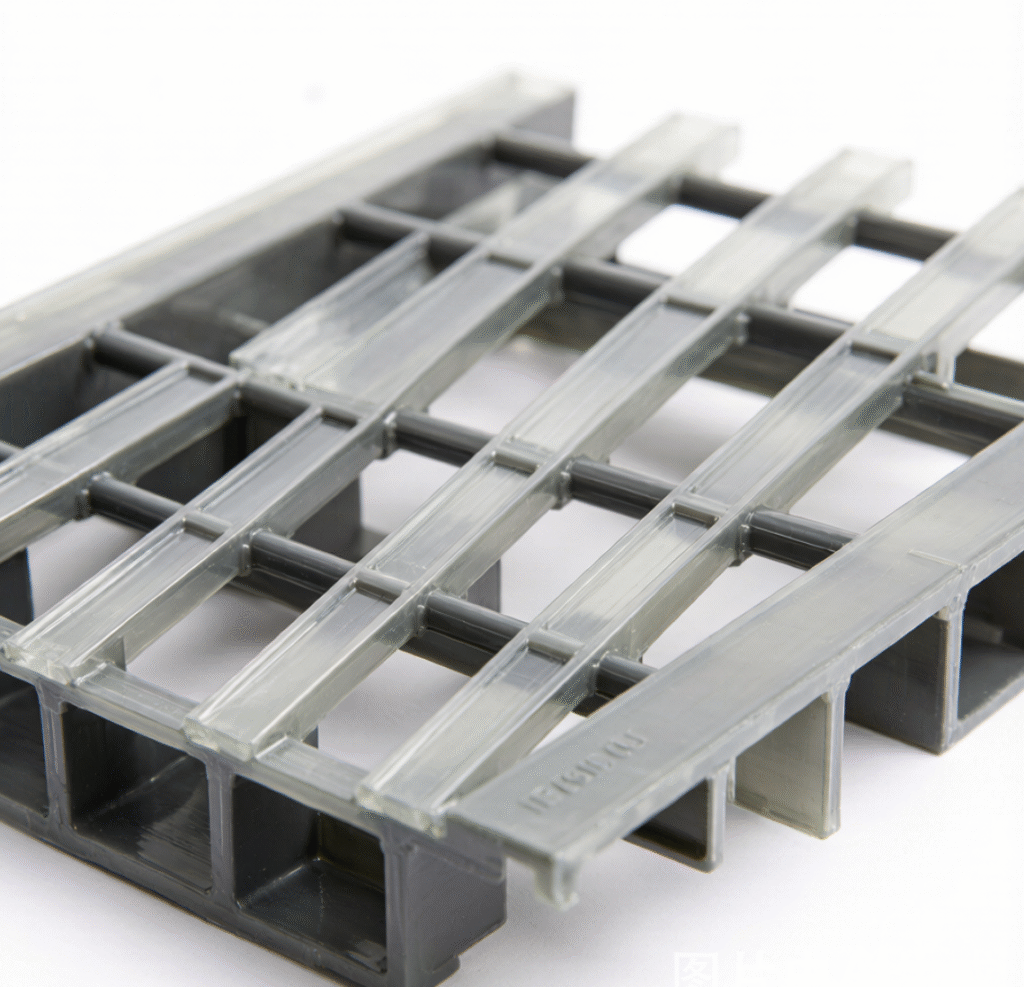
Pultruded grating is assembled from individual pultruded bearing bars that are held together by cross rods or tie bars. The bearing bars contain continuous glass fibers aligned along their length, giving them very high stiffness in that direction. The cross rods maintain spacing and provide lateral stability.
Manufacturing Differences
The manufacturing methods differ fundamentally, and these differences explain the distinct mechanical properties of each type.
| Factor | Molded Grating | Pultruded Grating |
|---|---|---|
| Fiber orientation | Random (chopped strand mat) | Unidirectional (continuous roving) |
| Production method | Closed mold, heat + pressure | Continuous pultrusion, assembled into panels |
| Glass content | 30–50% by weight | 50–70% by weight |
| Panel structure | One-piece monolithic | Assembled from individual bars |
| Surface | Integral anti-slip (concave or grit) | Grit-top applied after assembly |
Both manufacturing methods are covered under the ACMA FRP Composites Grating Manual (ANSI/ACMA/FGMC standard), which defines performance requirements for both types.
Side-by-Side Comparison
| Property | Molded Grating | Pultruded Grating |
|---|---|---|
| Strength directionality | Equal in both directions | Strong in bearing bar direction |
| Max clear span (38mm) | ~600 mm | ~900 mm |
| Stiffness-to-weight ratio | Good | Excellent |
| Corrosion resistance | Excellent (resin-dependent) | Excellent (resin-dependent) |
| Cost per sq m | Lower (standard sizes) | Higher (but better span performance) |
| Custom cutouts | Easy (drill/cut on site) | Moderate (cutting bars individually) |
| Typical applications | Walkways, platforms, trench covers | Heavy-duty flooring, long-span bridges |
Selection rule of thumb: For spans up to 600mm with moderate loads, molded grating offers the best value. For spans beyond 600mm or heavy concentrated loads, pultruded grating’s higher stiffness justifies the premium.
When to Choose Each Type
Choose molded grating when:
- Span requirements are 600mm or less
- Loads are moderate (pedestrian, light vehicle)
- Equal strength in both directions matters
- Budget is a primary consideration
- You need easy field modification (cutting, drilling)
Choose pultruded grating when:
- Spans exceed 600mm (up to 1200mm possible)
- Heavy concentrated loads are expected
- High stiffness-to-weight ratio is critical
- You need longer, uninterrupted runs
- Fire-rated phenolic or specialty resins required
For custom configurations combining both types, visit our custom FRP solutions page.
Frequently Asked Questions
What is the main difference?
Fiber orientation — molded = random (equal strength), pultruded = unidirectional (higher in bearing direction).
Which is stronger?
Pultruded is stronger along the bearing bar direction. Molded has more uniform strength in all directions.
Which is more cost-effective?
Molded for standard spans under 600mm. Pultruded for long spans where its strength can be utilized.
Can both be used in corrosive environments?
Yes, both offer excellent corrosion resistance depending on resin selection.
Which is better for heavy-duty industrial flooring?
Pultruded for long spans (900mm+), molded for standard spans (600mm or less).
Conclusion
Both molded and pultruded FRP grating have their place in industrial applications. The key is matching the product type to your specific span, load, and budget requirements. For standard industrial flooring, molded grating offers excellent value. For long spans and heavy loads, pultruded grating’s higher stiffness-to-weight ratio makes it the right choice.