
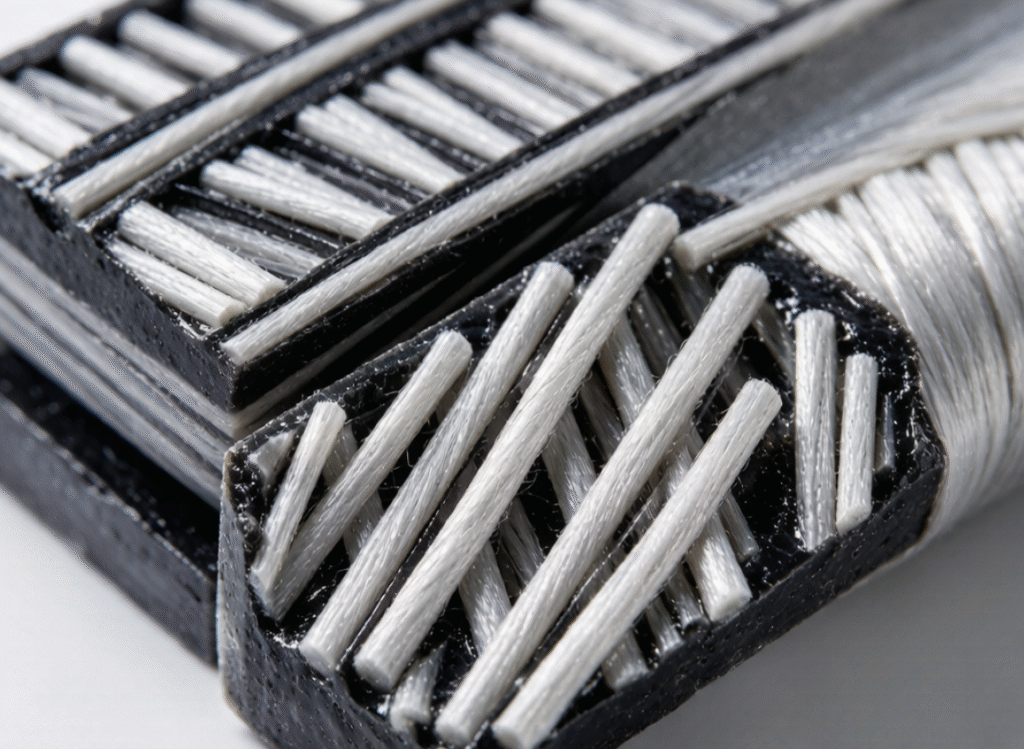
The fiberglass reinforcement is the backbone of any FRP product. It provides the strength, stiffness, and dimensional stability that makes composites so valuable. But not all glass fibers are the same — the type of fiber you choose directly affects product performance, cost, and longevity.
This guide explains the major glass fiber types used in FRP manufacturing and how to select the right one for your application.
Glass Fiber Overview
Glass fibers are made by melting raw materials (silica sand, limestone, alumina, etc.) at high temperatures (1400–1600°C) and extruding the molten glass through fine bushings to create continuous filaments. These filaments are then coated with a sizing agent (for bonding with resin) and gathered into strands or rovings.
By adjusting the chemical composition of the glass, manufacturers create fibers with different properties suited to different applications. The ACMA composites standards recognize several standard fiberglass types for structural applications.
Key fact: Over 90% of all FRP products use E-glass fiber. It is the default choice for a reason — excellent balance of strength, durability, and cost. Specialty fibers like S-glass and ECR-glass are reserved for applications where their specific advantages justify the premium.
E-Glass — The Industry Standard
E-glass (electrical grade) is by far the most widely used reinforcement fiber in FRP. Developed in the 1930s, it offers good tensile strength, excellent electrical insulation properties, and low cost. It is suitable for most industrial, marine, and construction applications.
Key properties: Tensile strength ~3,400 MPa (fiber level), modulus ~72 GPa, elongation at break ~4.8%. Density ~2.55 g/cm³.
S-Glass — High Performance
S-glass (high-strength glass) offers 30–40% higher tensile strength than E-glass. It was originally developed for military aerospace applications and remains the premium choice for ballistic armor, high-pressure vessels, and aerospace components.
Key properties: Tensile strength ~4,800 MPa (fiber level), modulus ~89 GPa. Cost is 5–10x higher than E-glass.
ECR-Glass — Chemical Resistance
ECR-glass (E-Corrosion Resistant) is a modified E-glass formulation with enhanced resistance to acids and alkalis. The chemical composition replaces boron oxide with other oxides, improving durability in corrosive environments. It is the preferred choice for chemical plant equipment and wastewater infrastructure.
Key properties: Similar tensile strength to E-glass (~3,400 MPa) but with 2–3x better acid resistance. Cost is 20–30% higher than E-glass.
Other Fiber Types
- AR-Glass (Alkali-Resistant): Used in concrete reinforcement (GFRC). Resists the high alkalinity of cement.
- R-Glass / T-Glass: Regional variants similar to S-glass. Used in European and Asian markets respectively.
- Quartz fibers: High-temperature applications (>1000°C). Very expensive, used only in specialized aerospace and defense applications.
Comparison Table
| Property | E-Glass | ECR-Glass | S-Glass | AR-Glass |
|---|---|---|---|---|
| Tensile strength (MPa) | 3,400 | 3,400 | 4,800 | 2,500 |
| Modulus (GPa) | 72 | 72 | 89 | 70 |
| Acid resistance | Good | Excellent | Good | Fair |
| Alkali resistance | Fair | Good | Fair | Excellent |
| Relative cost | 1x | 1.2–1.3x | 5–10x | 2–3x |
| Primary use | General FRP | Chemical plants | Aerospace | Concrete |
Selection Guide
Choose E-glass when: Standard industrial, marine, or construction application. No extreme chemical exposure. Budget matters. This covers ~90% of applications.
Choose ECR-glass when: Product will be used in acidic or alkaline environments (chemical plants, wastewater treatment, mining). The 20–30% cost premium is quickly recovered through extended service life.
Choose S-glass when: Maximum strength-to-weight ratio is critical. Weight savings justify significant cost premium. Applications include aerospace, high-performance marine, ballistic protection.
For our standard FRP products, we primarily use E-glass and ECR-glass depending on the application. See our FRP product range for more information.
Frequently Asked Questions
What is E-glass?
Standard electrical-grade glass fiber — over 90% of FRP uses this. Good strength, low cost.
What is S-glass?
High-strength glass — 30-40% stronger than E-glass. Used in aerospace, ballistic armor. 5-10x cost.
What is ECR-glass?
E-Corrosion Resistant glass — 2-3x better acid resistance than E-glass. For chemical environments.
Which fiber is best for my product?
E-glass for 90% of applications. ECR-glass for corrosive environments. S-glass only for high-performance needs.
Does fiber type affect cost significantly?
Yes. E-glass is $1-2/kg. ECR-glass costs 20-30% more. S-glass can cost 5-10x more.
Conclusion
Fiber selection is one of the most consequential decisions in FRP product design. While E-glass serves the vast majority of applications well, understanding when to specify ECR-glass or S-glass can dramatically improve product performance and longevity in specialized environments.