

If you work in industrial flooring, water treatment, chemical processing, or marine infrastructure, you have likely encountered FRP molded grating. It is one of the most widely used composite products in the world — and for good reason.
This guide covers everything you need to know about FRP molded grating: what it is, how it is made, its key properties, and how to select the right type for your project.
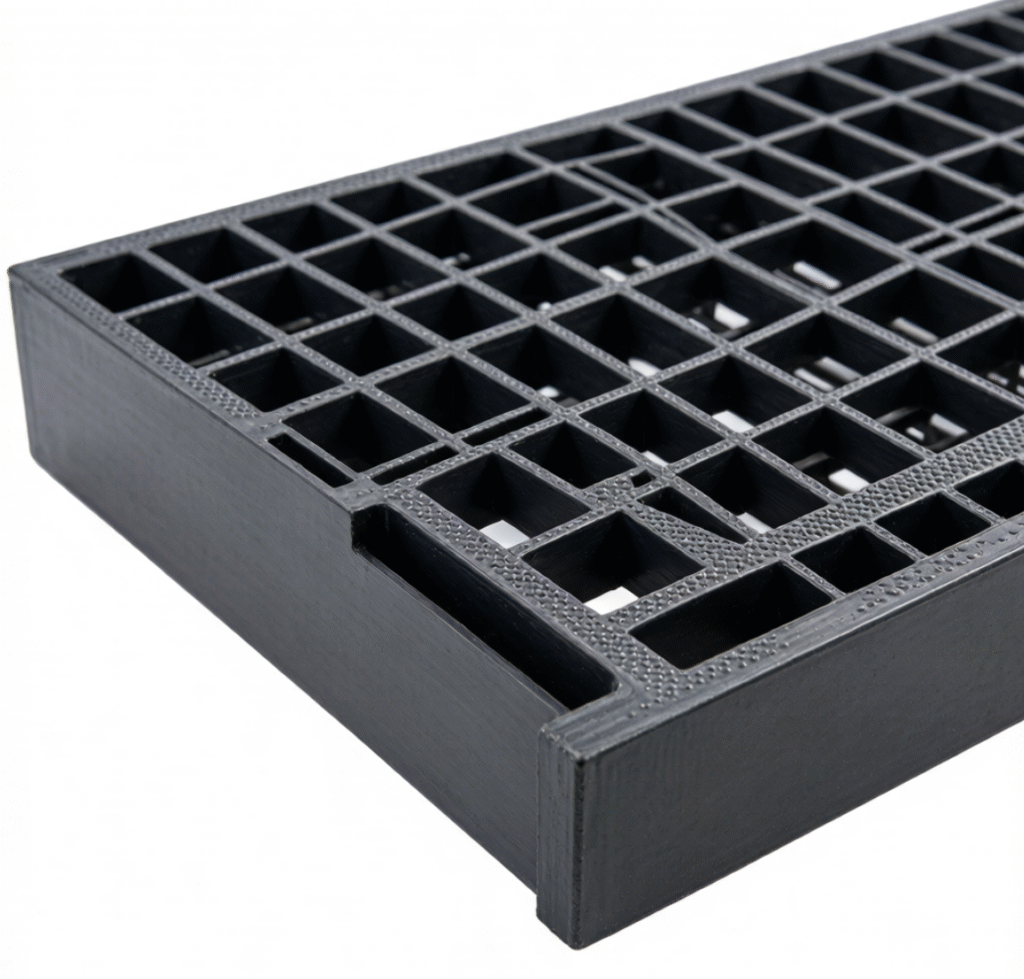
For an overview of our full product range, visit our FRP grating product page.
What Is FRP Molded Grating?
Key takeaway: FRP molded grating is a one-piece, seamless industrial flooring panel made by molding fiberglass reinforcement and thermosetting resin under heat and pressure. Its random fiber orientation gives equal strength in both directions.
FRP (Fiber-Reinforced Polymer) molded grating, also called molded fiberglass grating, is manufactured by layering continuous fiberglass strand mat and thermosetting resin in a steel mold. The mold is closed under hydraulic pressure and cured at controlled temperatures, producing a monolithic panel with an integral anti-slip surface.
The resulting product is lightweight (about 1/4 the weight of steel), corrosion-resistant, non-conductive, and maintenance-free in most environments. These properties make it ideal for industrial flooring, walkways, platforms, trench covers, and drainage applications.
The industry standard for FRP grating design and testing is published by the American Composites Manufacturers Association (ACMA), which maintains the ANSI/ACMA/FGMC FRP Composites Grating Manual.
Structure & Materials
FRP molded grating consists of two primary components: the fiberglass reinforcement and the resin matrix. The combination determines the grating’s mechanical properties and chemical resistance.
| Component | Function | Common Types |
|---|---|---|
| Fiberglass reinforcement | Provides strength and stiffness | E-glass, ECR-glass (corrosion-resistant) |
| Resin matrix | Binds fibers, provides corrosion resistance | Polyester, Vinyl Ester, Phenolic |
| Surface veil | UV protection, enhanced corrosion barrier | Nexus, C-glass |
| Anti-slip surface | Safety traction | Concave grit, silica sand, grit-top |
Manufacturing Process
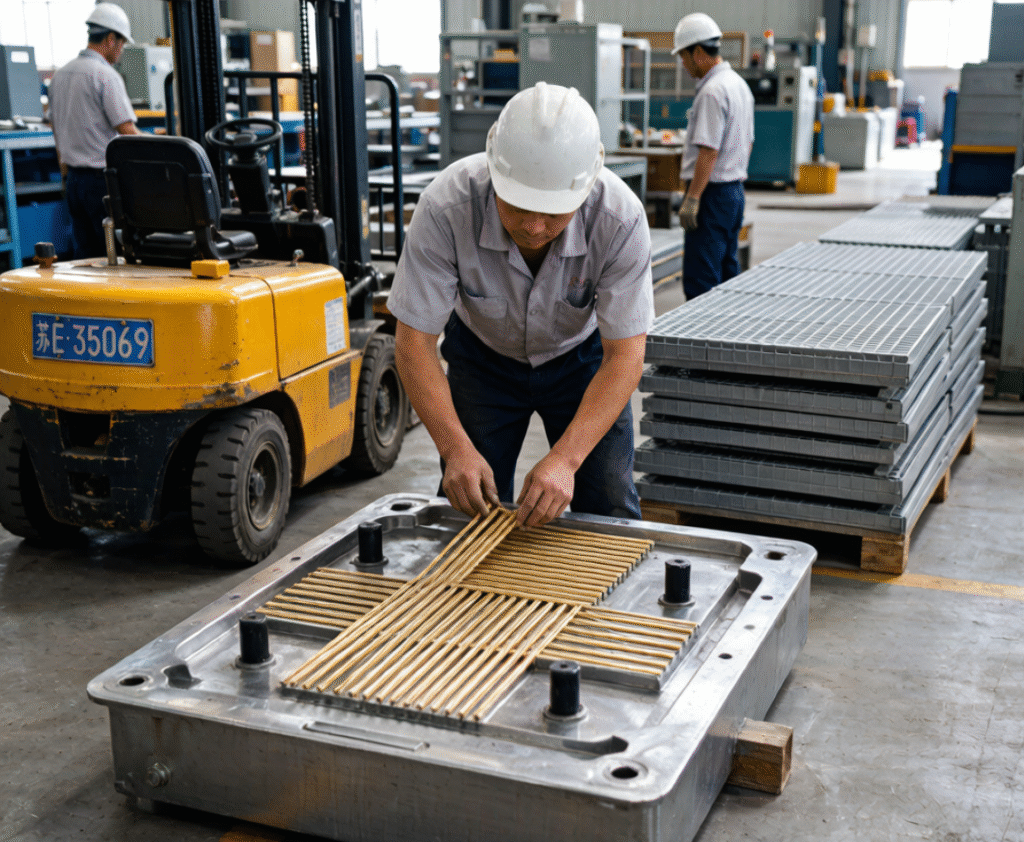
- Mold preparation — Steel mold is cleaned and coated with mold release agent.
- Layering — Fiberglass mats and resin are alternately placed in the mold. Surface veil is added on top for UV/corrosion protection.
- Molding — The mold is closed under hydraulic pressure (typically 50–100 tons) and heated to 80–150°C depending on resin system.
- Curing — The resin cross-links and hardens. Cure time ranges from 5–15 minutes per panel.
- Demolding & finishing — The cured panel is removed, trimmed to size, and inspected. Grit-top panels receive an additional anti-slip coating.
For a closer look at our production facility, see our factory tour page.
Key Properties
| Property | FRP Molded Grating | Steel Grating | Aluminum Grating |
|---|---|---|---|
| Tensile strength | 70–200 MPa | 400–550 MPa | 150–300 MPa |
| Weight (kg/m², 38mm) | ~20–30 | ~70–90 | ~25–35 |
| Corrosion resistance | Excellent | Poor (requires coating) | Good |
| Electrical conductivity | None (non-conductive) | Conductive | Conductive |
| Thermal conductivity | Low | High | High |
| Service life (typical) | 15–25 years | 5–15 years | 10–20 years |
Key insight: FRP molded grating’s combination of corrosion resistance, light weight, and long service life often makes it the lowest total cost of ownership option, despite higher upfront cost compared to steel.
Selection Guide
Choosing the right molded grating requires evaluating several factors:
Resin selection by environment:
- Polyester — General purpose, good for water treatment, mild chemical exposure
- Vinyl Ester — Enhanced corrosion resistance for chemical plants, pulp & paper
- Phenolic — Low smoke, fire-resistant for offshore, tunnels, mining
Panel thickness & span: 25mm (light duty, 400mm span), 38mm (standard duty, 600mm span), 50mm (heavy duty, 900mm span). For detailed load tables, refer to the ACMA FRP Grating Manual.
Surface type: Concave (standard), grit-top (maximum slip resistance), silica sand (anti-slip for wet areas).
For custom requirements, visit our custom FRP solutions page.
Common Applications
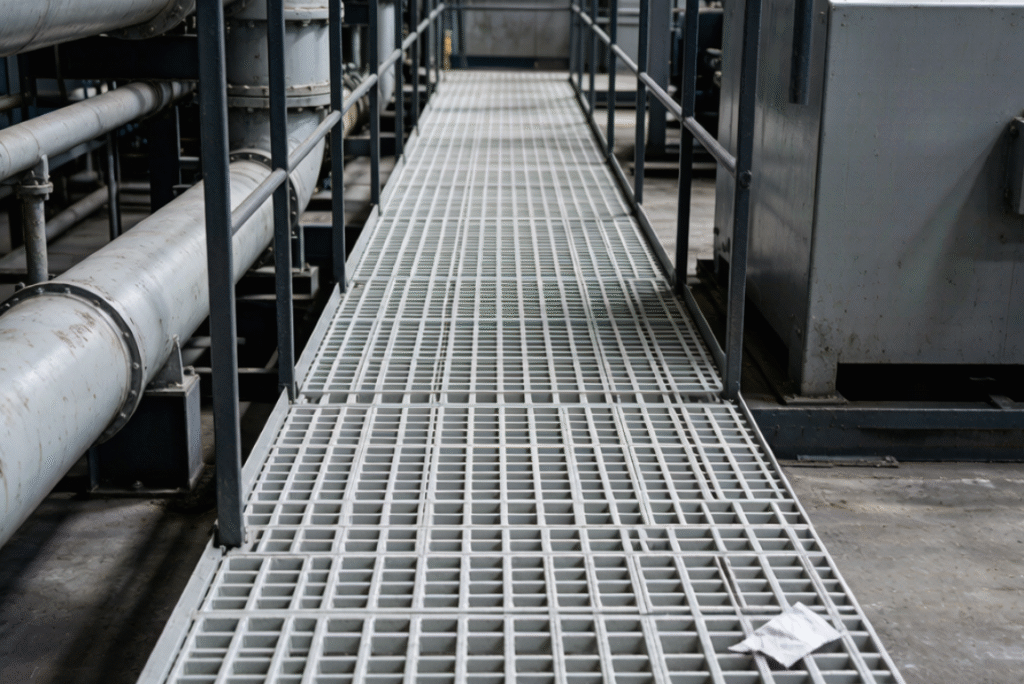
- Water and wastewater treatment plant walkways
- Chemical processing plant flooring
- Offshore platform decking and staging
- Food processing facility mezzanines
- Swimming pool and water park gratings
- Mining and mineral processing platforms
- Electrical substation flooring (non-conductive requirement)
Frequently Asked Questions
What is FRP molded grating?
It is a one-piece, seamless industrial flooring panel made by molding fiberglass and thermosetting resin under heat and pressure.
What is the difference between molded and pultruded grating?
Molded grating has random fiber orientation with equal strength in both directions. Pultruded has continuous fibers in one direction for higher unidirectional strength.
What resins are used?
Polyester (general), vinyl ester (chemical resistance), and phenolic (fire resistance).
How strong is it?
Tensile strength of 70–200 MPa; flexural strength of 140–300 MPa depending on specification.
How long does FRP grating last?
Typically 20–30 years in most industrial environments; 15–20 years in highly corrosive conditions.
Conclusion
FRP molded grating is a proven, reliable, and cost-effective industrial flooring solution. Its corrosion resistance, light weight, non-conductivity, and long service life make it the material of choice for demanding environments where steel and aluminum fall short.
When selecting molded grating for your project, consider the chemical environment, load requirements, span, and fire rating needed. With the right resin and thickness, FRP molded grating will outperform traditional materials for decades.