
The short answer is simple: because extreme temperatures may stress many traditional materials, but properly engineered FRP is built to stay stable where durability matters most.
For modern construction projects, environmental stress is no longer limited to corrosion or structural load. In many regions, materials must survive scorching summer heat, freezing winters, rapid temperature swings, and increasingly unpredictable weather conditions. That makes material selection less about what works in ideal conditions, and more about what continues performing when the environment becomes aggressive.
This is exactly why FRP (Fiber Reinforced Polymer) is gaining attention across construction applications.
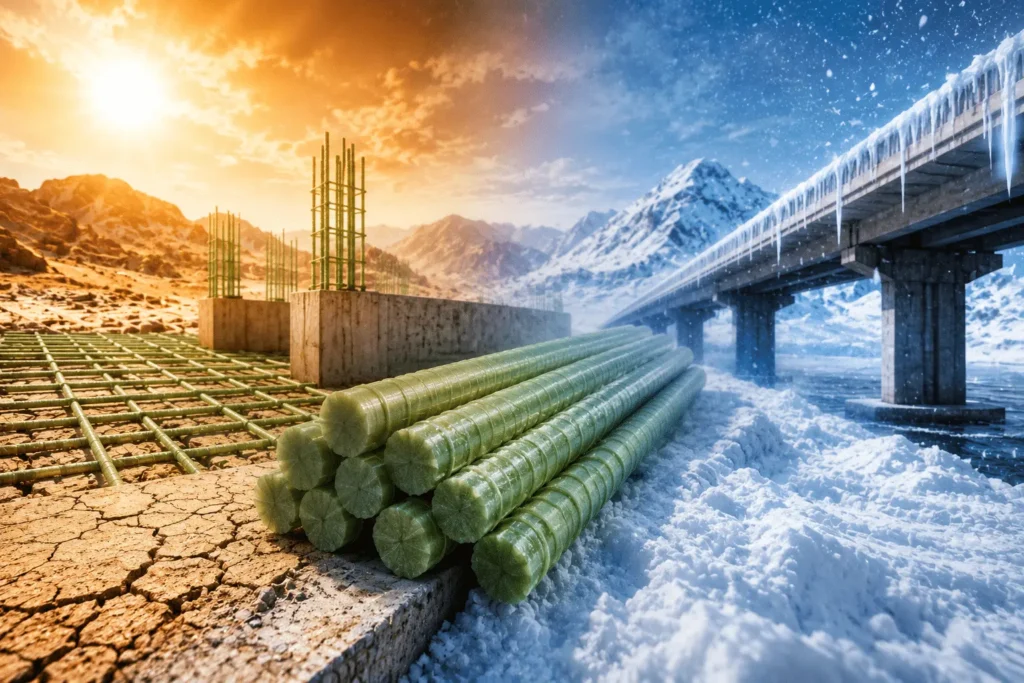
Why Extreme Weather Is Becoming a Bigger Construction Challenge
Construction materials are constantly exposed to environmental stress.
In hot climates, surfaces can absorb intense solar radiation, driving temperatures far beyond normal ambient levels. In colder regions, repeated freezing and thawing create expansion pressure, moisture damage, and long-term fatigue.
For infrastructure, these conditions often lead to familiar problems:
- Material expansion and contraction
- Surface cracking
- Moisture intrusion
- Reduced structural lifespan
- Higher maintenance frequency
As climate conditions become less predictable, resilience is becoming just as important as strength.
Where Traditional Materials Start to Show Limitations
Steel and concrete remain essential construction materials, but extreme weather introduces performance challenges.
High Heat Exposure
Steel conducts heat quickly, meaning structural components can experience significant temperature transfer. In exposed environments, prolonged heat can accelerate material fatigue, especially when daily temperature fluctuations are severe.
Concrete also faces challenges. Repeated thermal expansion and contraction can gradually create cracking, especially when combined with moisture infiltration.
Freezing Conditions
Cold weather creates a different kind of stress.
When water enters small cracks in concrete and freezes, it expands. Over repeated freeze-thaw cycles, this can worsen cracking and weaken the surrounding structure.
Steel reinforcement may further complicate the issue if corrosion is already present, since rust expansion adds another internal stress factor.
The result is simple: extreme environments accelerate wear.
Why FRP Performs Differently
FRP approaches environmental durability from a different material perspective.
Unlike steel, FRP does not corrode. That alone removes one major source of structural degradation in harsh climates.
But temperature resilience is also part of the equation.
Low Thermal Conductivity
FRP transfers heat far less efficiently than steel.
This can be valuable in applications where reducing thermal bridging or limiting heat transfer matters, such as:
- Building envelopes
- Exterior structural systems
- Infrastructure exposed to direct sunlight
- Temperature-sensitive facilities
Lower heat conductivity can improve overall system efficiency while reducing thermal stress concentration.
Strong Freeze-Thaw Resistance
Because FRP is corrosion-resistant and dimensionally stable under many environmental conditions, it performs well in freeze-thaw applications where traditional reinforcement may face combined moisture and corrosion risks.
This makes it increasingly relevant for:
- Bridges
- Parking structures
- Coastal infrastructure
- Water treatment facilities
- Cold-climate civil engineering projects
Extreme Weather Is Also a Lifecycle Cost Issue
Material failure is rarely just a technical problem.
It becomes a financial one.
A structure exposed to repeated temperature stress may require:
- More inspections
- Crack repair work
- Surface rehabilitation
- Corrosion mitigation
- Structural reinforcement upgrades
- Operational disruption during maintenance
Initial material cost often gets the most attention during procurement.
But long-term ownership cost is where extreme weather becomes expensive.
FRP may not always be the lowest upfront-cost material, but it can significantly reduce maintenance dependency in aggressive environments.
Where Construction FRP Makes the Most Sense
FRP is not a universal replacement for every structural material.
But in applications where environmental durability is critical, its advantages become harder to ignore.
Common use cases include:
Bridges & Transport Infrastructure
Continuous exposure to sun, rain, freeze-thaw cycles, and environmental stress.
Coastal Construction
Salt, humidity, temperature variation, and corrosion risk combined.
Parking Structures
Moisture, vehicle chemicals, and thermal cycling.
Industrial Facilities
Aggressive environmental and chemical exposure.
Building Facade Support Systems
Reduced thermal bridging and improved environmental resistance.
Final Thoughts
Extreme weather is becoming a bigger part of construction planning.
The question is no longer just whether a material is strong enough today, but whether it will remain reliable after years of heat, cold, moisture, and environmental cycling.
FRP is gaining adoption not because it replaces every traditional material, but because in harsh environments, it solves problems that traditional materials continue to struggle with.
For construction projects focused on durability, resilience, and lower long-term maintenance, that makes FRP a material worth serious consideration.