
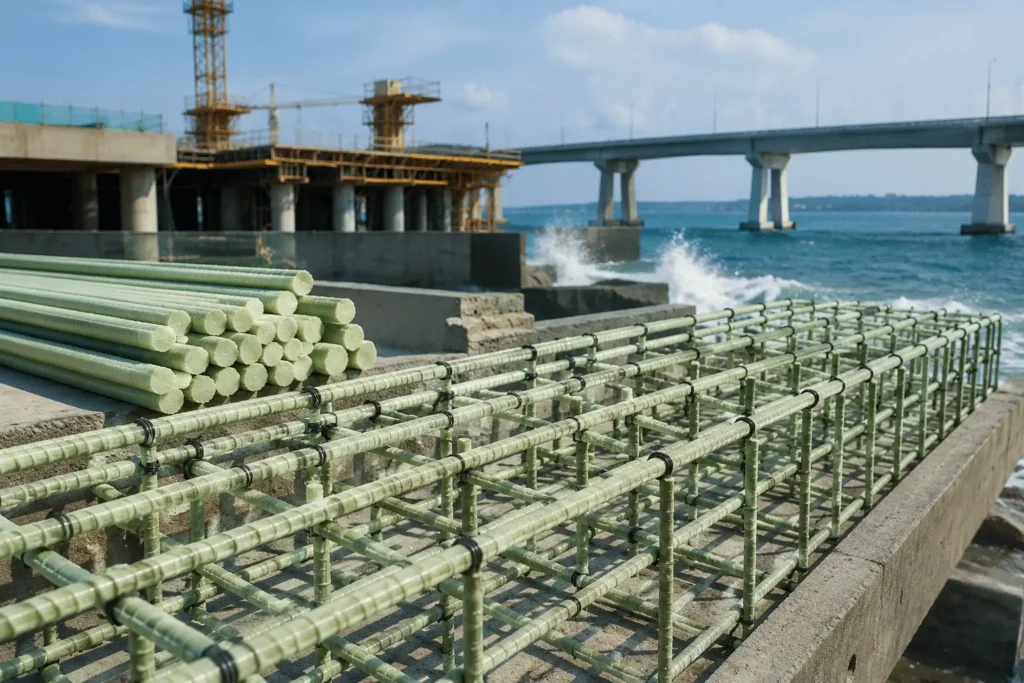
The answer is simple: because steel corrodes, and coastal environments make corrosion almost unavoidable.
For infrastructure like sea bridges, ports, docks, and seawalls, the biggest cost is often not construction itself — it is the decades of maintenance that follow. Traditional steel reinforcement has served the industry for years, but in coastal environments filled with salt, humidity, and chloride exposure, corrosion becomes a built-in problem. FRP (Fiber Reinforced Polymer) rebar is gaining attention because it removes that weakness at the source.
Why Steel Struggles Near the Ocean
Steel performs well in many structural applications, but marine environments expose its biggest limitation.
Salt-laden air, seawater splash, and constant moisture gradually penetrate concrete over time. Once chloride ions reach the embedded steel, corrosion begins. The issue is not just rust stains — steel expands as it corrodes, creating internal pressure that slowly damages the concrete itself.
This often leads to:
- Cracking concrete
- Surface spalling
- Faster moisture penetration
- Reduced structural durability
- Repeated repair cycles
Many coastal structures appear stable on the outside while hidden deterioration is already progressing internally.
Traditional Protection Methods Only Delay the Problem
The industry has long tried to slow corrosion using different protective strategies.
Common approaches include:
- Anti-corrosion coatings
- Higher-density concrete mixes
- Cathodic protection systems
- Additional waterproofing measures
These methods help, but they do not remove the root issue.
As long as steel remains inside the structure, corrosion risk still exists. For small buildings, that may be manageable. For large infrastructure assets, it becomes a long-term financial burden.
A bridge closure for repairs is not just a maintenance event. A port shutdown is not just a technical issue. The operational cost can quickly become far more expensive than the material itself.
Why FRP Changes the Equation
FRP takes a completely different approach.
Instead of protecting steel from corrosion, it removes corrosion from the design equation entirely.
Because FRP does not rust, it eliminates one of the most common causes of internal concrete damage in coastal infrastructure.
Beyond corrosion resistance, FRP offers other practical benefits:
- Lightweight for easier transport and installation
- High tensile strength for demanding structural applications
- Better durability in aggressive marine environments
- Lower maintenance dependency over time
For project teams, this is not simply a material replacement. It is a shift toward a more suitable reinforcement strategy.
The Bigger Cost Is What Happens After Construction
Steel often looks like the cheaper option at the purchasing stage.
But infrastructure decisions are rarely about initial cost alone.
The real lifecycle expense often includes:
- Regular structural inspections
- Concrete repair work
- Equipment mobilization
- Maintenance labor
- Temporary shutdowns
- Operational disruption
In coastal projects, these recurring costs can quickly outweigh the original savings from choosing steel.
That is why more owners are shifting from upfront cost thinking to lifecycle cost thinking.
Why This Trend Is Growing
Coastal infrastructure owners are asking a different question now:
Not “Which material costs less today?”
But “Which material creates fewer problems over the next 30–50 years?”
That mindset naturally makes FRP more attractive.
Steel is still a proven material, but when corrosion is predictable, constantly managing that risk becomes harder to justify.
Final Thoughts
FRP is not replacing steel because steel suddenly stopped working.
It is replacing steel in environments where corrosion is simply too expensive to ignore.
For coastal infrastructure, choosing FRP is less about following a trend and more about making a smarter long-term engineering decision.