
Introduction
In harsh environments such as marine facilities, chemical plants, wastewater treatment sites, and coastal infrastructure, material selection has a direct impact on durability, maintenance requirements, and long-term operational performance. While steel remains a widely used structural material, its vulnerability to corrosion and maintenance intensity in aggressive environments has prompted engineers to re-evaluate alternative solutions.
Fiber Reinforced Polymer (FRP) has gained increasing attention as a structural material designed to perform reliably under corrosive and high-humidity conditions. This article compares steel and FRP from a practical engineering perspective to support informed material selection for harsh environments.
Material Characteristics Overview
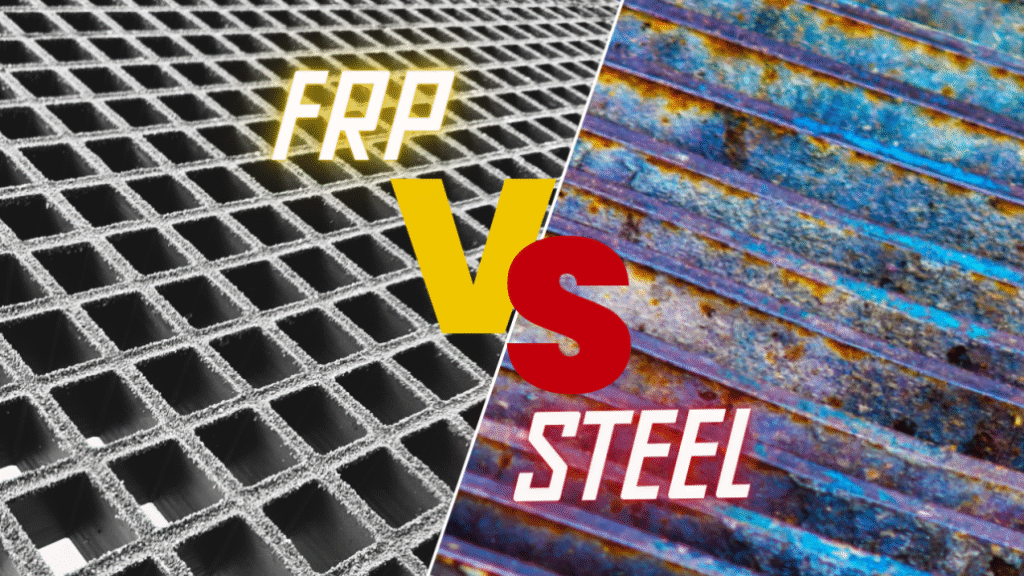
Steel is valued for its high stiffness, predictable mechanical behavior, and well-established design standards. It is commonly used in structures where rigidity and high concentrated loads are critical. However, steel is electrochemically active and susceptible to corrosion when exposed to moisture, salt, or chemical agents. Its long-term performance depends heavily on protective coatings and regular maintenance.
FRP is a composite material made of reinforcing fibers embedded in a polymer resin matrix. Because it does not participate in electrochemical reactions, FRP provides inherent corrosion resistance. Its low density allows engineers to reduce structural dead load while maintaining sufficient strength for many infrastructure and industrial applications.
Economic Considerations: Lifecycle Cost Perspective
From an initial procurement standpoint, steel often appears more economical due to its lower material cost and wide availability. FRP typically involves a higher upfront material cost, which can discourage its use in short-term or budget-driven projects.
However, in harsh environments, initial cost alone does not reflect true economic performance. A lifecycle cost (LCC) approach offers a more realistic comparison.
Steel structures exposed to corrosive environments usually require periodic inspection, recoating, and repair—often every 3 to 5 years. Over a 20-year service period, these recurring costs can exceed the original material cost. In contrast, FRP structures generally require minimal corrosion-related maintenance when properly designed and installed.
For long-term infrastructure projects, FRP frequently delivers lower total ownership cost despite higher initial investment.
Durability and Environmental Resistance
Corrosion is the primary failure mechanism for steel in harsh environments. Even advanced galvanizing or multi-layer coating systems degrade over time due to mechanical damage, UV exposure, and chemical attack.
FRP offers strong resistance to water, salt spray, acids, alkalis, and many industrial chemicals. In applications such as coastal walkways, wastewater plants, and chemical processing facilities, FRP components often achieve service lives of 30 to 50 years with minimal performance degradation.
Structural Performance and Safety
Steel’s high elastic modulus makes it suitable for structures where stiffness and deflection control are critical. It remains the preferred choice for heavy primary load-bearing frameworks.
FRP has a lower elastic modulus but a high strength-to-weight ratio. Through proper section design, FRP can meet the structural requirements of platforms, walkways, handrails, supports, and secondary structural systems. In addition, FRP offers non-conductive behavior, which improves electrical safety in power-related and industrial environments.
Steel vs. FRP: Comparison for Harsh Environments
The table below summarizes the key differences between steel and FRP from an engineering and operational standpoint:
| Comparison Item | Steel | FRP (Fiber Reinforced Polymer) |
|---|---|---|
| Material Type | Metallic material | Composite (fiber + resin) |
| Density / Weight | High density, heavy | Lightweight, ~20–30% of steel |
| Strength-to-Weight Ratio | Moderate | High |
| Elastic Modulus | High stiffness | Lower stiffness, design-dependent |
| Corrosion Resistance | Poor without coatings | Excellent, inherent resistance |
| Performance in Marine / Chemical Environments | Requires frequent protection | Highly suitable |
| Maintenance Requirement | High, periodic recoating | Very low |
| Electrical Conductivity | Conductive | Non-conductive |
| Installation Effort | Heavy lifting, welding | Easier handling, modular |
| Typical Service Life (Harsh Environments) | 10–20 years (with maintenance) | 30–50 years |
| Lifecycle Cost | High over long term | Lower over long term |
Sustainability and Long-Term Value
Steel benefits from a mature recycling infrastructure and high recyclability. However, the energy consumption and emissions associated with steel production and repeated corrosion protection are significant.
FRP recycling technologies are still evolving, but its long service life and reduced maintenance requirements often result in lower environmental impact over the full lifecycle. Fewer repairs and replacements also reduce operational disruption and safety risks.
Practical Material Selection Guidance
Material selection should be based on actual operating conditions rather than standard practice alone.
In general:
FRP is well suited for corrosive, high-humidity, chemical, or electrically sensitive environments where maintenance access is limited.
Steel remains appropriate for applications requiring very high stiffness, heavy concentrated loads, or specific fire-resistance solutions.
Lifecycle cost, maintenance capability, and environmental exposure should be evaluated together rather than independently.
Conclusion
In harsh environments, the long-term performance gap between steel and FRP becomes increasingly evident. While steel continues to play a vital role in structural engineering, its durability challenges in aggressive conditions are well documented.
FRP provides a balanced solution combining corrosion resistance, safety, and lifecycle efficiency, making it a rational material choice for many modern infrastructure and industrial applications. Effective material selection is ultimately about managing long-term risk, not just minimizing initial cost.

