
1.Introduction
Handrails are essential for safety in industrial and public areas.
They provide support, prevent falls, and define walkways.
Today, two materials are commonly used — FRP (Fiberglass Reinforced Plastic) and Aluminum.
Both are lightweight and corrosion-resistant, but they perform differently in real-world conditions.
This article explains the key differences between FRP and aluminum handrails.
It will help you decide which one suits your project best — whether it’s a chemical plant, marine dock, or commercial site.
2. Material Overview
FRP Handrails
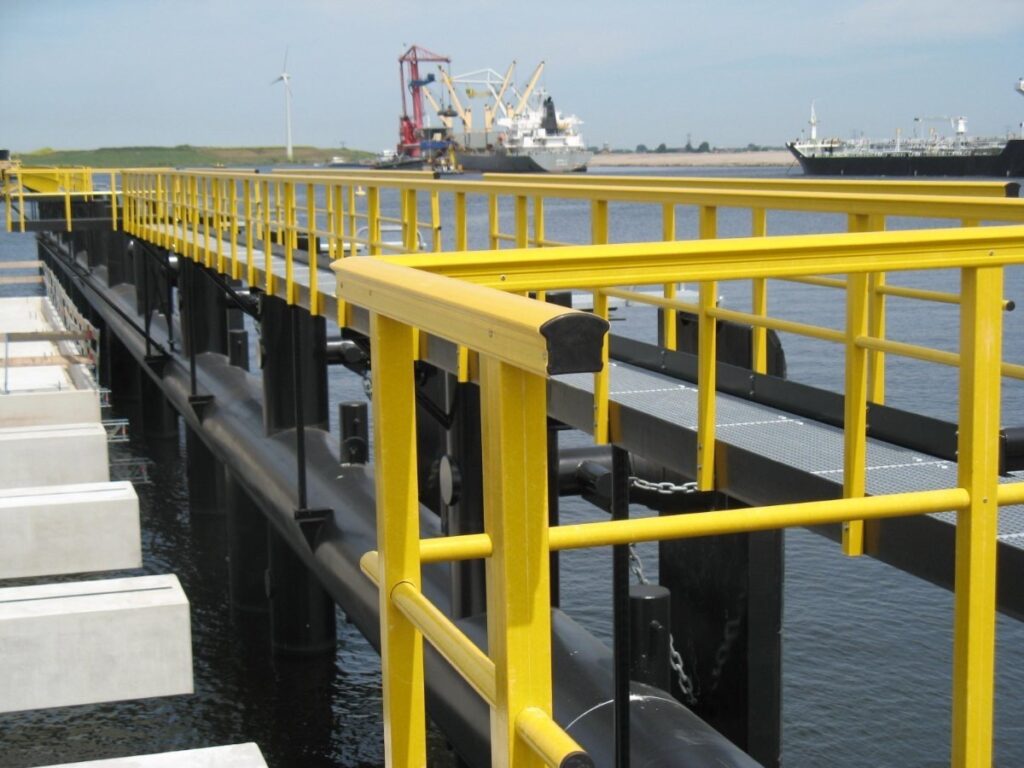
FRP is a composite material made from fiberglass and resin.
It offers excellent strength, corrosion resistance, and electrical insulation while remaining lightweight and easy to install.
These characteristics make FRP handrails ideal for chemical plants, marine docks, and power stations where long-term reliability is essential.
Aluminum Handrails

Aluminum handrails are made through extrusion and can be anodized or powder-coated for surface protection.
They are lightweight, visually appealing, and suitable for architectural or light industrial projects.
However, aluminum’s conductivity and susceptibility to chemical corrosion limit its use in harsh environments.
3. Key Performance Comparison
Weight
Both FRP and aluminum are much lighter than steel.
Aluminum is slightly lighter, but FRP provides greater rigidity relative to its weight, making it more suitable for long-span or heavy-duty structures.
Strength-to-Weight Ratio
FRP handrails maintain high tensile and flexural strength without deformation under load.
Aluminum may bend or dent under repeated vibration or impact.
For long-term structural reliability, FRP performs better.
Corrosion Resistance
FRP offers outstanding resistance to acids, salts, and moisture.
Aluminum performs well in moderate conditions but can degrade when exposed to chlorides, alkaline environments, or coastal salt air.
For marine docks, wastewater plants, and chemical facilities, FRP provides superior longevity.
Thermal Conductivity
FRP has very low thermal conductivity — it does not transfer heat or cold easily.
Even under extreme temperatures, it remains safe and comfortable to touch.
Aluminum conducts heat and cold quickly, which can make the surface uncomfortable or unsafe for users.
Electrical Insulation
FRP is a non-conductive material, ideal for power stations or areas near electrical systems.
Aluminum conducts electricity and requires grounding or additional insulation.
FRP offers a safer option for projects involving electrical or electronic components.
Maintenance Requirements
FRP requires little to no maintenance.
It does not rust, peel, or need repainting during its service life.
Aluminum can oxidize and lose its surface finish over time, requiring periodic cleaning or recoating.
Appearance
FRP can be molded and pigmented during manufacturing, maintaining consistent color for decades.
Aluminum offers a metallic appearance that fits architectural and decorative settings.
The choice depends on whether the project prioritizes aesthetics or long-term functionality.
Service Life
FRP handrails can last 20–30 years even in corrosive or outdoor environments.
Aluminum typically lasts 10–20 years, depending on exposure and maintenance.
When considering full lifecycle cost, FRP delivers longer performance and lower total expense.
4.Installation and Maintenance Comparison
FRP Handrails

Prefabricated modular components are easy to cut and assemble on-site.
No welding is required; mechanical joints make installation quick and cost-efficient.
Lightweight sections reduce labor and equipment costs.
Aluminum Handrails
Assembled with screws or rivets, suitable for moderate environments.
Must avoid galvanic corrosion when in contact with steel or other metals.
Surface coatings may require maintenance every few years in outdoor exposure.
Overall, FRP handrails provide easier installation, lower maintenance, and faster on-site adaptation.
5. Cost and Lifecycle Analysis
Initial Cost: FRP systems are usually 15–25% more expensive than aluminum per meter.
Maintenance Cost: FRP requires almost zero maintenance, while aluminum needs periodic refinishing.
Total Lifecycle Cost: Over a 20-year service period, FRP systems can save 20–30% in total expenses thanks to reduced maintenance and downtime.
6. Application Recommendations
When to Choose FRP Handrails
Chemical plants, wastewater treatment facilities, and marine structures.
Areas requiring non-conductive and corrosion-resistant materials.
Projects focusing on long service life and minimal maintenance.
When to Choose Aluminum Handrails
Commercial buildings, public spaces, and residential projects.
Projects that value appearance and lightweight aesthetics.
Environments with low chemical exposure and easy maintenance conditions.
7. Conclusion
Both FRP and aluminum handrails are strong, durable, and lightweight.
However, their performance over time is very different.
FRP handrails resist corrosion, moisture, and chemical exposure.
They are non-conductive, easy to maintain, and have a much longer lifespan.
This makes them ideal for industrial, marine, and outdoor environments.
Aluminum handrails are better when appearance and cost matter more.
They work well for architectural and decorative projects.
In short:
Use FRP when you want durability and long-term safety.
Choose Aluminum when you prefer aesthetics and lower upfront cost.
As industries move toward sustainable and low-maintenance materials,
FRP handrails are becoming the smarter and safer choice for future projects.

